
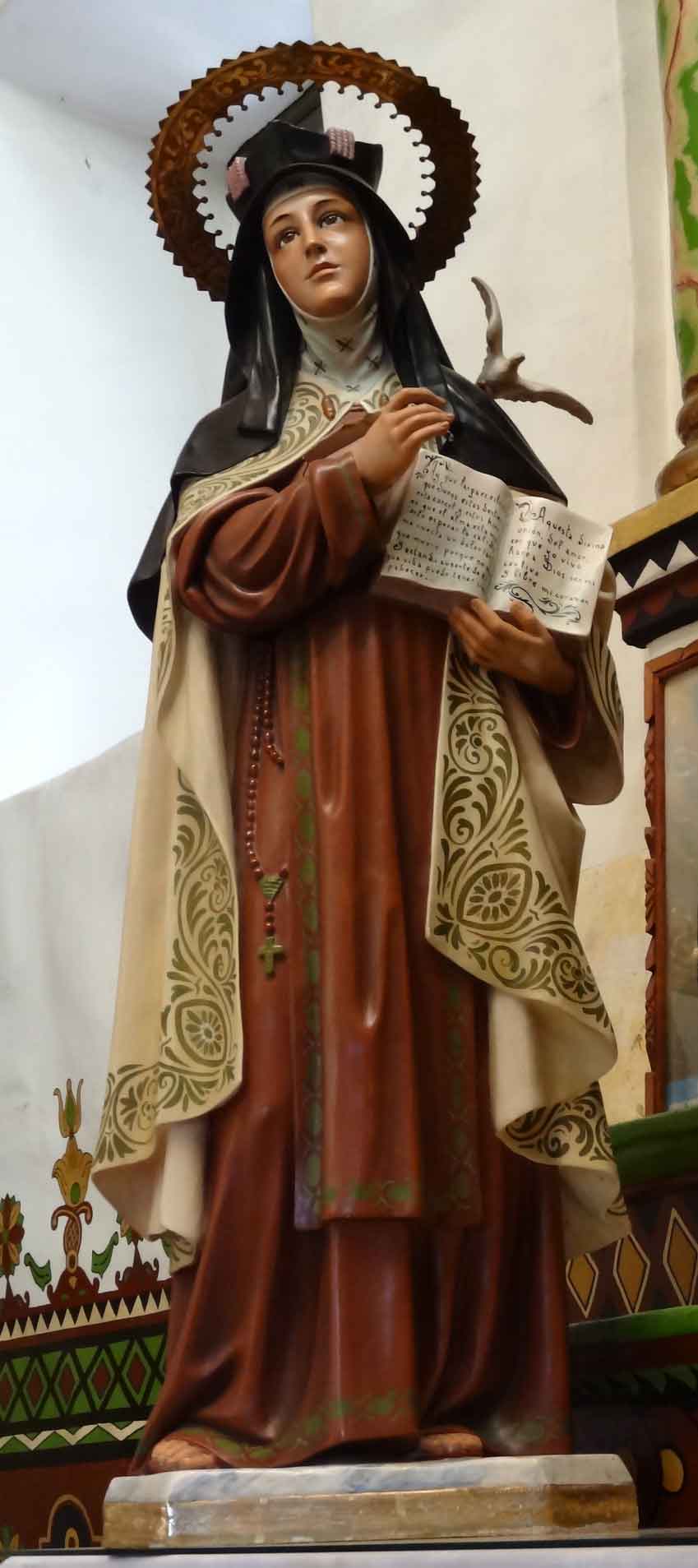
This article is the fourth part of a series about Purgatory, a topic that is rarely discussed today. A knowledge of Purgatory is essential if souls are to avoid the pains of this place of expiation. The previous article can be found here.
* * *
In Chapter Five of Purgatory by Father F.X. Schouppe, S.J.,1 readers encounter one of the great saints of all time, Saint Teresa of Avila (1515-1582). For those unfamiliar with her, she was a Carmelite nun blessed with many mystic visions. Her books, The Interior Castle and The Way of Perfection, are classics of Catholic spirituality. Pope Gregory XV canonized her in 1622, and Pope Paul VI named her a Doctor of the Church in 1970.
The Carmelites
Members of the Carmelite order are legendary for their rigorous way of life. Therefore, it is not surprising that three doctors of the Church and literally dozens of saints, blesseds, venerables and servants of God are among their members.
Father Shouppe introduces Saint Teresa of Avila as someone with “great charity towards the souls in Purgatory.” In response to that great love, “God frequently showed her the souls she had delivered.”
One of her visions concerned the death of a religious who had been a Provincial of the order. Saint Teresa had been favorably inclined toward him because of his “many virtues” and mentioned that “he had rendered me great service,” although the nature of that service is unrecorded. Nonetheless, she was uneasy at hearing the news of his death.
The Burdens of Priesthood
Saint Teresa’s uneasiness was based upon the fact that this man had been a Superior for over twenty years, “and I always fear much for those who are charged with the care of souls.”
In her musings, Saint Teresa realized an extremely important and often overlooked point. Our Lord reminds all in Luke 12:48, “unto whosoever much is given, of him much shall be required.”
One common interpretation of that verse is that those responsible for the care of souls, no matter how personally pious they may be, are to be held especially accountable for those they did not guide into Heaven. Because of their ability to celebrate the Holy Eucharist and absolve the penitent, priests possess a greater intimacy with God. Additionally, their seminary training has endowed them with greater knowledge than the laity. Both their intimacy and knowledge grow because of their daily reading of the Breviary. Finally, they receive greater respect from the people because of their priestly office.
Indeed, God gives them many gifts and expects them to live in an exemplary manner and expend great efforts to save souls. Therefore, a priest who is negligent in his duties suffers more after death than those who reflect similar attitudes in other walks of life.
A Prayer and A Vision
Therefore, when she heard of this priest’s death, Saint Teresa feared for him. Her fear moved her to make a special gift to this good man. She asked “our Divine Lord to apply to this Religious the little good I had done during my life, and to supply the rest by His infinite merits, in order that this soul might be freed from Purgatory.”
This unusual prayer brought immediate results. As Teresa fervently prayed, she was blessed with a vision.
“I saw on my right side this soul come forth from the depth of the earth and ascend into Heaven in transports of joy.”
Furthermore, although the priest was quite old on the day of his death, in the vision, he appeared “with the features of a man who had not yet attained the age of thirty, and with a countenance resplendent with light.”
A Holy Death
Some time later, Saint Teresa received news from those present at this holy priest’s death. All the witnesses agreed that he was conscious until the very end of this life. He passed his last moments in great humility, shedding tears for his shortcomings, and finally “surrendered his soul to God.”
Saint Teresa does not record the sins that may have been on this priest’s soul when he reached the point of death, only that he wept.
How this was unlike modern deaths! In this age, the suffering of a dying man triggers a call to a nurse, who quickly shows up with a sedative injection. This so-called palliative care has only one objective: to make the passage from life into death painless.
In the process, the “caregivers” remove the dying person’s last chance to suffer on earth for the remission of their sins. Many accounts of Purgatory emphasize that sufferings on earth are quicker and less painful than those sustained in Purgatory. Doubtless, Saint Teresa’s prayers and sacrifices helped this priest’s soul attain Heaven, but so did his tears.
May we have the grace to confess our last sins on our deathbeds and to receive absolution at that hour. May we also have the prayers of the saints to assist us on our path to Heaven! May we also pray, as Saint Teresa did, that our all our clergy live such exemplary lives that they will avoid the pains of Purgatory.
To read the next article in this series, please click here.
Footnotes
- All quotations in this article use the 1905 version of Father F. X. Schouppe’s Purgatory, published in Great Britain by Burns, Oates and Washbourne, Ltd, available through the Internet Archive.