This article is the fifth part of a series about Purgatory, a topic that is rarely discussed today. A knowledge of Purgatory is essential if souls are to avoid the pains of this place of expiation. The previous article can be found here.
* * *
Many who foolishly regard the trappings of eternity as playthings indulge an interest, maybe even an obsession, in accounts of the dead. In many tourist destinations, especially battlefields or crime scenes, “ghost tours” are regarded as mere entertainment, amusing diversions during the dark hours of the night. Such an attitude is a grievous error, perhaps even deliberate offenses against God.
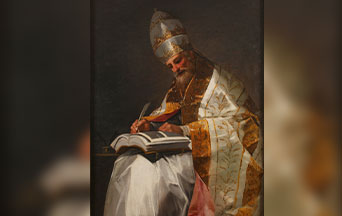
Nonetheless, God occasionally allows the dead to complete their sufferings in Purgatory on Earth. Father F. X. Schouppe, in his magnificent book, Purgatory1 recounts several such events, obtained from sources of undoubted piety. This article will focus on two vignettes coming from the pen of Pope Saint Gregory the Great (c.540-604).
A Disobedient Deacon
The first comes from Book Four, Chapter Forty of Pope Gregory’s Dialogues.2 It concerns a Deacon named Paschasius. Pope Gregory describes him as “a man of a wonderful holy life [and] a marvelous giver of alms.”
The only criticism of Paschasius arises from the disputed papal election of 498 A.D. The selection came down to two men: Symmachus and Laurentius (also known as Lawrence). Symmachus was elected, but Laurentius’s partisans, of whom Deacon Paschasius was one, disputed the election for several years thereafter.
In due time, the Deacon died. Nonetheless, his pious life was such that he was still capable of at least one miracle. As Pope Gregory described it, “a man possessed with a devil came and touched his dalmatic, as it lay upon the bier, and was forthwith delivered from that vexation.” As any practicing exorcist will explain, delivering someone from demonic possession is, at the very least, difficult. Notwithstanding his other virtues, Deacon Paschasius’s disobedience in not accepting Pope Symmachus required purification after death. However, Pope Gregory makes one additional vital point. He does not provide details, but he clearly points out that Paschasius’s fault lay in ignorance, rather than malice.
An Extraordinary Grace
Some years later, Germanus, the Bishop of Capua (later Saint Germanus of Capua), went to hot baths for medical reasons. Much to his surprise, his attendant was Paschasius, whom the Bishop had known in life. To say the least, Germanus was startled. Recovering this composure, the Bishop asked the Deacon why he was in so lowly a position as to be an attendant in a public bath.
“For no other cause,” said Paschasius, “am I appointed to this place of punishment, but for that I took part with Lawrence against Symmachus.” The Deacon followed his explanation with a request. “I beseech you to pray unto our Lord for me, and by this token shall you know that your prayers be heard, if, at your coming again, you find me not here.” Bishop Germanus diligently offered the requested prayers, and never again heard from the Deacon.
The Solicitous Servant
Chapter fifty-five of the Dialogues tells a similar story. An unnamed “virtuous Priest,” who served as pastor of the Church of Saint John in Tauriana—an ancient city whose site is now part of Palmi in the “toe” of Italy—also had reason to avail himself of medicinal baths.
On entering the baths, the priest encountered an attendant he had never seen before. The attendant was unusually helpful and solicitous as he went about the accustomed process. Impressed by the level of service, on his next visit, the priest brought two loaves of unleavened bread to give to the attendant as a kind of gratuity. The man’s sad reply startled the priest.
“Why do you give me these, father? This is holy bread, and I cannot eat of it, for I, whom you see here, was sometime lord [owner or manager] of these baths, and am now after my death appointed for my sins to this place: but if you desire to pleasure me, offer this bread unto almighty God, and be an intercessor for my sins: and by this shall you know that your prayers be heard, if at your next coming you find me not here.” Having said these words, the man vanished from sight.
Over the next week, the priest used the bread in his daily Mass celebrations, which he offered for the man’s soul. After those two encounters, however, the priest never saw the man again.
The Purpose of Such Accounts
There are several other such descriptions in Father Schouppe’s book. Without a doubt, such stories excite the interest of both the pious and the irreverent. However, God intends that such narratives serve His purposes. What can people learn from them?
Perhaps the most obvious conclusion is that God sometimes allows the deceased to occupy places they knew in life. However, these are not “ghosts” in the sense of those found in many fictional accounts. They are not, like Charles Dickens’s fictional Jacob Marley, doomed to tramp sorrowfully over the Earth eternally. Their presence is temporary, ending when they atone for their past sins.
Another fact is that these souls were enabled, by God’s Grace, to request that living people assist them on their way to Heaven. This desire is common to all of the poor souls in Purgatory. Being in no position to help themselves, all of them eagerly await the day that their purification is accomplished and they can move on to their happy union with Our Lord in Heaven. This is why prayers for the poor souls are so vital.
However, it would be folly for any individuals now living to believe that they will receive such graces after their own deaths. God has provided the living with many avenues to purity before death. It is foolish for people to ignore those possibilities today, thinking that God will allow them such unusual favors after death.
God’s Perfect Judgements
One last thought will conclude an article that can, at best, scratch the surface of so deep a subject. The first narrative, that of Deacon Paschasius, points out that the fault was one of ignorance rather than malice. This difference is essential in two ways. First, it disproves the common assumption that acts do not become sins unless the sinner knows that they are sins. However, equally important, sins that spring from ignorance are less serious eternally than those that spring from a decision to commit an act which the individual knows to be wrong. So, while ignorance itself is not an excuse, it is one of many factors that God, in His Omniscience, can consider when making those judgements about the state of souls that only He can make.
To read the next article in this series, please click here.
Footnotes
- All quotations of Father Schouppe’s book in this article use the 1905 version of Father F. X. Schouppe’s Purgatory, published in Great Britain by Burns, Oates and Washbourne, Ltd. It is in the public domain and available through the Internet Archive.
- This translation of Pope Saint Gregory the Great’s Dialogues was published in 1911 and is therefore in the public domain. Readers can find the document at Gregory the Great, Dialogues (1911) Book 4. pp. 177-258.