On May 27, 2026, Vladimir Putin’s Russia signed a “military and security cooperation agreement” with the Taliban rulers of Afghanistan. In at least two ways, this appears to be a very unlikely fellowship. However, irony often accompanies desperation.
A Pair of Significant Ironies
The first irony is that the one-time KGB colonel in the Kremlin Palace opposed the Taliban during the decade-long (1979-1989) Soviet invasion of Afghanistan. Indeed, the Taliban first took form to resist the Soviets. The Afghan signatory, Defense Minister Mohammad Yaqoob, is the son of Taliban founder Mullah Muhammad Omar.
Indeed, Mullah Omar not only fought against the Soviets but also provided refuge for Osama Bin Laden after the 9-11 attack on New York City’s World Trade Center. That act prompted the U.S. invasion of Afghanistan in October 2001.
The second, none-too-subtle twist is that Vladimir Putin often presented himself as the world’s leading defender of Christianity. As recently as March 2022, The Washington Post ran an article titled “The Bond that Explains Why Some on the Christian Right Support Putin’s War.” Author Prof. Bethany Moreton surmised that “many on the American right see Russia as an ally in the culture wars,” pointing to an “alliance of cultural conservatives in the United States and Russia [that] has also embraced racial and ethnic bigotry.”
A History of Islamic Accommodation
Putin’s new alliance with radical Islam, along with his suppression of Ukrainian Catholic churches in occupied territory, calls his image as Christianity’s champion into question. However, the sense that this is a policy change is unfounded. In 2015, The Economist published “Faith in Expediency,” an article that explored Putin’s long-running relationship with Islam.
Perhaps the most telling statement in this regard is Putin’s assertion, made in a Russian language videotape, that “Some analysts of Christianity say Orthodoxy is in many respects closer to Islam than to the Catholics.” That remark was not widely repeated among those who wanted to promote Putin as a bulwark of conventional Christianity.
That occasion was not the only time that Putin expressed support for Islam. In October 2013, Putin visited the largely Muslim city of Ufa in Central Russia to celebrate the 225th anniversary of Empress Catherine’s creation of a “spiritual authority” set up to inspire Russian loyalty among her Muslim subjects. As part of the celebration, Putin shared his understanding that “Islam is an outstanding element of Russia’s cultural makeup, an integral, organic part of our history.” Those are not the words of a man who came in hopes of converting his audience to Christianity.
Two years later, Putin presided at the reopening of the Moscow Central Mosque. On that occasion, he remarked, “Muslim opinion leaders always contribute to the development of peace and common sense against extremism in Russia.” Sitting next to him on the dais were Turkish President Recep Tayyip Erdogan and Palestinian President Mahmoud Abbas.
The Deal’s Details
However, smoothing relations with a religious faction that comprises over ten percent of Putin’s own population is one thing. Establishing a quasi-alliance with terrorists on the other side of the southern border is quite another. That is especially true when the terrorist band exists because of an invasion by Putin’s one-time superiors.
A recent piece in The Wall Street Journal, “The ‘Christian’ Putin’s Alliance With the Taliban” by Bernard-Henri Lévy, makes this point well. The subtitle is especially poignant: “His propagandists and useful idiots have characterized him as the savior of a decadent and declining West.” The main point is fairly straightforward: Putin abandoned any pretense of being a champion for Christianity when he signed the deal with the Taliban.
The terms of the deal involve training troops and repairing and maintaining Russian-made weapons systems already in Afghanistan’s arsenal, including helicopters and other aircraft. The Russians will also train “an elite force of 8,000 men” and provide intelligence capabilities to the Afghans. “In short,” Dr. Lévy concludes, “the Taliban will maintain order along the southern borders of Greater Russia and wage—or pretend to wage—war against rival groups such as the Islamic State Khorasan Province; in return, the former Soviets commit themselves to preserving Islamist rule in Kabul.”
A Russia-Afghan Alliance?
Fox News mentions an ominous set of motivations behind the Putin-Taliban Pact. “Russia and the Taliban government in Afghanistan have signed a military cooperation pact, cementing an alliance that further solidifies Moscow’s influence in Central Asia.”
Russia has long cast envious eyes on its neighbor to the south, always with limited success. Throughout the nineteenth century, Russia struggled with the British Empire (the owner of India to Afghanistan’s south) for control of the region. This struggle never came to war over Afghanistan itself, but both powers faced off in a series of minor “military interventions.” After the Bolshevik Revolution, the new USSR signed a Friendship Treaty which lasted, at least in principle, until a USSR-backed government fell in 1979. That fall inspired the disastrous Soviet invasion later that year.
Now, a desperate Putin is casting about for someplace, anyplace, that he can make himself appear to be a real player on the world stage. His disastrous Ukrainian invasion has made him a figure of international ridicule. Perhaps, by establishing friendly relations with the Taliban, he can convince his constituents that he has succeeded where Tsars and Bolsheviks failed. It is a desperate gamble, one fraught with peril for the surrounding region, but it is the only chance that he has.
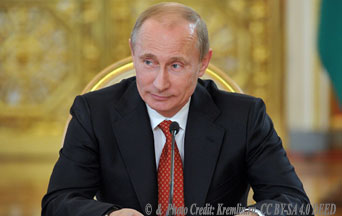
Photo Credit: © Kremlin.ru, CC BY 4.0 (Photo was changed for use on the home page slide show)