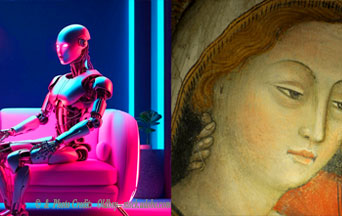
If there is one subject that is taking on great importance today, it is Artificial Intelligence (AI). Some people adore it; others hate it. Now more than ever, we need to have a balanced and Catholic vision of AI.
Indeed, Leo XIV’s recent Encyclical Magnifica humanitas highlights how timely the topic is. We will focus on some aspects of AI that enter into our daily lives. We believe AI represents a new revolution on par with the computer or Internet revolutions that have so transformed us. It demands a Counter-revolutionary response to the point that we can’t not have a position on it.1
Defining AI
Thus, we must begin by defining what we mean by AI to better analyze its ramifications. By AI, we mean any technology that enables computers and machines to simulate human learning, comprehension, problem-solving, decision-making, and autonomy. AI is the technology whereby we make our machines act like us—and even replace us.
As Catholics and Counter-revolutionaries, we must know what to think about AI. We must ask if it is good or bad, useful or harmful. We need answers to avoid being overwhelmed by AI. We need criteria to use it correctly.
The Need to Rethink How We Address Our Machines
Thus, we will avail ourselves of some considerations of Prof. Plinio Corrêa de Oliveira, who foresaw the implications of this new Revolution when its technology was still in its early stages in the eighties. In this way, we can contribute to this debate about regaining our humanity, for indeed that is what is involved.
We need to rethink how we address our machines and technology, especially as they come to dominate huge sectors of our time and culture. We risk being less human when machines take over on such a massive scale.
Let us begin by acknowledging that the problem is not technology itself. Technology comes from the Greek word techne, which means “art” or “skill.” Technology involves using our skills to apply our knowledge. It means putting our minds to work so that we might labor less.
The role of technology has always been to use our machines to lessen the burden of grueling, tedious work.
The Proper Use of Technology
This is the position of the Catholic Church. Christian civilization in the Middle Ages, for example, was a time of great technological advance and innovation. As historian Samuel Lilley reports, “The technological changes of the Middle Ages were greater in scale—by a very large factor—and more radical in kind than any since the start of civilization.”2
The Church favored these technologies not only for economic reasons but also for metaphysical and theological ones. The Church held that it is not proper for man, endowed with intellect, to be overwhelmed by the brutal, tedious work that deadens the intellect.
These tasks are often unavoidable due to Original Sin. Indeed, we are condemned to work by “the sweat of our brows” (Gen 3:19). However, anything that can be done to diminish this animal-like drudgery can and should be welcomed.
In our personal development, our principal concern should be about developing our souls. Thus, it would be helpful to define the tasks AI should not be doing, as they hinder this development.
I. What AI Should Not Be Doing
We are made up of body and soul. The soul is the most important and highest expression of our humanity. It is what distinguishes us from the animals. This truth is not only taught by the Church but even recognized by modern civil authorities. 3
We exercise our bodies by training our muscles to endure ever greater strain. In this way, we can eventually make our bodies stronger and resistant to fatigue.
We exercise the soul by developing its highest faculties, especially those found in the intellect that later orient the will. The soul is exercised by reasoning, pondering, speculating and judging—those things that put us above the animals and like unto angels. Thus, we are naturally attracted and oriented to the good, true and beautiful and ultimately to God, who represents the object of our best desires.
We are most human when we put these highest faculties to use and exercise them. We are the least human when we let go and give ourselves over to our unbridled imagination and passions that distort the working of the intellect.
That is how we should see technology—as the means by which we put our minds to work so that we might labor less and develop our souls more.
Frustrating Technology’s Purpose
AI frustrates the purpose of technology by intruding into areas that do not belong to it. It tries to do things that it cannot and should not do. It allows technology to simulate, replace, or even eliminate the speculative and contemplative functions that define and elevate us, thereby endangering our humanity.
AI vastly favors the instant, the superficial and the exercise of fantasy that can easily erode our higher faculties. It can do away with reasoning processes, speculative exercises and judgments whereby we exercise the soul. It does this quickly and effortlessly with the click of a mouse.
Frenetic Intemperance
This attack on thought, for that is what it is, is not new. Our industrial society has long imposed a brutal pace upon modern man who pursues goals with what might be called a frenetic intemperance. The result is a nausea for reflection and a shallowness of thought that wears away all that is most human.
AI takes processes, set in motion by the Industrial Revolution, intensifies them and puts them on steroids.
With AI, we are forced to run faster and ever more breathlessly to keep up with its flood of data and interactions. AI spits out sloppy data, insipid dialogue and endless commentary that our laziness will not bother to correct, nor will our minds seek to process fully.
The AI revolution destroys the organic thought processes that help us live calm, reflective lives. Indeed, we harness our machines to think for us. This replacement is an affront to our humanity, especially to the higher aspects of thinking, pondering and judging, which must function at their own pace.
Impact on our Personal Lives
AI impacts our daily lives in many ways. For example, many young people waste hundreds, if not thousands, of hours on AI-driven applications, silly videos and virtual chatbot relationships that keep them from developing their minds.
Reports relate that AI users will spend as many as 14 hours straight having personal conversations with AI chatbots about intimate decisions and emotional problems that require pondering and careful consideration. 4 Others overuse AI tools to determine what they should eat or drink every day. These activities replace mind-building functions with mind-numbing ones. AI should not be doing these things.
Affecting the Spiritual Life and Culture
These activities also affect our spiritual lives. God created us for pondering, wondering, meditating and analyzing Creation so that we might better know, love and serve Him. These higher spiritual faculties of the soul impel us to seek after our final end in God.
This abuse of our higher faculties can also impact culture. When people develop their higher faculties, it creates a whole culture oriented toward the love of God. Thus, Josef Pieper writes that culture flourishes only if we have the leisure to celebrate together what God has given us.
“Unless we regain the art of silence and insight, Pieper writes, “the ability for nonactivity, unless we substitute true leisure for our hectic amusements, we will destroy our culture and ourselves.”5
Time spent in silence and contemplation fosters a capacity to perceive the reality of the world, the sublime things in Creation and develop a relationship with God. It enhances the culture with richness and creativity.
To conclude, AI weakens those faculties of the soul where our humanity is most manifest—when we think, contemplate and ponder. Thus, AI must not enter into these fields. It must not interrupt those considerations that bring us to God.
These things are reserved for us alone.
II. What AI Can’t Be
Another reason for concern about AI is that it can leave us unanchored in reality. AI tends to destroy the way we know things and the limits we set for our actions.
We know things through the knowledge of ourselves. Every individual has a sense of being, the basic sense by which each person perceives a unique identity.
A man, for example, senses his being and distinguishes himself from others. Since he is conscious of himself, he can therefore say “I am.”
By this affirmation of “I am,” he defines his identity and acknowledges his limits.
The “I am” is the anchor by which we see all things. We start from our own identity, and work out to that which exists outside of ourselves. From this, we construct an objective reality. We naturally reflect on what we see and fit it into narratives with meaning and purpose. In this way, we can see Creation as a reflection of God, the Creator, and His Divine plan.
Denial of the Soul
The soul is the internal principle by which we think, feel, and will. It is that I by which our bodies are animated. The soul makes sense out of this life and the next.
AI is dangerous because it does not acknowledge the existence of a soul. AI tends to reduce us to its dimensions. The scientific consensus upon which AI is built sees us as just data or impulses without meaning or purpose. There is no “I am.”
Thus, Ross Douhat in The New York Times said it well, “The advent of AI is widely understood as a win for atheism and a blow against religious ideas of soul and spirit, persuading more people that their own minds are just computers—there is no divine spark or immoral soul, just the meatspace equivalent of a helpful chatbot or an AI therapist.”6
Adam Kirsh, a Wall Street Journal editor, summarizes this view in his book The Revolt Against Humanity: Imagining a Future Without Us. He says: “There is no intangible soul or spirit that occupies our bodies; the experience of being an ‘I’ is produced by chemical-electrical processes in the brain.” 7
Others, like writer Yuval Harari, claim that the “I” is a fiction that can be reduced to a collection of algorithms. In his book Homo Deus, he writes: “Humans are algorithms that produce, not cups of tea, but copies of themselves.”8
When man is reduced to such a state, we can be anything. AI algorithms refuse to define identity or recognize limits. It lets us define ourselves without limits.
Challenging Our Sense of Being
Thus, AI comes to mediate and define reality. The AI revolution facilitates changes in our identities so they no longer have to correspond to reality. Inside the AI world, a man can be what he wants or imagines himself to be. Inside an AI-driven space, a man can more easily claim to be what he is not—an animal, an avatar or a woman.
AI also defines the world around us, creating new fake worlds. Thus, we have today false identities, deepfake portrayals and AI-generated narratives, where it is not clear what is real and what is not.
People can be made to say things they did not say and be in places where they have never been. People can commit virtual acts of extreme violence and brutality without immediate consequences.
Annihilating the I Am
When AI dominates, it becomes the solver of all problems, even assuming the human role of comforter and advisor. By denying identity and reality, AI annihilates the “I am” and immerses everyone in an imagined world of uncertainty and fantasy.
When there is no more anchor in an I, AI can create dangerous echo chambers, reinforce anxieties and generate harmful dependencies. People spiral out of control and ruin their lives.
All this is done on a scale and at speeds never seen before. AI can broadcast false depictions, actions and identities across multiple platforms at dazzling speeds. It can do this without human agency, being directed by algorithms and other processes.
When these perceptions become generalized, people will no longer have the elements to make sound judgments since they will not know what is real.
Staying in Control
Thus, AI cannot be an enabler of the imagination, allowing free rein to unbridled passions. We must recognize our own identity and control our definable limits.
Above all, we must not allow AI to destroy the notion of a soul. We are not algorithms, electrical impulses or data, but immortal souls with an eternal destiny.
All these things define our humanity and involve our salvation, which we risk losing when AI dominates our lives.
III. What AI Can’t Know
A third danger of AI involves our need for knowledge and certainties.
Regarding AI, most people do not engage in speculation or pondering. They do not understand the “I am” concept. These approaches are all very philosophical.
Most take a practical approach to AI. They ask AI for information, and it gives answers. Everyone is impressed by the amount of knowledge that AI apps seem to have. The apps churn out vast amounts of information on any subject within seconds. Such results are deemed accurate and reliable.
Finding Data, Not Truth
AI seems to put an infinite amount of knowledge at our fingertips. However, it actually frustrates our quest for knowledge.
The end of knowledge is truth. However, there is a difference between truth and data. AI gives us data, but not necessarily the truth.
To know something means to perceive it directly or to have direct cognition or understanding of it. AI cannot know anything because it cannot perceive things.
Thus, its results are neither accurate nor trustworthy because AI treats everything as data, not truth. There is no knower AI because it is not conscious of its actions. It can only carry out processes.
AI lacks the capacity to know—to perceive directly. The AI apps gather, compile, and present findings according to pre-established procedures, mathematical probabilities and algorithms. These algorithms may be sophisticated and produce many results that simulate agency. But AI never knows anything.
No Understanding of Data
Not only does AI have no knower, but there is no understanding of that which is supposedly “known.” The apps only compile indiscriminate data.
Data is information in numerical form that can be transmitted or processed digitally. For the app, there is no meaning beyond the collection of ones and zeros that serve as the basis for identifying certain patterns, uses and criteria.
Thus, the sublime truth of the existence of God and the latest stock market prices are the same thing. Truth and error are likewise indistinguishable in its collections of zeros and ones.
AI systems use mathematical probabilities to gauge the best response to queries and dialogues. It will often spit out the most popular, not the most accurate response, based on its data analysis. It can err and does so badly.
Millions of Lies an Hour
Thus, AI systems will not always deliver the right information. The compiled responses of AI bots are only as accurate as the universe of data that we put into the system. That universe may include heavy reliance on untrustworthy sites like Facebook, Reddit and Wikipedia.
A recent study analyzed the AI-generated summaries that now appear at the top of most Google searches. The feature uses an AI program called Gemini 3, which turns Google from a curator of other people’s information to a creator of content.
A New York Times study concluded that the Google Overviews are accurate around 90 percent of the time. With over five trillion searches every year, the number of erroneous answers is huge. One article mischievously notes that Google tells tens of millions of lies every hour. Every minute yields hundreds of thousands of inaccuracies.9
No one in the real world can operate effectively with such scattershot accuracy. Telling the truth 90 percent of the time should not elicit our trust.
To Err is AI
This tendency to err is no secret. Every AI Overview response has a Google qualifier in fine print beneath it that says, “AI can make mistakes, so double-check responses.”
The problem is compounded when two identical Google searches, even made seconds apart, can give different results.
AI can get it wrong in many ways. It can report a false fact. It can also get it wrong by providing linked sites with no grounding evidence to support the response. Still other searches will get the desired detail correct, but err in additional contextual information.
The study also claims that AI can be manipulated. Those who know how to game the system can tailor their writing to be picked up in the summaries that appear in search results.
On the Edge of the Abyss
The seriousness of AI accuracy and reliability is evident when users trust chatbots to help them make life-changing decisions or resolve emotional issues. Users assume AI “knows” their state of mind and psychological health.
AI cannot know our souls; it knows ones and zeroes and can link patterns found on the Internet. Based on this data, AI can give bad advice that has resulted in suicides, addictions and other psychological damages. Developers are finding themselves on the receiving end of lawsuits that hold them responsible.10
This lack of certainty and right behavior is one danger of AI. It reflects the decadent state of humanity. It is only as good as we are. And we are not good. We cannot expect to see certainty and morality reflected in AI until we have mended our wicked ways.
IV. AI For Catholics in the Real World
Discussion of AI can be very theoretical. It often fails to address AI’s more spiritual aspect, which affects the daily lives of Catholics in the real world.
Indeed, what Catholics in the pews want to know is how to deal with the AI threat to their sanctification. They want to know how to resist the occasions of sin that AI presents to them, especially young people. They struggle with the frenetic intemperance of this new medium, which is absorbing vast amounts of their time and culture to the detriment of their souls. Many young Catholics are wasting hours seeking advice from AI chatbots that lead them astray.
No References to Personal Salvation
The encyclical, Magnifica humanitas, for example, mentions nothing about this struggle for personal salvation. It does not even use the words “sanctification, “Hell,” or the “devil.” Sin is hardly mentioned. The daily struggle to overcome the devil, the flesh and the world does not figure into this document, which takes an anthropological and naturalistic approach that most faithful find hard to understand.
Real Catholics, who still believe in the devil, need very concrete and practical answers about these issues.
Exploring AI as an Instrument of Temptation
Such a discussion is controversial. These questions sit on the edge of the debate, lurking in the shadows of the dark web. People are afraid to ask these questions. They hesitate to come out in public lest they appear to be living on the fringe.
Perhaps it is better just to state the problem outright: Does the influence of AI threaten the salvation of souls? Can AI serve as a medium for temptation and perdition? Catholics need to know whether there can be something beyond the interplay of electronic impulses within AI.
These are legitimate questions that correspond to the experiences of real Catholics who believe in the devil. To answer them, however, some premises about the devil and his evil work need to be re-established.
Re-establishing Premises
The first premise is that the devil exists. So many people don’t believe in the devil anymore, and he does everything possible to convince them that he does not exist. He works better in the shadows.
Indeed, many theologians today don’t believe in or mention the devil. Some affirm Hell is empty, so there is no reason for the devil to stay around Hell or even to “prowl about the world seeking the ruin of souls.”
However, the devil does exist, regardless of the feelings of those who deny him. He is very active.
The second premise is that the devil desires the eternal damnation of everyone. He works relentlessly to send people to Hell, using any means to accomplish this purpose. The vision of Hell at Fatima showed it to be very full, thus testifying to his success.
Finally, the devil can concretely exert his influence on souls and matter.
Ways the Devil Acts Upon Souls
The Church teaches that this action can be done in several ways.
The devil can act, tempting people to sin. This can be done by working on the imagination with images, suggestions and evil thoughts.
The devil can make use of matter to influence people. He cannot create matter, but he can manipulate, move or attach himself to it. Thus, he can produce sounds and light, and project images. He can affect the nervous system and cause illnesses. He can manipulate what people see or perceive. This impact on matter is why Ouija boards, for example, facilitate dabbling in the occult.
Finally, the devil can present himself or his deceptions to human sight, either visibly and directly or through a medium or channel.
For this reason, the Church has many prayers and exorcisms directed against the devil and his works. He is very real and makes his influence felt everywhere. Since the devil makes use of created things, it follows that there is nothing contrary to Church teaching in admitting that this influence might apply to AI, which could even increase his impact exponentially.
The AI Opportunity
Indeed, AI is a powerful medium because it enables machines to appear to act like humans. It is on the cutting edge of communication. The devil would be crazy not to use it to the greatest possible extent to accomplish his end. He is a fallen angel with angelic intelligence and can thus perceive its usefulness. The devil is no Luddite.
Moreover, AI is an ideal medium for his manipulating action. It is not too physical; it is more spiritual and virtual. It involves images that he is especially adept at manipulating.
Indirect Action
The liberal mentality refuses to recognize that both angels and devils are capable of supranatural actions in the real world. Given this refusal, any consideration of how this action might be carried out using AI is deemed to be the speculative musings of the ignorant.
However, the devil’s actions with AI would be consistent with how he acts with any material thing or system. He rarely appears directly because he is repugnant in his fallen, eternally condemned state. Humans are naturally attracted to God, and all that is good, true and beautiful. If the devil were to fully manifest himself in all AI actions, people would be shocked, and the devil would thus be working against his own interests.
The most frequent way for him to act via AI would be by indirectly influencing people. Even the most skeptical people, who only vaguely believe in the devil, would have to agree that such an action is possible.
Thus, AI can create conditions in the human soul that open people to demonic action. For example, AI can favor narcissism, flattery and false realities, which opens the way to demonic action associated with self-aggrandizement and pride. It can erode critical thinking by overreliance on algorithms, leading to a decline in human reasoning. The devil thrives when reason is absent or greatly reduced. AI-driven social media and chatbots favor isolation and loneliness by replacing human relationships. The devil can then fill the void.
The devil might also tempt the person to sin using AI. For example, he might tempt a person to use AI to find pornography and create even more sinful and degraded forms of it. He might consume people with intemperance, leading, for example, to 14-hour chatbot conversations. AI opens up huge opportunities for every type of sinful passion and vice.
The Power to Manipulate Matter and Systems
If it is admitted that the devil can manipulate existing matter, then some kind of demonic intervention is possible in chatbot conversations, the projection of images or the manipulation of perceptions. The systems can communicate temptations.
Indeed, if the devil caused noises like those that kept the Curé of Ars awake at night, transmitted via sound waves, why not electronic impulses via fiber-optic cables? If the devil can communicate through a Ouija board, why not a computer or mobile phone motherboard?
Finally, the devil might even, though rarely, present himself to human eyes in AI applications, since these media are conducive to his actions through images.
Dark Places Where Strange Things Happen
Indeed, there are dark places on the web where strange things happen. The Internet has long been a haunt for the occult. From the very beginning, the so-called technopagan movement inside cyberspace blended spiritual beliefs with emerging tech. Its followers set up digital altars as ritual spaces to display imagery and invoke its occult deities within immersive online platforms. 11
Today, the web is full of online witchcraft, astrology and other occult activities that can be enhanced with AI apps.
For example, there are reports that AI apps or chatbots with occult overtones are inducing people to commit suicide. Exorcists warn people to stay away from these influences. All these things suggest the devil’s participation in this field is very great.12
Destroying Real People’s Lives
The extent of the devil’s influence within AI depends on how much individuals reject the devil in their daily lives. However, the threat is real.
These influences are damaging real people’s lives. Souls are being lost by these temptations.
Thus, any analysis of AI should include mention of the devil who “prowls about the world seeking the ruin of souls.” The Church should make use of its vast experience in this matter to warn of and repel this danger.
The salvation of souls is at stake. When Church officials fail to mention this danger, Catholics in the real world who still believe in the devil are left to their own devices and left undefended in these wicked times.
What to Think About AI
AI has invaded so many aspects of our daily lives that it is almost impossible to avoid using it. If we are going to survive as Counter-revolutionary Catholics, we must make use of all available and legitimate means to fight against “the principalities and powers of this world of darkness.”
Thus, we must use AI with caution. However, we should not allow it to replace the higher human faculties needed for our sanctification. We should not waste precious time with chatbots that might give us bad advice. We must not let AI serve as a gateway to occult and dangerous practices.
Some call AI a tool we can use, even characterizing it as a neutral tool that depends on how we use it. This designation is too generous and naïve. The devil does not respect pacts of neutrality. He will exploit AI, seeking every unfair advantage to do harm to unwary souls.
We must characterize it better, not as a tool but a weapon. We can use it to fight against the wickedness that surrounds us. We should use it well and skillfully.
However, we must keep in mind that it is a weapon to be taken with deadly seriousness. We don’t play with weapons or point them at others. Likewise, concerned Catholics must be vigilant when using AI.
If we turn this weapon upon ourselves, we will no longer ponder, wonder and contemplate. We will lose a notion of who we are and no longer make the soul our primary concern. We will engage in fourteen-hour chatbot conversations with nobody. We will be full of data, not knowledge and wisdom. Such empty, hollowed-out souls with feeble wills will become the playthings of the devil.
Far better it is for us to turn our souls to God and Our Lady and put ourselves under their protection as we fight against the wickedness of our days.
Photo Credit: © Oldboy – stock.adobe.com
Footnotes
- We use the terms Revolution and Counter-revolution in the sense employed in the book, Revolution and Counter-revolution by Prof. Plinio Corrêa de Oliveira. The Revolution represents a historical process that began with the Protestant Revolution, aiming at the destruction of Christian civilization. The Counter-revolution represents an organized response.
- Samuel Lilley, “Technological Progress and the Industrial Revolution 1700-1914,” in The Industrial Revolution 1700-1914, ed. Carlo M. Cipolla (New York: Harvester Press, Barnes and Noble, 1976), 214.
- Barry Goldwater wrote that man is a “spiritual creature with spiritual needs and spiritual desires.” This affirmation has come to define the conservative tradition, as it is a central thesis of Goldwater’s Conscience of a Conservative. See Barry Goldwater, The Conscience of a Conservative, (N.p.: Bottom of the Hill Publishing, 2010), 11.
- https://www.nytimes.com/2026/04/04/technology/ai-chatbots-teen-roleplay.html
- See Josef Pieper, Leisure: The Basis of Culture, trans. Gerald Malsbary (South Bend, Ind.: St. Augustine’s Press, 1998) 45.
- Ross Douthat, “The Atheist and the Machine God,” The New York Times, May 9, 2026.
- Adam Kirsh, The Revolt Against Humanity: Imagining a Future Without Us (New York, N.Y.: Columbia Global Reports, 2023), 69.
- Yuval Harari, Homo Deus: A Brief History of Tomorrow (New York, N.Y.: Harper-Collins, 2017), 85.
- https://www.nytimes.com/2026/04/07/technology/google-ai-overviews-accuracy.html
- https://www.nytimes.com/2026/05/12/technology/chatgpt-lawsuit-wrongful-death.html
- https://techgnosis.com/technopagans/
- See Matthew Petchinsky, AI and the Occult: Digital Spirits, Sigils, and Cyber-Witchcraft, (Nashville, Tenn., Apophis Enterprises LLC) 2026.