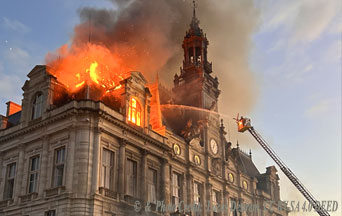
On October 17, the clock tower of the Limoges town hall fell in flames. By the next day, France’s interior minister had counted 2,400 arrests and nearly 1,000 injured officers. In Lyon, rioters burned the tourist office. Across the country, rioters looted businesses and attacked police.1
It started with high school students in the working-class suburbs north of Paris, protesting teacher shortages and crumbling classrooms. It continues as a national revolt over prices, spending cuts and inequality. It now involves leftists, Islamists, unionists and others.
There are those who try to ascribe the violence to foreign sources such as Russia. However, Russia did not start the riots in France. It did something cheaper, and more useful to Moscow: for six weeks, it taught angry Europeans to blame the wrong culprit. Moscow pointed at Kyiv. The real culprit sits in Paris.
What Moscow Did Not Do
The French government blamed ultra-left groups and criminals. That explains who threw the firebombs. It does not explain the story that was told about them afterward.
No credible evidence shows that a foreign power started the unrest. Macron, no friend of the Kremlin, said so plainly: “There is no evidence of foreign interference in the events that took place.” An EU official said Brussels had no confirmation either.
France’s foreign minister did name “hostile narratives” from Russia, China, Iran and “the MAGA community.” But the coordinated operations that researchers have actually documented lead back to Moscow. Macron finished the thought himself: “However, there has been foreign manipulation of information in the aftermath; that much is true.”2
What Moscow Did Do
The watchdog group Alliance4Europe went through 547,471 social media posts and articles. In the first phase, from September 2 to October 14, a bot network it attributes with high confidence to Russia’s Doppelgänger operation posted 639 coordinated messages in 22 synchronized waves, in French, German, English and Polish. They received about 7.4 million views.
Another Russian network, Pravda, published 1,018 articles across 28 websites in nine languages. About two-thirds of the posts can no longer be read because the accounts had been suspended, so those totals are a floor, not a ceiling.3
The message never changed: “Every euro paid to Kyiv is a euro taken away from our prosperity.”4
Then Limoges burned and the second wave arrived. BBC Verify examined more than 15 fake news videos masquerading as Le Monde, Euronews and France 24. Researchers attribute them to a Russian operation called Matryoshka. A Sciences Po researcher said pro-Kremlin influencers tied to a second campaign, Storm-1516, “amplified the events and spread a number of false narratives.”5
Moscow did not create the anger; it aimed it at Kyiv.
Why Ukraine Is the Target
Look at the war Russia is losing. The Institute for the Study of War reports that Russia has lost a net 93 square miles of Ukrainian territory since September 1. This year, Russia’s gains have averaged about 60 acres a day, roughly the size of a small Pennsylvania farm. Since September 1, it has gone backward, losing a net 93 square miles.6
An army that cannot take a county in Donetsk has to look for wins somewhere else. It looks to Paris, Berlin and Warsaw, wherever the money for Kyiv is approved.
France’s 2027 election raises the stakes. Marine Le Pen has said, if elected, she would cut French aid to Kyiv.7 Yet her party’s president, Jordan Bardella, says France must not let Ukraine be “consumed by Russian imperialism.”8 No evidence shows Moscow working for her party. Its bots mainly went after centrist, pro-European and pro-Ukraine politicians.9
The Kremlin does not need a candidate. It needs a slogan, repeated in four languages across Europe, that every candidate has to answer.
None of this is new. European governments have blamed Russia for a growing list of arson attacks, cyberattacks and sabotage in NATO countries. The method never changes: find a crack, widen it, deny everything.
Who Sent the Bill
The answer to Russia’s lie is not panic. Nor is it blaming foreign agents for choices France made itself. The answer is to name those who ran up the bill.
The EU Council found that French public spending hit 57.2 percent of GDP in 2025, second highest in the EU and 7.7 points above the EU average. France also collected the EU’s highest share of GDP in taxes and social contributions, at 45.4 percent.10
France spends more of its national income than almost any other country in Europe and taxes its citizens more than any other, yet its students have protested crumbling classrooms since 1990. The money did not go to Kyiv. It went into a state that cannot fix its own schools.
The Irony
Moscow, heir to the most ruinous socialist experiment in history, is lecturing the French about prosperity. And Paris, still running a milder version of that experiment, would rather blame radicals, criminals and foreign trolls than its own ledger.
French rioters lit the fire in Limoges, and the Kremlin brought the gasoline. But the woodpile was built in Paris, one budget at a time, over decades.
Photo Credit: © Lucas Destrem, (CC BY-SA 4.0)
Footnotes
- https://www.reuters.com/world/europe/france-faces-aftermath-worst-unrest-years-2026-10-18/—–https://www.cnbc.com/2026/10/19/france-protests-paris-violence-pictures.html
- https://www.euronews.com/2026/10/21/france-and-italy-blame-foreign-powers-for-riots-but-wheres-the-evidence
- https://alliance4europe.eu/report/eu-unrest-report-how-frances-october-2026-protests-were-manipulated-then-retold-abroad
- https://www.ilfoglio.it/en/world/2026/10/22/news/this-is-how-russian-iranian-and-algerian-media-outlets-have-exploited-the-protests-in-france–411295
- https://www.bbc.com/news/articles/ckjrw044ggxgo
- https://understandingwar.org/research/russia-ukraine/russian-offensive-campaign-assessment-october-22-2026/
- https://english.nv.ua/nation/marine-le-pen-promises-to-end-aid-to-ukraine-statement-ahead-of-2027-elections-50650060.html
- https://kyivindependent.com/bardella-or-le-pen-what-frances-far-right-choice-means-for-ukraine/
- https://www.cyfluence-research.org/post/cyber-based-influence-campaigns-19th-25th-october-2026-report
- https://ec.europa.eu/eurostat/statistics-explained/index.php?title=Government_finance_statistics