This article is the seventh part of a series about Purgatory, a topic that is rarely discussed today. A knowledge of Purgatory is essential if souls are to avoid the pains of this place of expiation. The previous article can be found here.
* * *
About a half-hour’s drive southeast of Assisi is the Franciscan Convent of Sant’Anna at Foligno. It was founded around 1393. The most significant event in the convent’s long history occurred on November 16, 1859, when it received a visitor from Purgatory. Not only did she visit, but she left behind a visible artifact attesting to her presence.
The visitor was Sister Teresa Gesta. Before her death, she had been the convent’s mistress of novices. This position required someone who thoroughly applied the rule under which the convent operated, while also showing the proper amount of compassion for those adjusting to religious life. She was also the sacristan, another highly responsible position. All of the accoutrements of Holy Mass and other ceremonies were under her charge.
Father Schouppe1 includes a short but incisive comment about the regard that the community held for her. “Sister Teresa was a model of fervor and charity. We need not be astonished, said her director, if God glorifies her by some prodigy after her death.” On November 4, 1859, she suddenly died at age sixty-two from a stroke.
Twelve days after Sister Teresa’s passing, her successor as sacristan, Sister Anna Félicia, was about to enter the sacristy when she heard moaning from inside. When she opened the door, she saw no one, but the moaning continued. Nearly overcome with fear, the nun cried out, “Jesus! Mary! What can that be?”
These words were barely out of Sister Anna Félicia’s mouth when she heard the moaning voice say, “Oh! My God, how I suffer! Oh! Dio, che peno tanto!” In her agony, the soul confessed that her fault was related to her role as sacristan. Sister Anna Félicia immediately recognized the voice of her late predecessor.
At that point, the room filled with thick dark smoke. In the midst of the haze, Sister Teresa’s spirit became visible, moving toward the door. As she reached it, she cried out, “Behold a proof of the mercy of God.” Reaching out, she placed the palm and fingers of her right hand on a panel of the door. She then disappeared.
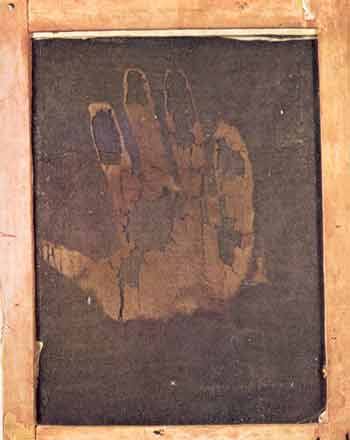
Nearly overcome with fear, Sister Anna Félicia noticed something extraordinary. Where the spirit of Sister Teresa had touched the door, the image of a hand was burned into it as though left by a red-hot iron.
Sister Anna Félicia then called out in fear. Within minutes, the entire community had flooded into the sacristy, which clearly smelled of burnt wood. Sister Anna Félicia told them about the visitation, and all marveled at the burn marks left on the door. Many of the nuns immediately recognized the print of Sister Teresa’s hand, as the late sister’s hands had been remarkably small.
As soon as the nuns realized what they were seeing, they immediately ran to the choir. Most of them spent the entire night in prayer and penance for Sister Teresa. The following morning, their chaplain offered Mass for her soul. By this time, word of the vision had transcended the convent walls. Many of Foligno’s villagers joined their prayers to those of the convent.
On the evening of November 18, Sister Anna Félicia was preparing for sleep. As she entered her cell, she once again heard Sister Teresa’s voice. At the same moment, the cell filled with light as bright as that of midday. Sister Teresa called out triumphantly, “I died on a Friday, the day of the Passion, and behold, on a Friday, I enter into eternal glory! Be strong to bear the cross, be courageous to suffer, love poverty.” To her benefactress, she added with affection, “adieu, adieu, adieu!” Instantly, her face appeared, as if transfigured and encased in a dazzling cloud. The cloud rose toward heaven and disappeared.
If the purpose of this article was simply to tell a good story with a happy ending, it could end here. The beautiful moment when Our Lord receives one into His eternal presence is delightful—and even beneficial—to contemplate. However, stopping there would miss the point. God’s miracles do not take place merely to entertain idle humanity or to offer pleasant enticements. He designs them to have lasting and salutary effects. Father Schouppe saw two purposes in this vision, which he carefully explained.
The first was simple, even if it surprises those who conceive of God as endlessly understanding and never offended. “Thus,” he explains, “we see Divine Justice punishes most severely the slightest faults.” One blemish on an otherwise exemplary life cost Sister Teresa Gesta two weeks in Purgatory. Her time was short because her sin was minor. Nonetheless, her pains during that time were very real, as her cry, “Oh! my God, how I suffer! Oh! Dio, che peno tanto!” indicates.
The second lesson is a reflection on the true nature of God’s mercy and is intended for all. Father Schouppe understood that many would struggle to comprehend how such suffering could be a sign of mercy. He explained, “[I]n giving us a warning of this kind, God shows us a great mercy. He urges us, in the most efficacious manner, to assist the poor suffering souls, and to be vigilant in our own regard.”
It is advice that all people will be wise to consider carefully.
To read the next article in this series, please click here.
Footnotes
- All quotations in this article use the 1905 version of Father F. X. Schouppe’s Purgatory, published in Great Britain by Burns, Oates and Washbourne, Ltd. It is in the public domain and available through the Internet Archive. The spellings of certain words were Americanized by the author.