
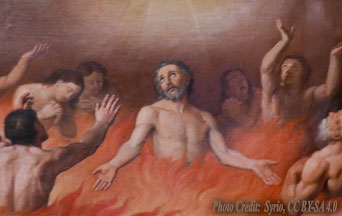
This article is the sixth part of a series about Purgatory, a topic that is rarely discussed today. A knowledge of Purgatory is essential if souls are to avoid the pains of this place of expiation. The previous article can be found here.
* * *
Most modern Catholics hear almost nothing of Purgatory from the pulpit. Too many priests seem reluctant to share information about such a gloomy prospect. It interferes with the sunshine, love and mercy that drip from felt banners, poorly written hymns and homilies designed to avoid any mention of God’s judgment.
Occasionally, though, primarily during the first week of November and the last weeks of Lent, the “Four Last Things”—Death, Judgement, Heaven and Hell receive fleeting notice. These moments are essential, but they are not enough. It is precisely that information that all Christians need to prepare their souls for the inevitability of death.
Experiencing Heaven and Purgatory
In 1599, Brother Anthony Pereyra, S.J., experienced each of the Four Last Things. Then, God sent him back to earth to relate the knowledge he gained.
Brother Anthony would eventually occupy the office of Brother Coadjutor at the Colégio do Espírito Santo in Évora, Portugal.1 However, in 1599, he was one of many young Jesuits on the island of São Miguel (Saint Michael) in the Azores—a chain of islands in the Atlantic roughly nine hundred miles from the coast of Portugal. At this station, he was suddenly stricken with what Father Schouppe referred to as “a mortal malady.”2 He appeared to take his last breath a few minutes after receiving the Last Rites.
Unusually, although his body went cold almost immediately, those who examined him thought they detected a faint heartbeat. He probably experienced what doctors today call a coma. Therefore, Brother Anthony’s companions delayed the usual burial preparations. On the fourth day, the seemingly dead man suddenly opened his eyes, breathed and spoke. At the insistence of his superior, he related his experiences.
A Tour of the Afterlife
“I saw first,” he says, “from my deathbed my Father, Saint Ignatius,3 accompanied by several of our Fathers from Heaven, who came to visit his sick children, seeking those whom he thought worthy to be offered by him and his companions to our Lord. When he drew near to me I believed for a moment that he would take me, and my heart thrilled with joy; but soon he pointed out to me that of which I must correct myself before obtaining so great a happiness.”
At that moment, Brother Anthony’s body separated from his soul. Immediately, a horde of demons charged toward him. It was as though a pack of guard dogs had been suddenly unchained after their keeper set out their food bowls. At that exact moment, though, Brother Anthony saw his patron, Saint Anthony of Padua, as well as his guardian angel, descend from Heaven. Momentarily, the demons had been put to flight, having lost the opportunity to seize their prey.
Then Brother Anthony’s protectors invited him to take a kind of tour with them as guides. They took the young Jesuit to see both “the joys and sufferings of eternity.”
“They led me then by turns,” he adds, ‘‘towards a place of delights, where they showed me a crown of incomparable glory, but which I had not as yet merited; then to the brink of an abyss, where I saw the reprobate souls fall into the eternal fire, crushed like the grains of wheat cast upon a millstone that turns without intermission. The infernal gulf was like one of those limekilns, where, at times, the flames are, as it were, stifled by the mass of materials thrown into them, but which feeds the fire that it may burst forth with more terrible violence.”
Return to Earth
Following this incredible sequence of events, Brother Anthony heard himself condemned to Purgatory. Then, just as suddenly, he heard God’s command that his soul be reunited with his body on earth, whence he awoke from his coma.
Brother Anthony was not, however, immediately cured of the disease that nearly killed him. He would suffer its symptoms for another six months. His pains did not cease with his recovery. Having experienced the agonies of Purgatory, he imposed every penance on himself that his Jesuit superiors would allow. His disciplines lasted for the remaining forty-six years of his life, until he died on August 1, 1645.
Not all souls bound for Purgatory are given a glimpse of Heaven first, as Brother Anthony. Some accounts imply that even those condemned to Hell get a glimpse of the Heaven they will never inhabit as part of their punishment. Indeed, it has been said that the greatest difference between Purgatory and Hell is that the poor souls in Purgatory have the hope and certainty of going to Heaven eventually, while those in Hell despair for all time.
Important Subjects, Frequently Ignored
This account reinforces the truth that the knowledge of Heaven, Purgatory and Hell is immensely beneficial for all people on earth. Thus, Satan and his minions are so anxious to quell any real consideration of them. Many are those who do not know that they are bound for Hell and, all the while, openly ridicule those who aspire to Heaven. At the same time, too many who would be destined for Heaven abandon their virtue in light of that ridicule.
All believers should, for their own benefit and that of their loved ones, regularly contemplate the Four Last Things. The world will label any such consideration as an obsession, a needless distraction from the “important” things of earth. After so many years of being lulled to sleep on such matters, even many who see themselves as devout may be inclined to ignore these essential truths of the Faith. Pray that God will open the minds of bishops, priests, and the laity—as He did that of Brother Anthony Pereyra—to give these considerations the emphasis that they deserve, and use them to claim more souls for the Kingdom of Heaven.
To read the next article in this series, please click here.
Photo Credit: Syrio, CC BY-SA 4.0.
Footnotes
- The college has been secularized, and the government now operates as the Universidade de Évora.
- All quotations in this article use the 1905 version of Father F. X. Schouppe’s Purgatory, published in Great Britain by Burns, Oates and Washbourne, Ltd. It is in the public domain and available through the Internet Archive. The spellings of certain words were Americanized by the author.
- Saint Ignatius of Loyola, Founder of the Jesuit order.