
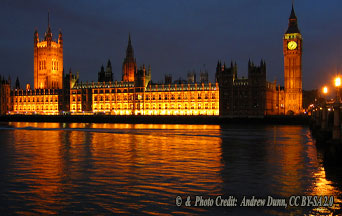
The following article is the third of a four-part series that features the life of Augustus Pugin, the renowned English Catholic architect of the nineteenth century. The prior article is found here.
Curiously, the word “ambience” is little used in today’s modern, materialist world. Ambience is a word frequently used to describe the “feel” and “use” of a place. All places convey an ambience of some sort that is imponderable and difficult to define in mechanical terms.
The nineteenth-century architect Augustus Welby Northmore Pugin gave utmost importance to the notion of ambience in his works.
Defining Ambience
Picture, if you will, a modern high school auditorium. The venerable word auditorium means a “place where something is heard.” Rows of chairs all point to a central spot, the stage. Unless there is a performance, that stage is bare. The decoration is deliberately bland, so as not to detract from the action on the stage. There are two lighting systems, one that illuminates the entire room and a separate series of lights designed to create effects upon the stage.
Contrast that auditorium with a living room in a middle-class home. The two rooms have very different purposes. Although not an auditorium, much listening does take place there. Usually, all the chairs are on the same level, facing the center of the room to facilitate conversation. Small tables may be set around the room to hold light refreshments, books or magazines. Favorite pieces of art or family photographs may be on the wall. There may be a television or other electronic entertainment device. In a well-designed living room, the furniture, decorations, lamps, draperies, and other elements are distinct yet form a cohesive whole. All of these items affect the ambience.
Augustus Pugin understood the importance of ambience. Thus, he created a different ambience for each project that reflected the building’s purpose and the tastes of those who commissioned it. He designed homes for both very wealthy patrons and the middle class. A few of his churches are cathedrals in major cities, and others are country chapels. His work on the Houses of Parliament formed the seat of the largest Empire in the history of the world.
The Importance of Ambience
Catholic thinker Professor Plinio Corrêa de Oliveira also understood the importance of ambience. In Revolution and Counter-Revolution, he discusses its importance in this way:
“Given that God established mysterious and admirable relations between, on the one hand, certain forms, colors, sounds, perfumes, and flavors and, on the other, certain states of soul it is obvious that, through the arts, mentalities can be profoundly influenced and persons, families, and peoples can be induced to form a profoundly revolutionary state of spirit.”
He continues with a historical example, noting that, “It suffices to recall the analogy between the spirit of the French Revolution and the fashions created during it, or the analogy between the revolutionary turmoil of today and the present extravagances in fashion and in the so-called advanced schools of art.”
Thus, he concluded that, “Ambiences may favor good or bad customs. To the degree they favor good ones, they can oppose the Revolution with the admirable barriers of the reaction, or at least the inertia, of everything that is wholesomely customary. To the degree they favor bad customs, they can communicate to souls the tremendous toxins and energies of the revolutionary spirit.”
Pugin’s Home
Augustus Pugin knew this to the core of his being.
It is no surprise that Pugin’s home was a Gothic structure.
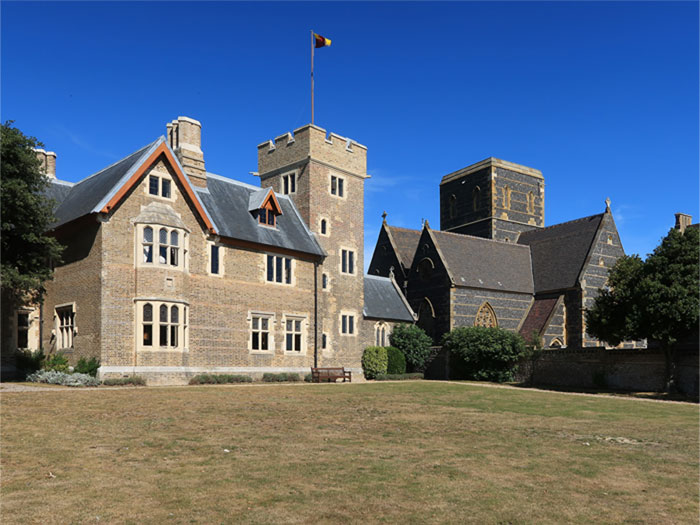
Could there be a more idyllic setting for raising a family than this? Pugin was married three times. His first wife died in childbirth less than a year after their marriage. About a year later, he married Louisa Burton, who bore him five children before she died in 1844. His last marriage, to Jane Knill, took place in 1848, and they had two children before Pugin died in 1852 at the age of forty.
When he began building here in 1843, he aimed to construct “a Catholic house, more than a cottage and less than a mansion.” He also wanted a fine Church next door.
The interior projects the same ambience as the exterior. There is stateliness and refinement, but there is also comfort.
The Palace of Westminster
The biggest project of Pugin’s life, and the one which probably killed him, was the Palace of Westminster, better known as the Houses of Parliament. In 1834, the medieval Palace burned down.
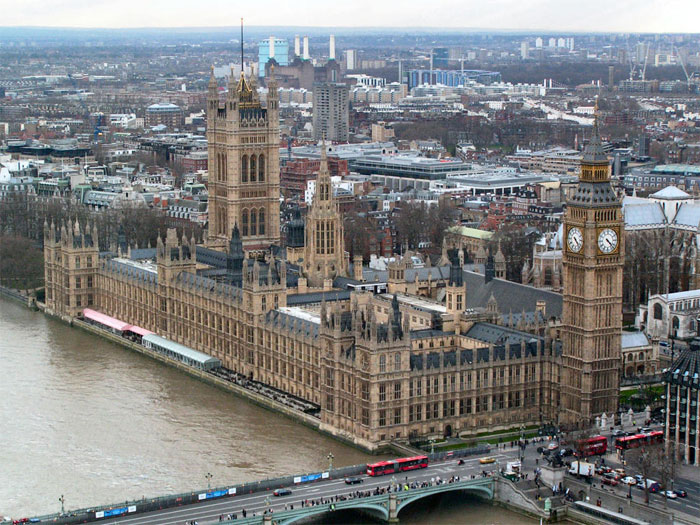
The architect of record was Sir Charles Barry, but Pugin did most of the detail work and decorating. Barry built the box, and Pugin did everything else.
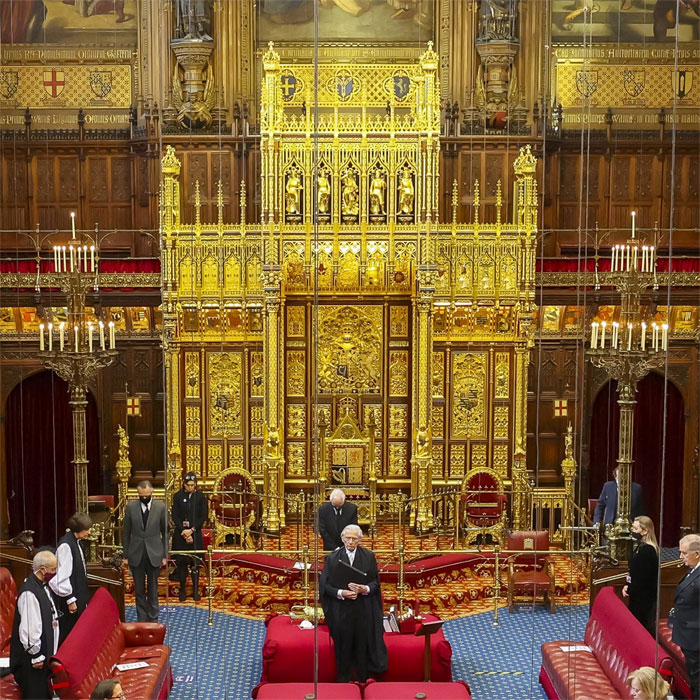
Pugin’s best work was probably in the House of Lords chamber, for which he had the rare honor of designing Her Majesty’s throne. Few chambers on earth can rival its stateliness.
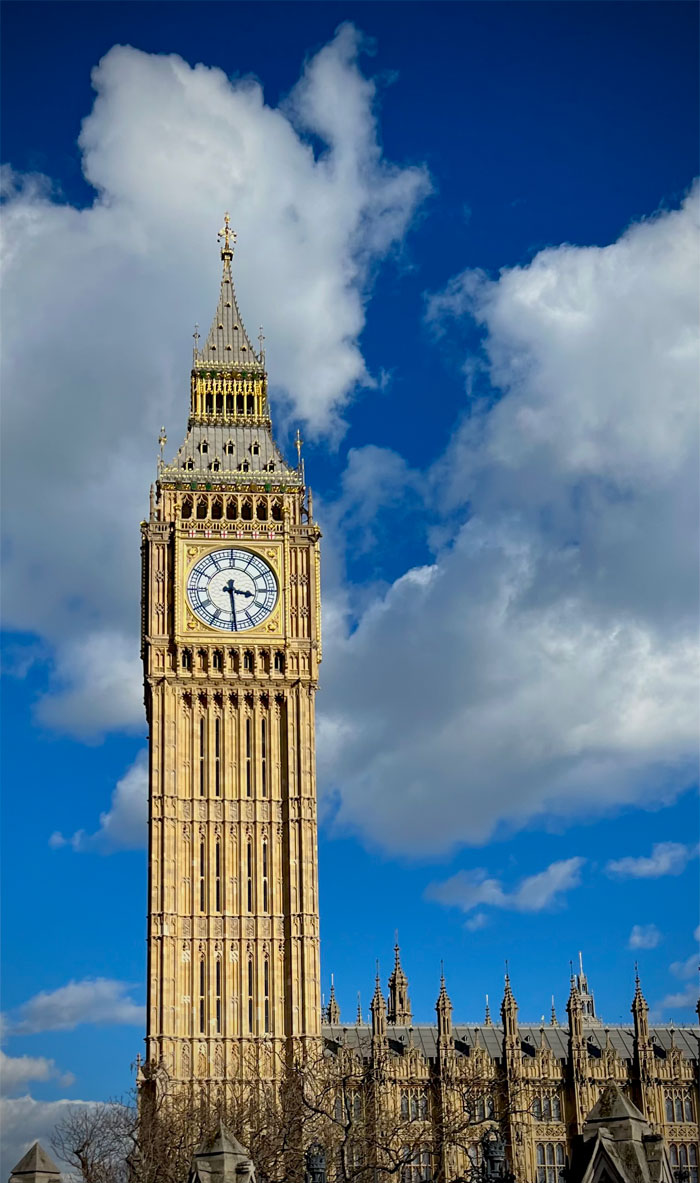
Undoubtedly, Pugin’s most famous design is the clock face of ”Big Ben” Perhaps the most magnificent aspect of this view is the amount of detail work that most of Pugin’s contemporaries, looking from the sidewalk, would never have seen clearly. Yet, to carry off the medieval ambience, Pugin knew that the detail must be present, just as he had seen and drawn it in the cathedrals he visited with his father as a boy.
The result is that a project that started as a mere clock tower became a symbol of the nation.
Pugin’s Death
Unfortunately, Pugin worked himself to death on the project and was too ill to attend the dedication. In a massively unjust move, Barry claimed all of the accolades and Pugin’s work went unnoticed for almost a century.
Pugin died on September 14, 1852, and is buried in a tomb in the Shrine of Saint Augustine, the church he constructed adjacent to his home in Ramsgate. Pugin’s son designed the tomb. Images of Pugin’s children are carved into the base, and his three wives are seen in the stained glass over the tomb.
It is a fitting setting for a man who did so much to promote a truly Catholic way of life.
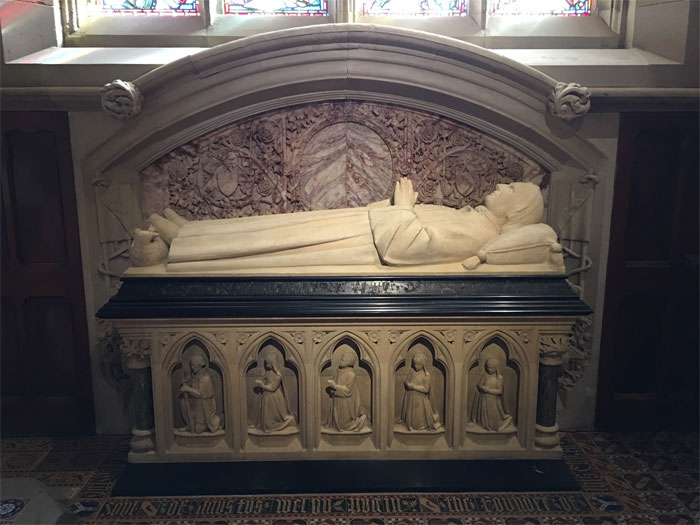
Photo Credit: © Andrew Dunn, CC BY-SA 2.0