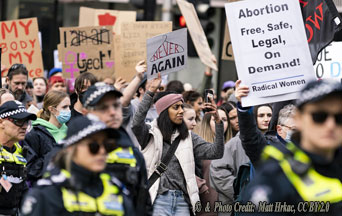
Is abortion a “settled” issue in Europe?
At first glance, it certainly seems so. In most European countries, the battle to decriminalize abortion was fought—and won—in the sixties and seventies. With the exception of Poland and a few tiny countries like Liechtenstein, abortion is widely available and often fully funded by taxpayers. Very few political parties in any European country seek to restrict abortion, much less recriminalize it. European conservative politicians, if they don’t already support abortion themselves, generally avoid the issue.
Public opinion polls show overwhelming support for abortion across all European countries. According to a 2024 poll by Pew Research Center, approximately 56% of Poles, 74% of Spaniards, 80% of Italians, 84% of Britons, 84% of Germans, 87% of the French, and 95% of the Swedish believe that abortion should be legal in either all or most cases. Support for abortion is generally higher among young people than among older adults. Pro-life associations in European countries, if they exist at all, are much smaller and less developed than in the United States. And the pro-abortion cause continues to obtain big victories in the past decade, including the legalization of abortion by plebiscite in the Republic of Ireland in 2018 and by parliament in Northern Ireland in 2020.
All true. But dig a little deeper, beneath the sound bites and slogans, and you’ll find signs of deep concern—even fear—about the future of abortion.
A telling example of this was a recent BBC article about the growing pro-life movement in the United Kingdom. More and more British young people are embracing pro-life views. American pro-life organizations, with their decades of expertise and deep financial resources, are also helping British pro-life activists grow their movement.
Christianity, particularly Catholicism, is a major reason for this shift. Since 2020, a significant and growing number of British young people have converted or reverted to Catholicism or more conservative forms of Protestantism. Many are on a search for meaning and certainties in a chaotic world, and they find it in the Catholic Church, with its 2,000 years of history. Catholicism has become especially attractive to many members of Generation Z. Some are calling this small but growing phenomenon the “Quiet Revival,” and it’s having real effects on the social and religious landscape of Europe.
Many young converts have been inspired by the fire and dynamism of American pro-life figures such as the late Charlie Kirk, whose assassination shocked young Christians on both sides of the Atlantic. His success and that of the American pro-life movement have led to the founding of British versions of American associations such as Turning Point UK, 40 Days for Life, and Alliance for Defending Freedom UK. These groups are taking pro-life activism to the public square to defend the rights of pro-lifers to express their views in public, to engage in sidewalk counseling, and above all to challenge the supposed consensus in public opinion that abortion is a settled issue.
The hope is that the UK pro-life movement can achieve big victories by making small but steady progress over the long term, just as in America. “After 50 years, they were able to help overturn universal access to abortion in the US,” one British professor observed. “These are people who play a long game.”
The growing feminist fear for this “long game” exploded into the public view after the June 24, 2022, US Supreme Court decision that overturned Roe v. Wade, which permitted individual US states to ban abortion. European reactions were a curious mix of confidence in having the upper hand on the issue, but fear that things might be beginning to change. The following day, French President Emmanuel Macron vowed to make France the first country in the world to enshrine the “right to an abortion” in the federal constitution. French Prime Minister Élisabeth Borne said, “For all women, for human rights, we must engrave this acquired right in stone.” Socialist Prime Minister of Spain, Pedro Sanchez, wrote that “we cannot take any rights for granted. Social achievements are always at risk of going backwards and their defense has to be our day to day.”
European governments and pro-abortion NGOs vowed to strengthen abortion “rights.” Still, they clearly expressed fear that the example from the United States is a mortal threat to abortion in Europe and around the world.
European countries passed a wave of new laws expanding abortion access. In March 2024, France put the right to abortion in its constitution by a vote of 780-72. One month later, the European Parliament voted 336-163 to approve a non-binding resolution calling for abortion to be added to the European Union’s Charter of Fundamental Rights. Since 2022, the UK, Germany, Spain, Denmark, Luxembourg, Norway, Finland and others have all reduced abortion restrictions and the legal gestation limit for obtaining one. Several countries, including England and Wales, Scotland, Northern Ireland, Germany and Spain, have introduced “buffer zones” which prohibit pro-life speech close to where abortions are performed.
Despite these victories, the pro-abortion left in Europe is more fearful than ever. In a 2025 study by Amnesty International, “When rights aren’t real for all: The struggle for abortion access in Europe,” warned against the “alarming attempts to roll back reproductive rights” taking place across the continent by “increasingly well-resourced anti-rights groups” seeking to restrict abortion. The feminist association My Voice My Choice was founded in April 2024 explicitly to fight back against the growing threats to abortion in Europe.
The BBC is also worried. Europe, of course, is very different from America. But there are signs that the pro-abortion “consensus” is not as solid as feminists would have people believe. According to one survey, less than half (46%) of British men aged 16-34 agree that abortion should be legal in all or most cases. A very large pro-life minority has little or no voice in European politics.
Just like in America, a small but well-organized and dedicated number of pro-life activists in Europe can activate this minority and cause real damage to the pro-abortion cause. In fact, many already have. TFP Student Action Europe, a Catholic university student association, has sparked intense controversy with its courageous street campaigns at universities across Europe, particularly in Germany, Belgium, and the Netherlands.
Numbers do matter, but as the pro-life fight in America has shown, numbers can change. Like most political issues, the fight over abortion is a fight between two small but dedicated groups. Whichever side demonstrates greater fervor and dedication will win. From the founding of Christianity to the Bolshevik Revolution, history is never decided by the majorities, but always by small but dedicated minorities.
European pro-life movements, with a little help from America, have an opportunity to achieve victories. But the first and most important victory, by far, is the shattering of the pro-abortion “consensus.” Once the average European realizes that Europe is divided, not united, on the issue of abortion, the feminist fight to defend abortion becomes much more difficult. It doesn’t matter how small a minority the pro-life movement may be. “These young people remain a minority in the UK,” the BBC article concluded, “but with Britain’s anti-abortion movement enjoying fresh blood and funding, Britain’s broadly pro-choice consensus is not guaranteed to last.”
Photo Credit: © Matt Hrkac, CC BY 2.0