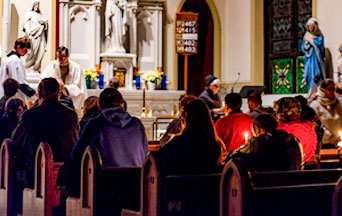
As the number of adult baptisms grows, many Catholics rejoice in the prospect of what is being called a quiet revival. It is a cause of great hope to see so many young people eager to learn more about the Faith.
It is also a cause of great mystery. The bishops have announced themselves confounded and “stymied” by the flood of new converts entering their churches this Easter. It does not fit into any new evangelization scheme. No one seems to have an explanation for why Catholicism, especially traditional Catholicism, is suddenly popular among Gen Z.
However, there are those who might be called revival skeptics. They are unsettled by what is happening. These critics downplay the trend as something interesting but not significant. Some adopt a wait-and-see attitude to avoid appearing exaggerated. Others warn of the danger of politicizing Catholic tradition, thereby questioning whether the spirit is really at work.
The more liberal (and progressive) the skeptics are, the more one senses fear in them. They fear this revival might get out of hand. Thus, they seek to explain away the revival and diminish its importance.
Numbers Game
The most common refutation of the revival is a numbers game. Although dioceses are reporting record numbers of conversions, the skeptics point out that for every enthusiastic new Catholic that enters the Church, many lukewarm members are leaving the Faith.
In the battle of numbers, the lapsed will eventually win, and the Church will inevitably shrink. The revival is hardly a game-changer.
The problem with the numbers refutation is that it assumes that all conversions are equal. It does not look at who is converting and why.
The Surprising People Who Convert
Indeed, the fact that lukewarm and often promiscuous Catholics without catechetical formation are leaving the Church in droves is no surprise—it is an ongoing trend since the Second Vatican Council. Such Catholics are the most likely demographic group to leave—and leaving they are.
What makes the conversion numbers extraordinary is that the least likely demographic groups are entering the Church. According to the liberal narrative, they are not supposed to be attracted to the Church—and yet they are.
They enter with contagious enthusiasm and energy, eager for instruction. One finds Muslims, non-Christians, pagans, atheists, leftists, youth, libertines, young men, celebrities, elites, scientists, philosophers and intellectuals. Major Protestant figures are also converting, shaking the foundations of many a congregation. Those who have everything to gain by staying with the establishment now want out. They want to tell their stories and evangelize the world.
Indeed, the numbers are not the most important factor in the revival.
Conversion for Benefits
A second way skeptics refute the idea of a revival is sociological. This method involves attributing conversions to economic or social factors. For these, conversion is almost a consumer choice driven by the benefits they will receive. A Pew Research report, for example, concludes that “more people begin to see the efficacy and the rewards of religious faith and practice.“
Thus, some not-very-good observers have labeled the conversion process as an “elite marker” and even a status symbol. They try to make the conversions understandable by affirming that people will find stability, risk mitigation and community in the Church, which in turn contributes to their prosperity and status as elites.
Even poor people can be attracted to the Church because the parish is a place to be “exposed to rich people,” which increases their chances of leaving poverty. Conversion opens up pathways to success.
Ross Douthat, from The New York Times, says that “going to church is increasingly associated with higher education levels, with ambition, and with upward mobility.” He thinks people will look back on these times as a “period of elite revival” in religion, not necessarily one of fervor.
Die-hard liberal Fr. Thomas Reese cautions against these conversions leading to a return to tradition: “Young people today say that they are interested in spirituality and are longing for community…. The Catholic Church has a rich tradition of spirituality, but it needs to do more than simply repackage old products. Contemporary spirituality needs to respect developments in psychology, science and culture.”
Forgetting God
The skeptics are forgetting one major character in the conversion process: God. They act as if He does not exist.
God is always the principal agent in any authentic conversion. His grace works inside the souls of those whom He calls. When the convert corresponds to this grace, the soul desires God with great fervor and is disposed to do anything to obtain unity with God, even to lose all material advantages and sever valued links with friends.
The converted soul becomes capable of overcoming obstacles, changing inveterate habits and accomplishing great things because supernatural grace is at work within.
What makes the present wave of conversions so spectacular is that it overturns all assumptions, demolishes liberal myths and rewrites narratives long considered untouchable.
Something extraordinary is at work, unsettling many people. It might even terrify those who have consigned religion to irrelevance. It scares the skeptics who do not want their complacent lives interrupted by this “something” they cannot define.
The Divine Touch
Everything indicates that God is acting in history, directly touching the most unlikely souls in the most secular of circumstances, calling them to reject modern and postmodern philosophies they had once so wholeheartedly embraced.
In his fictional-autobiographical book En Route, the nineteenth-century author J.-K. Huysmans presents the scene in which the principal character, Durtal, a liberal and promiscuous writer, unloads his heavy conscience to a wise old priest. Durtal relates how he came to the Church alone, without direction, after contemplating her sublime beauty while visiting churches. The priest is amazed.
“The way in which your conversion has worked leaves me in no doubt whatever. There has been what Mysticism calls the divine touch, only—note this—God has dispensed with human intervention, even with the interference of a priest, to bring you back into the road you have left for more than twenty years.“
Perhaps this is what the revival skeptics fear: this divine touch, working independent of the human agency, which changes everything. The prospect of this divine “something” may well terrify those who have given themselves over to sin and unbridled passion, although they face a loving God who only desires their good.
In a liberal world organized as if God does not exist, this divine touch does not fit. It cannot be explained. It should not exist and must not exist. However, as the skeptical Romans discovered, it can change the world.
First published in Crisis Magazine.