
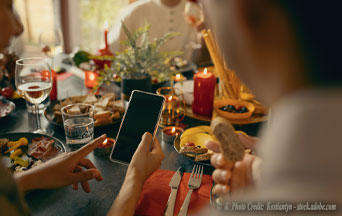
The dinner table was once a sacred space. The dining room was a domestic sanctuary where families and friends gathered to share meals, exchange ideas, and occasionally argue over politics and religion. Children learned first principles, manners and valuable life lessons from their parents that are rarely taught elsewhere. Today, however, this sacred space is often invaded by an uninvited, silent guest: the smartphone.
Chick-fil-A is fighting back against mixing meals and screens. It is offering a free IceDream cone when customers put their phones in the “cell phone coop.” This novel idea has sparked great interest among restaurateurs and is spreading quickly.
The Silent Brain Drain in Your Pocket
We like to think we can ignore our devices, but science suggests otherwise. A fascinating study from the University of Texas at Austin finds that the mere presence of your smartphone is enough to drain your brainpower—even if the device is turned off.
Researchers discovered that your cognitive capacity is significantly reduced when your phone is simply within reach. Why? Because a portion of your brain is actively working to avoid picking up the device. Indeed, our brains, still more powerful than artificial intelligence and Google, become exhausted by resisting the temptation to see what’s happening in the ether.
The Loudest Gesture in the Room
If our phones are quietly depleting our cognitive reserves, what are they doing to our relationships? Human communication is highly complex, with more than 55 percent of how we connect with others conveyed through nonverbal cues such as facial expressions, body language, gestures, posture, tone of voice and eye contact.
When you place your phone on the dining table, you send a clear, perhaps unintentional, message: You are only my temporary entertainment until a better notification comes along. Even if you genuinely intend to be present, your body language says the opposite. Putting the device out of sight is a fundamental act of respect. It shows that the person sitting across from you is more important than the internet’s infinite void.
A Culinary Rebellion
Fortunately, a quiet rebellion is brewing. While more than 80 percent of American families still gather around the table, only 25 percent manage to do so without digital distractions. Recognizing this, the dining industry is stepping in to save us from ourselves.
A growing number of bars and restaurants across the country are proudly declaring themselves phone-free zones. Patrons willingly lock their devices in specialized pouches that open only outside the dining area. Servers are ditching tablets to take orders by hand. The goal is to bring back the warmth of personal interaction. And people love it. More than half of Gen Z and Millennials, 40 percent of Gen X, and nearly a third of Baby Boomers are now actively seeking ways to intentionally disconnect while dining.
Fast Food and Deep Connections
One pioneer of this analog movement is a fast-food chain. To challenge modern cultural norms, Chick-fil-A restaurants in Georgia have introduced the “cell phone coop”—a small box placed directly on dining tables—and many more are following suit.
The challenge is simple: Families who successfully lock their phones away for the duration of their meal are rewarded with a free IceDream cone from Chick-fil-A. Over 200 locations have adopted this charming incentive, successfully trading digital isolation for a scoop of ice cream and a real conversation.
As President Ronald Reagan noted upon leaving office, all great change in America begins at the dinner table. Perhaps it is time to take up the challenge. The next time you sit down for a meal, leave your phone in your car. Strike up a conversation, ask a thoughtful question, or simply look out the window and enjoy the view. The internet will still be there when you finish dessert. Your dinner companions might not.
Photo Credit: © Kostiantyn – stock.adobe.com