
Russia doesn’t recruit foreign fighters for its war in Ukraine by telling the truth. It recruits them by lying—boldly, dishonorably, and without remorse. When the lies catch up with their victims, the result is beatings, brutal conditions, and casualty rates that defy comprehension. These men are sent to a front line that devours soldiers faster than the Kremlin can replace them, with a life expectancy of 20 minutes.
Faced with a struggling economy and a deepening manpower crisis ,Russian leader Vladimir Putin is running low on money, men, and p
ublic support. Another mass conscription of young men would be political suicide, so the Kremlin has quietly built a shameless machine that funnels desperate and uninformed young people into its military ranks through fake job ads—targeting victims in foreign countries.
Social media campaigns and human trafficking networks do the dirty work, keeping the front line fed without triggering the kind of domestic backlash that could threaten Putin’s grip on power.
It is a system built on lies. That is not an accusation. It is an accurate description. Here is how it works.
The Dishonest Pitch
In a shopping mall in Lima, the offer sounded almost too good to refuse: a security job in Russia, $4,000 a month, a $20,000 signing bonus and a fast track to Russian citizenship. For young men in need of money, the offer wasn’t just an opportunity—it was a lifeline. Hundreds said yes. Many never came home. At least 13 are dead, not as security guards or cooks, but as infantry soldiers in the front-line trenches under relentless Ukrainian drone fire. 1
The recruiters did not look like recruiters. They pretended to be overseas placement companies, advertising on Instagram, Facebook, Telegram and TikTok for security guards, chefs, mechanics, engineers and instructors—civilian roles, none of them near a battlefield.2
According to Percy Salinas, a lawyer representing roughly 120 Peruvian families, the network specifically targeted graduates of Peru’s armed forces and national police and was run by a mix of Peruvian, Colombian and Mexican intermediaries.
To stay ahead of investigators, the operation reportedly changed its name six times. After the first complaints surfaced, it changed its offers to include study scholarships and sports invitations—a cynical reinvention meant to slip past worried relatives who had begun asking inconvenient questions.3
Norma, the mother of a 31-year-old, said her son assured her he would work as a cook for the Russian army, far from the fighting. Rosa said her husband left, believing he would serve as a civilian security guard.4
Russian Deceptions
Across dozens of testimonies, the same pattern emerges with eerie consistency. Recruits met handlers in public places—malls, parks—and signed contracts written in Russian, a language the victims could not read, with no translation provided. They surrendered their passports, often told that it was the only document they would need. Days later, they were flown to Moscow.5
Upon arrival, the script flipped. Some were told they now “owed $20,000” in transportation costs. Their phones were confiscated. It turned out the Russian-language documents they had signed were military enlistment contracts with the Russian Ministry of Defense.6
Peru’s Foreign Minister Carlos Pareja put it plainly. These men believed they were headed for administrative roles, engineering positions, embassy security, hospitals, and civilian schools—only to discover, after signing, that the job was for front-line combat in the Russian army, with a training period of seven to fifteen days. They were promised one thing, but the papers they signed condemned them to the trenches with only seven to fifteen days of military preparation to meet battle-hardened Ukrainian soldiers!
One Man’s Story
One account cuts to the heart of just how brutal this deception is. Freddy, a Peruvian who traveled to Russia hoping for an IT job, said a Colombian acquaintance introduced him to a man who promised security work “in the Kremlin, in Moscow.” He was invited to a party, then woke up drugged in a moving car. Instead of the Kremlin, he found himself attached to Russia’s First Tank Army near Kharkiv.
“The promised job didn’t exist,” he said. “We were deceived.”
He described being repeatedly beaten each time he attempted to escape.
A separate case—widely reported—involved a 41-year-old Peruvian who told Ukraine’s 77th Separate Airmobile Brigade that he had traveled to Moscow as a tourist, lured by the promise of a high-paying civilian job. He was abducted, his documents were seized, and he was threatened with prison if he refused to sign military contracts. He was wounded in combat and escaped under fire, reached Ukrainian lines and urged citizens of other nations not to trust any of Russia’s false promises.7
He said Russia was shamelessly lying.
The Harsh Reality of Putin’s Failing Military
Instead of salaries, recruits described food shortages, a lack of medicine, punishment by Russian commanders and relentless Ukrainian drone strikes. Relatives described their loved ones being used as cannon fodder. Most never received the money they were promised—if they survived.8
A report by the International Federation for Human Rights (FIDH), Truth Hounds, and the Kazakhstan International Bureau for Human Rights found that foreign recruits are typically sent to the front within weeks of signing up and assigned to high-risk “meat assault” operations.
Of 16 prisoners of war interviewed, 13 said they had been told they would not have to fight—yet within weeks they were deployed to forward positions with inadequate training and weapons that barely qualified as such.9
How Widespread Is Russia’s Dishonorable Scheme?
The numbers are disputed, though they are alarming. Lawyer Percy Salinas estimates that at least 800 Peruvians may currently be fighting in Russian ranks, including about 600 recruited since October 2025. At least 13 are confirmed dead; 73 are missing.10
Ukrainian authorities say Russia has enlisted at least 27,000 foreign nationals from more than 130 countries since 2022, drawing on Central Asia, Africa, and South Asia. The focus is increasingly shifting to Latin America, where Cuba and Colombia are the largest sources of victims. The European Parliament has formally condemned the practice as human trafficking and forced labor.11
Lima Responds
In early May 2026, Peru’s Specialized Prosecutor’s Office for Human Trafficking Crimes opened a preliminary investigation based on at least 36 family complaints. The Russian embassy in Lima confirmed that Peruvians had signed contracts to join Russia’s armed forces—a statement notable for its casual indifference to the shocking circumstances surrounding those contracts.12
Peru’s Foreign Ministry says it has petitioned Moscow more than 240 times for information and for the safe return of its citizens. Eighteen deceived Peruvians returned home over a two-week period. But officials concede their leverage is limited. These men “voluntarily” signed contracts—after being lied to—and extracting anyone from an active combat zone is, in practice, nearly impossible.13
Is This Human Trafficking?
Under international law, human trafficking rests on three elements: the act (recruitment), the means (threats, fraud or deception) and the purpose (exploitation).
The first element is clearly met. Recruiters are actively identifying and transporting people to Russia to fight in Putin’s war.
The second is also met, and more troubling still. Intelligence reports describe false employment promises and deliberate concealment of what military service entails—textbook fraud.
The third element is less clear-cut, but no less damning. Human trafficking is not confined to sexual exploitation or conventional forced labor. Deceiving untrained civilians into armed conflict and pushing them into front-line positions is, by any reasonable measure, a form of forced labor.
And what awaits those caught in this trap makes it even more grim. There is no clean exit. Those who resist either return home in a body bag or face execution by Russian thugs for attempting to flee.
The Kremlin has built a machine that turns desperation into cannon fodder, disguising coercion as opportunity. For the men ensnared in this scheme, the realization of deceit comes too late.
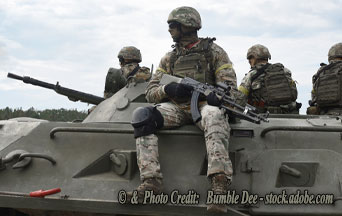
Photo Credit: © Bumble Dee – stock.adobe.com
Footnotes
- https://www.aljazeera.com/news/2026/5/2/peru-probes-trafficking-of-citizens-to-fight-for-russia-in-ukraine
- https://newsukraine.rbc.ua/news/russia-tricked-hundreds-of-peruvians-into-1782695507.html
- https://www.breitbart.com/latin-america/2026/04/28/report-peruvians-trafficked-through-false-russian-work-offers-to-fight-in-ukraine/
- https://focus.ua/uk/voennye-novosti/759156-peruanci-na-viyni-v-ukrajini-lyudey-zamanyuvali-do-rosiji-obicyankami-roboti
- https://newsukraine.rbc.ua/news/russia-tricked-hundreds-of-peruvians-into-1782695507.html
- https://www.breitbart.com/latin-america/2026/04/28/report-peruvians-trafficked-through-false-russian-work-offers-to-fight-in-ukraine/
- https://euromaidanpress.com/2026/04/16/peru-national-forced-into-russian-army-after-alleged-abduction/
- https://newsukraine.rbc.ua/news/russia-tricked-hundreds-of-peruvians-into-1782695507.html
- https://www.fidh.org/IMG/pdf/executive_summary_report_russia_s_exploitation_of_foreign_fighters_in_its_war_against_ukraine.pdf
- https://www.riotimesonline.com/up-to-8000-latin-americans-fighting-in-russian-army-against-ukraine/
- https://english.elpais.com/international/2026-04-29/cuba-and-colombia-the-main-recruitment-hubs-for-the-russian-army-in-latin-america.html
- https://kyivindependent.com/peru-launches-investigation-into-citizens-allegedly-trafficked-to-fight-russias-war-in-ukraine/
- https://www.pravda.com.ua/eng/news/2026/05/03/8032942/