
Introduction—On July 20, 2026, the U.S. State Department released the report “Cuba—The Capital of 21st Century Communism.” This hundred-page report took a long look at the history of the conflict between the United States and Cuba since Fidel Castro’s 1959 Revolution. In light of its importance, the TFP has prepared a four-part review of this report.
During the Advent season of 1991, certain Miami neighborhoods were buzzing with an excitement that had nothing to do with the upcoming Christmas festivities. The Soviet Union was disintegrating. Many Cuban refugees were certain that Fidel Castro’s fall would come soon after that of his Soviet patron. Many Cuban families looked forward to returning to la patria, deeds and other documents in hand, to reclaim all that they had lost in the years of communist rule.
Keeping Communism Alive
Then, amazingly, Cuba did not fall. In fact, it didn’t even seem to budge. The Castro regime appeared to be totally unaffected by events that many expected to spell its doom. If anything, that feat of survival lent a new dimension to the legend of indestructibility that Castro’s partisans had always nurtured. Once again, the impoverished island had proven itself impervious to massive world events.
About six months later, the founder of the Tradition, Family Property movement, Prof. Plinio Corrêa de Oliveira, rendered his opinion. He was a veteran observer of all things Revolutionary, and of communism in particular. His response was emblematic of his style, leaving no doubt about his intention while also employing a rich analogy with traces of the poetic.
“Imagine a submarine,” he began, “in which the periscope, besides its optical function, also serves as a snorkel which lets air in for those inside the vessel. Cuba, presently, is playing the role of the hypothetical periscope. The communist crew, submerged amid the waters of misery, feels diminished, disheartened and asphyxiated before the vision of the sinking of Russian communism. However, the existence of Castro’s Cuba brings oxygen to these lungs. In such a fashion that if communists breathe today it is because Castro breathes. And this is of great importance for the survival of communism.”
A New Revolutionary Model
In the spring and early summer of 2026, the United States Department of State—without knowing it—proved the point Professor Corrêa de Oliveira had made in July of 1992. That conclusion comes in the State Department’s report, titled Cuba—The Capital of 21st Century Communism. This document is worthy of scrutiny by anyone who wonders how the left gained such strength after being virtually moribund between Ronald Reagan’s first election in 1980 and the rise of the Democratic Socialists, starting about 2016.
The report does not waste time getting down to its work. It sets the tone in the first two paragraphs.
“For nearly seven decades, the Cuban regime has waged a sustained campaign of subversion against the United States. It is a campaign that has infiltrated the highest reaches of the U.S. government, recruited and cultivated generations of American activists, backed an unprecedented wave of left-wing terrorism on American soil, and carried out one of the most durable and damaging foreign intelligence penetrations in American history.
“The Cuban campaign against America is unique. It is irregular and covert—even at the peak of its military power, Havana never possessed the capacity to defeat the United States in a conventional armed conflict. Instead, the Cubans perfected a new model for a long war of attrition, organized around espionage, infiltration, sabotage, proxy networks, and a revolutionary infrastructure designed to turn America against itself.”
Underestimating Castro
It is almost as if Cuba were a cocoon, a retreat for the larvae of communism until it could burst forth as a fully developed specimen. To consider the cocoon’s construction, it is necessary—as with all aspects of modern Cuba—to look back to January 1, 1959 and Fidel Castro.
It was always easy to underestimate Castro. On Sunday, January 11, 1959, less than two weeks after his successful march into the Cuban capital, CBS television brought its cameras to Havana, where “Dr. Castro” was the guest on the network’s long-running series, “Face the Nation.”
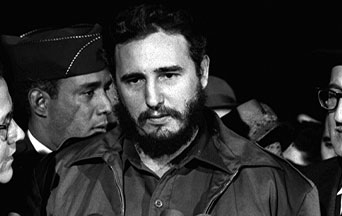
Dressed in his trademark shabby uniform and his scrawny beard, he presents himself as the earnest, soft-spoken servant of the people. In his halting, ungrammatical English, he salutes the importance of public opinion and a free press. “Public opinion in Cuba is now very strong and with a tremendous force. Nobody is enough powerful opposite now the public opinion of the free country of Cuba.” At one point, he smiles sheepishly as an apology for his poor English.
The image of the patriotic, almost pacifistic, young democratic leader would linger long in the American imagination. The further left the viewer was, the more vividly the image was imprinted in the mind’s eye. Seeing him this way makes it much easier to understand the mistaken point of view of so many American academics of the sixties, seventies and eighties who believed that Castro had started out as “a freedom-loving small-d-democrat” who had been forced to turn toward the Soviets because of American intransigence.
An Intentional Delusion
One of the report’s first important accomplishments is showing that this impression was always mistaken. Fidel Castro never wanted to be an ally of the United States. An excerpt from a 1958 letter that he wrote to his long-time paramour, Celia Sánchez, proves that point. “I swore to myself that the Americans were going to pay dearly for what they were doing. When this war is over, a much wider and bigger war will begin for me: the war that I’m going to launch against them. I am saying to myself that this is my true destiny.”
If the world underestimated Castro, he never made that mistake himself. He understood his role in the Soviet power hierarchy—manager of an often-ignored outpost of a patron that provided much-needed protection and occasional supplies. At the same time, he could revel in the support of U.S. and Western European “progressives.” As for the conservatives, he knew that the Missile Crisis had frightened the United States and that Washington would never run such a risk again. That combination gave him a position in which he could act with impunity in his backyard.
So, the Cuban leader gradually built networks connecting communists in almost every nation in Latin America. To South American Marxists, Castro was a hero—someone who had already achieved what they had only dreamed about doing. Their shared enemy was a grossly distorted vision of a repressive United States, the dreaded “Yankee imperialist regime.”
A Conduit into the American University
True to Revolutionary form, the exact nature of Yankee imperialism was never clearly defined. Such legends are more powerful when they remain hazy rather than being encumbered with “facts” that can be proven or disproven. As the report states succinctly, “Since its founding in 1959, the raison d’être of the regime in Havana has been the violent export of Communism abroad. But its true target—above any other momentary enemy—has always been the United States.”
Castro had many supporters in the U.S. Indeed, Castro’s most useful network was the one he developed there, an uninterrupted conduit into the heart of the American university. He knew about the liberal newspapers and magazines authored by leftist sympathizers, spelling out their admiration for a man they thought they understood.
The process by which Castro developed that network will be the focus of the next article in this series.