
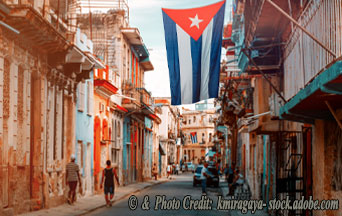
For over sixty years, Havana has offered the world one alibi for Cuba’s misery: El bloqueo, the American embargo. It is a marvelous excuse for its failure, since it keeps blaming a country ninety miles away. The evidence, however, proves the contrary.
Havana insists the American embargo starved the island. But Cuba trades with half the planet, can’t operate four of its five flour mills, and can’t pay for what it buys.
The embargo forbids Americans from trading with Cuba. It is real and it stings. However, it is not why Cubans line up for bread, why the lights go out for twelve hours a day, or why over a million people have fled since 2020.
The cause of Cuba’s poverty is the communist system, which measures progress not in dollars but in terms of class struggle and equality. Centrally planned socialist economies will never work like the free market. They will always function as a mechanism of class struggle to ensure equality.
A Country That Descended the Economic Ladder
Western defenders of Cuban communism tell the classic story of Cuba as an oppressed nation that rose up against its capitalist oppressors in 1959.
However, at that time, Cuba was not a starving nation but one of the wealthier societies in Latin America, with per capita income estimated at about 80 percent above the regional average. Today, that figure is far below the regional average—roughly $1,082 per capita, or three dollars a day. Compare that figure with the Latin American average of over $10,000.
Indeed, Cuba managed to accomplish the rare feat of descending the economic ladder while all its neighbors ascended. This is quite an achievement for a socialist system that promised “the masses” freedom from oppression.
The Experiment the Regime Can’t Explain Away
The alibi of the American embargo cannot explain the present misery. Economists have designed tests to help determine the cause. Using a synthetic control method, these economists have built what they call a “synthetic Cuba,” which plots the sharply divergent paths: the way similar economies in the region have gone and the way Cuba has actually gone since 1959.
When these studies isolate the embargo as a cause of the difference, they find it caused only a minor decrease. A study showing the fall in living standards in Cuba, the Bastos—Geloso—Bologna Pavlik paper estimates the embargo’s share of Cuba’s underperformance at roughly 3-8 percent and concludes that the communist revolution was the main driver of poverty.1
The U.S. Embargo Didn’t Close 80 Percent of Cuba’s Flour Mills
If the embargo is the cause of scarcity in Cuba, shortages would mirror the missing imports.
Instead, they reflect the failures of Cuba’s state monopolies.
Take bread, for example. In 2024, the state conglomerate announced a shortage “due to a lack of flour.” Wheat was available, but it could not be milled because only one of its five flour mills was operating.2 The state simply could not operate its own mills.
Washington does not operate Cuban flour mills.
The pattern is everywhere. Compared with 2019, domestic output of pork fell by 90 percent, cooking oil by 89 percent, fertilizer by 96 percent, and cement by 61 percent. Sugar, once the heart of Cuba’s economy, cratered from 8 million tons in 1989 to roughly 165,000 by the 2024—25 harvest—so feeble that China, a friendly buyer, canceled its standing order.3 Indeed, Cuba is importing sugar, which is the equivalent of Saudi Arabia importing sand.
These are collapses in domestic production on Cuban land, using Cuban labor and communist management. The embargo does not grow sugarcane. The communist state does, and it failed.
Cuba Can Buy from the World
One more inconvenient fact quietly demolishes the entire communist narrative. The embargo is an American measure; it cannot and does not prohibit the rest of the planet from trading with Cuba. Furthermore, Cuba can freely trade with every other country—Spain, China, Brazil, Canada, Germany and well over a hundred other partners.
Even the United States, which permits cash sales of food, shipped about $811 million in goods to Cuba in 2025, making it one of Cuba’s top suppliers.4 If Cuba can buy from half the world, including its enemy, why is it perpetually short on everything?
Because it cannot pay. It has no money because its communist system does not produce goods for export; it only promotes class struggle.
The value of its exports has collapsed to about $1.47 billion, near historic lows.5 A country that produces nothing sellable cannot import, no matter how open the world’s shelves are. As Carmelo Mesa-Lago, professor emeritus of economics and Latin American Studies, documented, Cuba’s export slump is due to “structural factors, mainly the inefficient economic system”—explicitly not the embargo.6
The Witnesses Live in Havana
Cuba’s independent economists, who have no fondness for Washington, admit this inconvenient fact. In October 2025, eight of the most respected Cuban economists said sanctions hurt but “are not the fundamental cause” of the present crisis, pointing instead to “the Island’s own political and economic system.”7 Even the Association for the Study of the Cuban Economy ranks the culprits in order: socialist central planning first, the Soviet collapse second, and the embargo third.8
The Alibi has a Job to do
Thus, the regime guards the embargo excuse (lie) so jealously. It even embellishes its claims, asserting that GDP would otherwise have grown by 9.2 percent. As a European Parliament briefing dryly noted, the government came to depend “politically on the U.S. embargo,” which supplied “the image of an enemy” to rally the public. The blockade is not merely the alibi the regime uses; it is the asset the regime cannot afford to lose because it reinforces its class-struggle narrative.
The Verdict
None of this makes the embargo painless—leftists call it cruel and counterproductive. But the evidence reveals the real culprit behind the crisis. Cuba was prosperous and made itself poor. It can trade with the world yet cannot produce anything to sustain that commerce. Its own economists accuse the communist regime of causing the very problem it is accused of creating by the U.S.
The embargo is the excuse. Communism is the cause.
Photo Credit: © kmiragaya – stock.adobe.com
Footnotes
- https://papers.ssrn.com/sol3/papers.cfm?abstract_id=5235912
- https://cubacenter.org/cuba-brief-archives/2024/03/07/cubabrief-how-communist-central-planning-creates-shortages-of-flour-and-milk-in-cuba-today-2/
- https://www.cato.org/blog/cubas-self-induced-crisis-may-be-its-worst-yet
- https://ustr.gov/countries-regions/americas/caribbean
- https://tradingeconomics.com/cuba/exports
- https://ics.fiu.edu/_assets/docs/cuba-economic-crisis.pdf
- https://translatingcuba.com/eight-independent-economists-comment-on-the-effects-of-the-us-sanctions-on-cuba/
- https://ascecubadatabase.org/asce_proceedings/cubas-new-agricultural-cooperatives-and-markets-antecedents-organization-early-performance-and-prospects/