
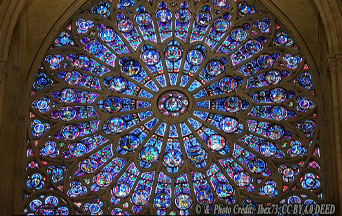
There is something profoundly unacceptable in the Notre-Dame stained-glass window affair: an appalling alliance to impose the ideological mark of modernity on the historic cathedral in Paris that was recently restored.
The powers that be want to change a sector of windows from the nineteenth century with modernistic ones. On one side stands the political power, represented by Emmanuel Macron. The French President wants to stamp “the twenty-first century” on Notre-Dame. On the other hand, the diocesan authority, Archbishop Laurent Ulrich of Paris, refuses to defend the sacred and patrimonial integrity of the cathedral. He is complicit in this act of desecration.
Thus, the spiritual, artistic, and national heritage of Notre-Dame, which should be protected with upmost care, becomes the object of a contemporary experiment. It is an attempt at disfigurement, not only from an aesthetic perspective but also from a symbolic one.
Faced with this offensive, Catholics and historic preservation advocates are now engaged in a fight to keep Notre-Dame whole. This is not simply a matter of a few stained-glass windows. The question is whether Notre-Dame will still reflect the Christian soul of France. Will it be surrendered to the combined whims of the government and ecclesiastical hierarchy seduced by the spirit of the world?
France’s Sites & Monuments Association will challenge the authorization for the work in court. The petition launched to preserve Viollet-le-Duc’s stained-glass windows at Notre-Dame has already gathered over 342,000 signatures, making it the most-signed heritage petition in the world. It can be signed here:
https://www.change.org/p/conservons-%C3%A0-notre-dame-de-paris-les-vitraux-de-viollet-le-duc
——————————–
The controversy is indeed tragic in light of the cathedral’s restortoin. Who can forget April 15, 2019? Paris nearly lost its cathedral. The whole world wept, first with grief, then with relief. Alas, Notre-Dame’s ordeal was not yet over. Driven by an unscrupulous opportunism, the President of the Republic attempted to impose a “contemporary” look on the plans for the reconstruction of the roof and spire.
Prime Minister Édouard Philippe quickly announced the launch of an international architecture competition. Immediately, prestigious architectural firms proposed outlandish projects: a glass spire, a suspended vegetable garden, even a swimming pool. Every conceivable absurdity was considered. Faced with this horrible prospect, an international petition was launched, spearheaded by a dozen associations, including Avenir de la Culture. The effort alone resulted in nearly 150,000 signatures.
Cornered by public pressure, Emmanuel Macron backed down. Notre-Dame Cathedral was rebuilt exactly as it had been originally. An immense crowd, including heads of state from around the world, were present when it was reopened on December 8, 2024. Since then, a constant stream of visitors has thronged beneath its ancient vaults. Eleven million visitors were recorded in one year.
Leaving the Mark of the Twenty-First Century
The President of the Republic has now shifted his ambition. At the improbable request of the Archdiocese of Paris, he plans to leave his mark and that of modernity on the building with some new stained-glass windows. On December 8, 2023, two years before the cathedral’s reopening, the head of state publicly announced his plan to remove a section of Eugène Viollet-le-Duc’s stained-glass windows and replace them with contemporary creations. Emmanuel Macron declared at the time that he aimed to leave “the mark of the twenty-first century” on Notre-Dame.
Two days earlier, according to press reports, Archbishop Laurent Ulrich had written to the Élysée Palace. In the letter, he requested the commissioning of six new stained-glass windows for a side chapel to mark the rebirth of Notre-Dame. On December 18, the Élysée Palace and the Archbishop of Paris announced the selection of artist Claire Tabouret and the Simon-Marq workshops to create the new windows. In this action, they followed the recommendation of the artistic committee chaired by Bernard Blistène, former director of the Centre Pompidou.
Strong disapproval from experts
As soon as it became known, the project sparked almost unanimous disapproval from preservation experts. It broke the preservation principles that France has pledged to uphold. Article eleven of the Venice Charter of 1964, the foundational text of international preservation doctrine, ratified by France in 1965, specifies that “the valid contributions of all periods to the construction of a monument must be respected.” In other words, an intact historical element cannot be removed to make way for a new creation.
The fire did not destroy Viollet-le-Duc’s stained-glass windows. They were preserved and then restored. When the idea of replacing them was raised in November 2020, the former Minister of Culture, Roselyne Bachelot, herself ruled it out. “The stained-glass windows are an integral part of the monument.”
More recently, the National Commission for Heritage and Architecture met on July 11, 2024, and unanimously issued a negative opinion. It deemed these stained-glass windows an integral part of the cathedral’s architecture and argued that their replacement violated historic preservation doctrine. Didier Rykner, director of La Tribune de l’Art, denounced the decision as “vandalism of a historical monument” and a politically motivated decision imposed against the advice of experts.
An Extremely Dangerous Precedent
Beyond the specific case of a few stained-glass windows, a much more serious principle is at stake. If a political or ecclesiastical power can arbitrarily leave its mark upon a building by removing perfectly preserved historical elements and replace them with contemporary works, then what limit remains?
If stained-glass windows can be replaced at will, authorities might also remove the choir stalls, sculptures, murals or even an entire chapel tomorrow. The unity patiently crafted over centuries is destroyed if each era feels entitled to inscribe its whims upon it. A historical monument is not a blank canvas offered to the aesthetic ambitions of the present. It is a legacy received.
Historic preservation law exists to prevent this fragmentation. It protects monuments against the arbitrary actions of power. By the modernizers’ logic, each generation could claim its right to “update” Notre-Dame according to its own codes, fashions and obsessions.
The Unsettling Aesthetic of Claire Tabouret
The choice of Claire Tabouret as the window maker adds further controversy. This artist has built a body of work marked by explicitly erotic scenes, including those between people of the same sex.
When the Élysée Palace and the Archbishop’s office officially announced their choice, the theme of the window project was presented as a reinterpretation of Pentecost. When the full-scale models were unveiled at the Grand Palais in December 2025, it became obvious that the new art clashed with the Gothic balance of the cathedral. The design’s floating silhouettes, expressionistic features, dense chromatics and narrative composition are far removed from the architectural sobriety intended by Viollet-le-Duc.
Where Gothic stained-glass structures serve to elevate the spirit and unify the space, Tabouret’s proposals impose a separate language, immediately identifiable as that of a contemporary artist. The goal is no longer the blending of the artwork and the cathedral but rather having the artwork leave its mark on the monument.
A Stone Bible
Notre-Dame is far more than a building: it is a hymn of praise in stone, a symphony of faith and reason that lifts the soul to the infinite. From its twelfth-century foundations, it was conceived as a temple of light and prayer by Abbot Suger of Saint-Denis, the father of Gothic art. Every stained-glass window, every tower, every elevation points towards Heaven, lifting the soul to God and telling the Gospel through its imagery. Notre-Dame is a Bible in stone, designed to teach the faith to generations to come.
Its rose windows, sculptures, and arches impress not only by their beauty but also as living witnesses to a spiritual heritage that transcends centuries. Contemplating Notre-Dame, no one remains unmoved by this unique harmony between reason and beauty. Everything in this work speaks of a profound balance between rigor and wonder.
A Church of Perfect Beauty
Plinio Corrêa de Oliveira describes Notre-Dame in this manner: “Notre-Dame possesses the foundation of seriousness and the full development of wonder. It is fundamentally serious, planned according to the best rules of calm and reflective reason, achieving something of great grandeur. […] Now, in addition to this art and this reason, a dream has appeared: the building is a dream. And this dream is its capacity to evoke wonder in viewers, even in the smallest things. There is not a gargoyle that is not marvelous.”
This cathedral is not simply a tribute to art or history. It is an act of love for God and the Blessed Virgin, whose glory shines forth in every stained-glass window and every sculpture. Plinio Corrêa de Oliveira added: “Notre-Dame is a church of perfect beauty, the joy of the whole world.” As Marcel Dufour noted, “Gothic cathedrals are also reminders of our eternal destiny.”
Revolutionary France and the France of Saint Louis
The new stained-glass windows allow an unholy modernity to penetrate the very heart of Notre-Dame. This operation is a joint effort of Emmanuel Macron and Archbishop Laurent Ulrich. This strange reenactment of an unholy alliance between throne and altar no longer serves Heaven, but the world.
All too often, contemporary art is the antithesis of sacred art. It is egalitarian, secular and focused on the material world. It represents the notion of deconstruction. Notre-Dame is today at a crossroads, as is France itself. Will it plunge into postmodernity to the point of losing its soul, or rise again?
The France that is faltering is also the France that is converting. Never in decades have so many adults asked for baptism. How many new Paul Claudels still await grace in the shadow of Notre-Dame’s pillars? Modern France is the country of the Revolution. If France converts, it could become the country of the Counter-Revolution.
The mobilization of Avenir de la Culture and the petition launched by Didier Rykner, with over 342,000 signatures, prove that the France of Suger and Saint Louis continues to speak to souls. As Saint Joan of Arc declared, “The men-at-arms will fight, and God will grant victory.”
Sources:
https://www.latribunedelart.com/vitraux-de-notre-dame-un-mensonge-d-etat
Notre-Dame stained glass windows: the fight continues! – La Tribune de l’Art
https://www.clairetabouret.com/en/works-drawing
https://www.clairetabouret.com/files/media_file_907.pdf
https://entrevoirart.blogspot.com/2019/09/claire-tabouret-if-only-sea-could-sleep.html
https://dioceseparis.fr/interview-de-mgr-laurent-ulrich-64263.html