
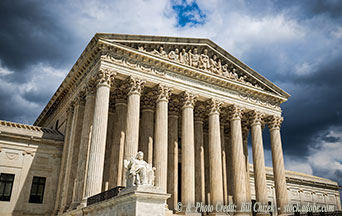
On April 21, 2026, the U.S. Fifth Circuit Court of Appeals, adjudicating en banc, issued a narrow 9-8 ruling in Rabbi Nathan v. Alamo Heights Independent School District upholding the constitutionality of the Texas law (S.B. 10) mandating the posting of the Ten Commandents in Texas public school classrooms.
The ACLU plans to appeal the case to the Supreme Court of the United States. I pray that SCOTUS accepts to hear it. Here’s why.
Few of us know that the Supreme Court changed the relationship of Church and State in 2022. The left is happy to leave us in the dark because they don’t like the change. Many people recall the case, Kennedy v. Bremerton School District, in which a high school football coach won the right to pray after each game.
Most people don’t know that the case’s importance went far beyond that man. Press stories focused on the nice older man. They didn’t explain that his case marked the first significant use of a new method of evaluating the relationship between Church and State, one that should be far more cordial than the old “separation” doctrine. The situation is a bit complicated, and its importance is just now becoming understood.
An Imaginary Wall
Many people believe that the phrase “separation of Church and State” is in the Constitution. It is not. It appears in a letter from Thomas Jefferson to a group of Connecticut Baptists in 1802, fourteen years after the Constitution took effect.
The First Amendment to the Constitution, the only part of the document that refers specifically to religion, states,
“Congress shall make no law respecting an establishment of religion, or prohibiting the free exercise thereof; or abridging the freedom of speech, or of the press; or the right of the people peaceably to assemble, and to petition the government for a redress of grievances.”
The Lemon Test
Since 1971, the most common application of the First Amendment in public schools has been known as “The Lemon Test.” Its tart title came from the fact that the Supreme Court devised it in settling the case of Lemon v. Kurtzman.
The Lemon Test had three parts. The first was that any official action, law or policy had to have a secular purpose. The second was that the action could not be primarily intended to advance or inhibit religion. The third was that it couldn’t create “an excessive entanglement with religion.”
However, meeting that standard was far more complicated than the test’s relatively simple language implied.
Lemon in the Classroom
During my thirty-four years teaching history in public high schools, I often needed to reflect on the line between teaching religion and teaching about religion.
As a teacher, the Lemon Test allowed me to explain religious events that directly applied to the material. I could discuss the role of Catholic priests in Medieval life and the Puritan settlers of Massachusetts’ religious motives, among others. Both topics were essential to understanding the history I was responsible to teach. Therefore, those inclusions served “a secular purpose.” On the other hand, I could not discuss my belief in Catholicism and rejection of Puritan Calvinism; that discussion ran the risk of “an excessive entanglement.”
If the rules were this complex in a single classroom, readers can easily imagine the difficulty of interpreting them nationwide. The patchwork gradually became so complex that Lemon became virtually inoperable. In 1993, a frustrated Justice Antonin Scalia described Lemon as “some ghoul in a late-night horror movie that repeatedly sits up in its grave and shuffles abroad, after being repeatedly killed and buried, Lemon stalks our Establishment Clause jurisprudence once again, frightening the little children and school attorneys.”
Squeezing the Lemon
Yet, Lemon remained the law of the land, enforced in every public school. Leftists rapidly sprang to its defense whenever it was challenged. It was an integral brick in their precious “wall of separation.”
The Kennedy case, referred to earlier, brought down Lemon. Most people interpreted Kennedy as a free speech case because the press largely reported it that way. The lawyers, though, argued about the establishment of religion. The official decision runs thirty-five pages of rather dense legal jargon. However, on page twenty-two, a sentence depicted the Lemon test as a dead letter.
“[T]he ‘shortcomings’ associated with this ‘ambitiou[s],’ abstract, and ahistorical approach to the Establishment Clause became so ‘apparent’ that this Court long ago abandoned Lemon and its endorsement test offshoot.”
To replace the Lemon test, the Supreme Court sent instructions to lower courts that they were to interpret such cases through “reference to historical practices and understandings.”
The New Test Is Applied to the Texas Ten Commandments Law
The Fifth Circuit Court of Appeals, which has jurisdiction over Louisiana, Mississippi and Texas, offered a first look when it ruled in favor of a new Texas statute, dubbed S.B. 10, that requires public schools to display the Ten Commandments in each classroom.
Instituting the “Historical Practice” Test Rules
To apply this “historical practice” test, the Fifth Circuit first considered the prevailing ideas of those who wrote and ratified the Amendment in 1791. Since the United States began as thirteen British colonies, the court reasoned that the writers of the First Amendment had the Church of England in mind. Under that system, the government constructed the buildings and paid the clergy, who followed rules set by the King and Parliament. The Establishment Laws set penalties for non-observance.
Having studied the history, the Fifth Circuit Court then applied it. It found that “S.B. 10 looks nothing like a historical religious establishment. It does not tell churches or synagogues or mosques what to believe or how to worship or whom to employ as priests, rabbis, or imams. It punishes no one who rejects the Ten Commandments, no matter the reason. It levies no taxes to support any clergy. It does not co-opt churches to perform civic functions. These are the kinds of things ‘establishments of religion’ did at the founding. S.B. 10 does none of them.”
Therefore, the court reasoned, the Texas law is constitutional and the Lone Star State may proceed to display the Ten Commandments.
A Potentially Potent Weapon Against Radicalism
Of course, the left disagrees with the shift. The old “Lemon Test” was far more restrictive. Once again, those who depended on the old “wall of separation” faced a bitter defeat.
For more conservative parents and others who are trying to breathe a bit of sanity into the nation’s public schools, this is an opportunity. However, relatively few people know about it. The vast majority of teachers and administrators were trained extensively in the Lemon Test and its implications, as this author was during the eighties and nineties. Given the lack of press interest in the new test, many of them likely still think that Lemon is the settled law of the land. Those who face off against these denizens of public education will likely need to come equipped with the sort of information this article contains.
The implications of how the Supreme Court’s Kennedy decision jettisoned Lemon are only now becoming apparent, and it is an exciting new time for those who understand that separating education and morality is foolish.
Photo Credit: © Bill Chizek – stock.adobe.com