
Reading the recent report of the Synod on Synodality’s Study Group No. 7 on the selection of bishops reminded me of a rather memorable, let us say, fairly tumultuous episode that took place in the parish of my adolescent years in Chile.
It was May 1969, six months after the occupation of Santiago, Chile’s cathedral by a group of Catholic-communist activists, supported by eight priests. Its banner read, “For a Church on the side of the people and their struggle.” The group had christened itself “Young Church” (Iglesia Joven). Indeed, the era had a certain fondness for ambitious self-designations. At that time, it had decided to make another dramatic gesture to advance its demands.
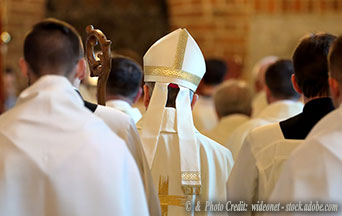
The occasion was the consecration of a new auxiliary bishop for Chile’s capital. The ceremony was celebrated in the very fashionable parish of the Sacred Heart. “Young Church” activists stormed the nave. They interrupted the ceremony, reading a manifesto denouncing the authoritarianism with which the Roman Curia imposed the appointment of bishops and demanding popular participation in their election.
The disrupters expected nothing less. They even called for the suspension of the episcopal consecration “as a sign of protest on the part of the Church of the marginalized of the diocese against a structure that isolates them, and as a sign of a new stage in the journey of Christians through history.”
The incident caused mayhem. The faithful protested, and many bishops present were bewildered. The ordinand, incidentally a highly progressive cleric, begged the protesters to stop the scandal that would “destroy the happiest day of his life.” Fights broke out, and the members of “Young Church” were eventually punched out of the church. It was a particularly lively liturgical atmosphere, one might say.
Catholic Chile was stunned, while the official newspaper of the Communist Party praised the event as “a spectacular protest” carried out by groups seeking “to obtain greater democratic participation in the conduct of its own destiny,” in opposition to “the castes that benefit from the status quo.”
At the time, I myself interpreted these events through that rather fashionable socio-political lens. It was only a few years later, upon reading Church, Charism, and Power (1981) by liberation theologian Friar Leonardo Boff, that I grasped the ecclesiological significance of the scandal. There one could read: “At the beginning, Christians participated in the power of the Church, in its decisions and in the election of its ministers; later, they were merely consulted, and finally, in terms of power, totally marginalized, and deprived of a capacity they once possessed. Alongside the social division of labor [bourgeois v. proletarians], an ecclesiastical division of religious labor was established. A body of officials and experts was created, tasked with safeguarding the religious interests of all through the exclusive production of symbolic goods [the sacraments] intended to be consumed by a people now dispossessed.”
According to this logic, “Young Church” was only demanding, in the name of the fundamental equality of all the baptized, that an unjustly confiscated right be restored to the People of God.
To this egalitarian interpretation of the texts of Vatican II, John Paul II and Cardinal Joseph Ratzinger responded at the 1985 Synod of Bishops with the formula of an “ecclesiology of communion,” seeking to reconcile the charisms and new ministries that the council ascribed to the laity with the hierarchical powers linked to Holy Orders instituted by Christ. It was an attempt at compromise, an exercise that is rarely successful in Church history.
Revolutionary movements are rarely satisfied with intermediate solutions. Beginning with the pontificate of Pope Francis, demands for the appointment and oversight of bishops by the faithful were thus revived in the name of “synodality.”
Thus, the Final Document of the Sixteenth General Assembly of the Synod of Bishops called for a review of the criteria for selecting episcopal candidates and “to expand consultation with the faithful People of God, and to involve a greater number of lay people and consecrated persons in the consultation process.”
Regarding the selection of candidates, Study Group No. 7 recalls that, according to Vatican II, bishops “are called to listen to the lay faithful, to make use of their counsel, to recognize their ministries and charisms, and to entrust them with responsibilities for the good of the Church.” Hence comes the need to consider the “synodal competencies” of the candidates.
This new method of discerning candidates moves quite noticeably away from the traditional model of the shepherd chiefly concerned with the faith and morals of his flock. “Synodality” seems instead to require that candidates have the qualities of a well-trained corporate CEO: “Openness to complexity, a disposition toward innovation, the ability to adapt to new situations, a deep knowledge of local cultures, and a willingness to integrate into them constructively.” The next bishop may also need some training in crisis management and collaborative leadership.
As for apostolic nuncios, those intermediaries between Rome and the local Church, the new report recommends that these might also be selected, with the prospect of eventually welcoming lay men and women into their ranks, based on “their willingness and ability to carry out their responsibilities in a synodal style” and an “appropriate experience in ecclesial discernment” through listening.
Regarding the actual selection of candidates, the Study Group suggests major changes. The prior method consisted of having the bishops of an ecclesiastical province draw up a list of three names to be sent to Rome, the terna. Study Group No. 7 recommends that the bishop should now convene the presbyterial council and the diocesan pastoral council and ask all their members (including the laity, naturally) to submit, in sealed letters, the names of priests in the diocese whom they judge suitable for the episcopate. A sort of discreet consultation, ecclesiastical style.
The group would widen the circle even further—for apparently, one can never consult quite enough people. The texts say, “Where circumstances allow, the cathedral chapter, the diocesan finance council, the lay council, the unions of consecrated men and women, and diocesan groups that institutionally represent youth and the poor should also be convened.”
When the episcopal see of the local Church is about to become, or already is, vacant, the report suggested that a Committee for the Governance of the Local Church should be established. It should include two diocesan priests elected by the Presbyteral Council, two consecrated persons (one man and one woman), and two lay persons (one man and one woman) elected by the diocesan pastoral council. Where applicable, the diocesan administrator or apostolic administrator joins the body.
From that point onward, the nuncio should rely on this committee to clarify the situation of the diocese, define the profile of the future pastor, and, of course, gather opinions regarding potential candidates. Simultaneously, the apostolic nuncio consults the bishops of the ecclesiastical province to activate a circular process between them and the local Church at the different stages of the inquiry. At this point, one could almost speak of a multi-level participatory governance model.
To this already highly democratic, and rather sophisticated, mechanism, the nuncio must further add consultations with other informants: “not only clergy but also a possibly equivalent number of consecrated persons and laity, avoiding risks such as clericalism, politicization or polarization of views, and familial, tribal, or ethnic influences.” Informants should include “a suitable number of women and young people, representatives of ecclesiastical universities and faculties, members of ecclesial movements, individuals recognized for special charisms, the poor and marginalized, and members of indigenous communities or ethnic/linguistic minorities.”
The report calls for caution on the part of those responsible for the process. The Church must certainly not become self-enclosed. Openness to the world—and especially to the peripheries—remains essential: “It is also possible to hear from individuals representing civil society and the cultural sphere, as well as those who do not profess faith or have left ecclesial practice.” As one particularly lucid observer remarked, it might perhaps be better to choose the bishop by lot; at least then there would remain some little possibility of leaving room for the intervention of the Holy Spirit.
As is well known, the Chinese Patriotic Church—under the vigilant supervision of the Chinese Communist Party—organizes elections in which priests vote to fill vacant episcopal sees. In this, it follows the model established by the Civil Constitution of the Clergy, which organized the schismatic church born of the French Revolution. However, the French revolutionaries went much farther by expanding the electorate for the selection of parish priests to include all citizens, even non-Catholics. When it comes to inclusivity, there seems to be no limit.
The somewhat labyrinthine system of exhaustive consultations devised by Study Group No. 7 has certainly not gone quite that far. Yet one must admit that it has already done a fair amount of egalitarian clearing of the ground in that direction.
Photo Credit: © wideonet – stock.adobe.com