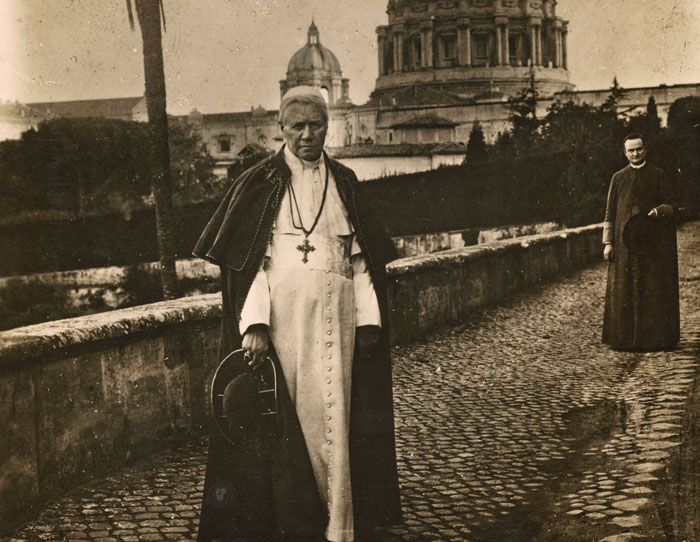
Pope Pius X was elevated to the papacy on August 4, 1903. He faced a challenging prospect.
An intellectual revolution, begun in the days of the pseudo-Enlightenment, was continuing, spreading and intensifying. It threatened to sweep away the Church and much of Western Christian society. He knew that the Roman Pontiff was one of the few men on Earth who could stand against the crashing wave he called modernism.
To Renew All Things in Christ
Two months after his elevation to the papacy, he fired off the first salvo in his crusade against modernism in his encyclical E Supremi. In the document, he established the phrase that would be the theme of his pontificate, “To renew all things in Christ.” The phrase was, simultaneously, his motto and his greatest desire.
That word “renew” deserves special notice. For Pius, the great need facing the Church as the twentieth century dawned was not exploration or finding new directions, but to restore that which had been lost. The Protestant and French Revolutions had devastated humanity. Repairing that damage required bringing mankind back to a real relationship with God through the truths of the Faith.
Scholars, both during and since the Second Vatican Council, present Pope Pius X as unique. If they regard him at all, they perceive a singular character disfigured by a fetish that reflexively resisted anything new. This is a blatant falsehood. He was, perhaps, modernism’s greatest enemy, but he was part of a long line. The works of his predecessors – especially Gregory XVI and Pius IX – prepared the way. His successors, Pius XI and Pius XII, were inconsistent, but generally carried on the line.
Humanity’s Pursuit of Novelty
Of course, this admirable Pope lost little time in enlisting Our Lady into the battle. Four months after E Supremi, Pius published Ad Diem Illum Laetissimum, which explained that “through the Virgin, and through her more than through any other means, we have offered [to] us a way of reaching the knowledge of Jesus Christ.”
The key year, however, in Pope Pius’s crusade against modernism is 1907.
On July 3, 1907, Pope Pius published “Lamentabili Sane Exitu.” The opening paragraph spelled out the overall problem as the Pope saw it.
“Our age, casting aside all restraint in its search for the ultimate causes of things, frequently pursues novelties so ardently that it rejects the legacy of the human race. Thus, it falls into very serious errors, which are even more serious when they concern sacred authority, the interpretation of Sacred Scripture, and the principal mysteries of Faith. The fact that many Catholic writers also go beyond the limits determined by the Fathers and the Church herself is extremely regrettable. In the name of higher knowledge and historical research (they say), they are looking for that progress of dogmas which is, in reality, nothing but the corruption of dogmas.”
The Pope then proceeded to list sixty-five errors, all of them expressing the mistakes and deceptions of modernist pseudo-scholars.
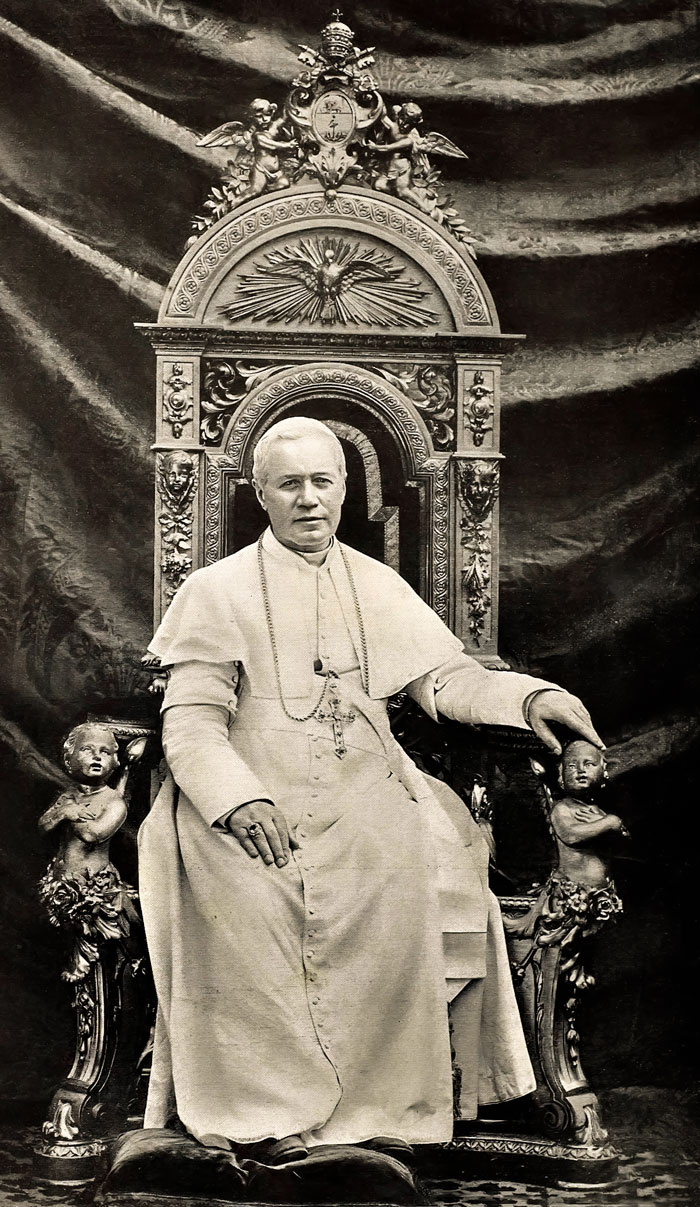
Naturalism, the Philosophy Behind Modernism
Lamentabili Sane Exitu, however, was only the prelude for the far more crucial Pascendi Dominici Gregis – usually referred to in the English-speaking world as “On the Doctrines of Modernism.”
This encyclical is somewhat challenging to read (and even more difficult to briefly summarize), presenting a philosophical refutation of a pernicious idea.
The Pope saw that modernists disregard the supernatural, reducing all knowledge to that which is experienced through the senses. This theory is sometimes called naturalism. This assumption automatically excludes God, rendering Him unknowable because one does not experience Him through sight, hearing, smell, taste, or touch. If God is unknowable, then any belief in the supernatural cannot be factual. It must be something less. Pope Pius used the term sentiment. It could also be called emotion.
The Role of Sentiment
Of course, sentiments or emotions are utterly unreliable. They are subject to a range of factors, including whims, moods, alertness, fatigue, euphoria, pain and others. They are absolutely unpredictable from one person to another. For instance, some people are speechless with grief at a tragic event, while others babble uncontrollably. Even the same person will respond to similar situations in different ways on different days – or even different times on the same day.
Therefore, by viewing all religion as a product of human sentiment, modernists turn religion into something purely personal and individual. In effect, they argue, people create the God that they want or need.
They further theorize that organized religion originated from groups with similar psychological tendencies. Over time, these groups developed rules of behavior that aligned with their beliefs. This process, modernists imply, is the origin of dogma.
The Modernist’s Justification for Change
However, the modernist is quick to point out, circumstances change. Dogmas that work for one group of people in one place might not apply to another group. Forcing one group to follow another group’s dogmas is, therefore, ridiculous, and perhaps even inhuman.
Thus, the modernist insists, the Catholic Church exists in folly. Our dogmas developed over a couple of thousand years, and we teach that they apply to all people in all places at all times. To the modernist mind, such a course is, at best, ridiculous and probably oppressive.
The modernist sees any idea of truth as separate from religion. How, he might ask, can you get truth out of emotion? The best you can achieve is to create symbols that represent what some people consider to be the truth. The result is chaos.
The Blind Leading the Blind
Pope Pius responded to that conclusion in scathing words.
“[T]hey audaciously charge the Church both with taking the wrong road…and with clinging tenaciously and vainly to meaningless formulas whilst religion is allowed to go to ruin. Blind that they are, and leaders of the blind, inflated with a boastful science, they have reached that pitch of folly where they pervert the eternal concept of truth and the true nature of religion.” (Emphasis in the original.)
Therefore, modernism is essentially an atheist philosophy. What does that mean, however, about modernists within the Church?
Religious modernists base their own religious views on their experiences, combined with a strong emotional component. For them, objective religious truth cannot exist because it lies outside of the senses. Therefore, the sense of experience is all that they have left. For instance, a religious modernist might say, “I just can’t believe that God wants us to put people in prisons for the rest of their lives.” Such vague assertions are neither theological, moral, nor even logical. It is a purely emotional response based on that person’s perception that prisons are unpleasant and inhumane.
Genuine and False Ecumenism
This attitude also robs modernists of a vehicle to evaluate the religious experiences of others, including those of other faiths. Pope Pius made that point with a simple question, “[W]ith what right will modernists deny the truth of an experience affirmed by a follower of Islam?”
This impulse is the foundation of the false ecumenism that floods modern Catholicism. Properly understood, ecumenism fulfills the Biblical passage sometimes referred to as “The Great Commission,” which says “Going therefore, teach ye all nations; baptizing them in the name of the Father, and of the Son, and of the Holy Ghost. Teaching them to observe all things whatsoever I have commanded you (Matthew 28: 19-20).”
What is the difference between true ecumenism and the false stuff peddled by the Modernists? Our Lord instructs His followers to take Catholicism to the world and bring all people into Holy Mother Church. Modernists dismissed such practices as proselytizing.
Instead of presenting the truth to others, Modernists seek a lowest common denominator with those of other faiths, focusing on commonalities that allow them to overlook the actual and crucial differences between faiths.
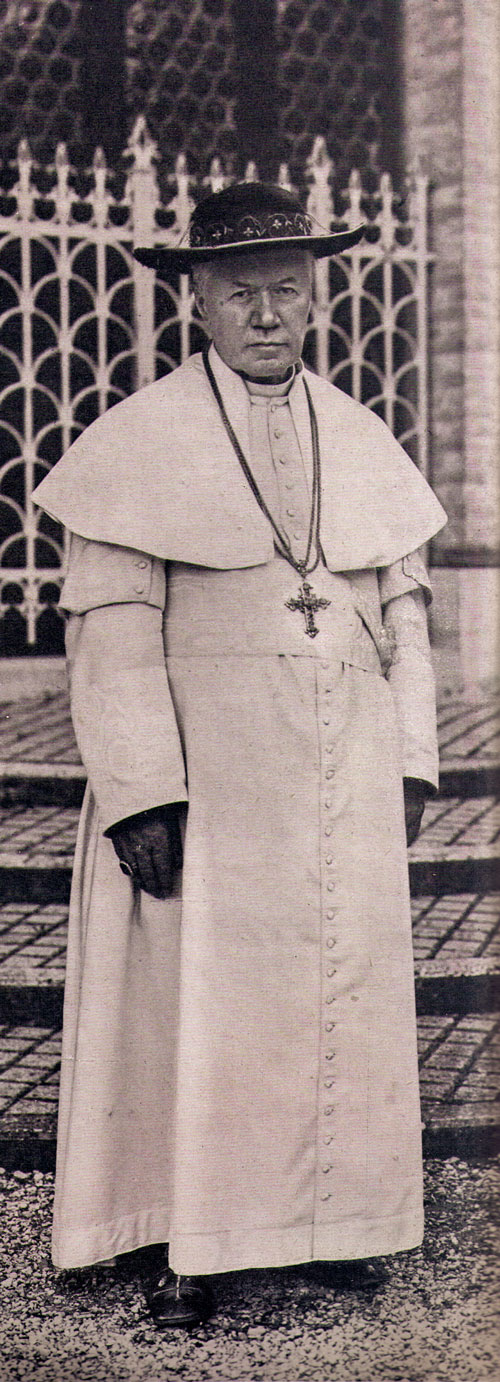
Loving, but Stern, Correction
This explanation only skims the surface of Pascendi Dominici Gregis. Skipping to its last section, the pontiff spells out the steps needed to fight the scourge.
The first admonition emphasized the scholastic methods and conclusions of Saint Thomas Aquinas as the sole approved method to be used in colleges and seminaries. Where they had fallen out of use, the local Bishops were to “impose them and require their observance.”
Those directions did not only apply to teaching theology, but also to other subjects. When teaching the natural sciences, history, mathematics, and other subjects, professors could not use information in ways that contradicted Scholastic Theology. For instance, instructors could explain the historical importance of Rousseau’s theories, but at no point should the professor teach or imply that Rousseau’s ideas are true, thereby contradicting Church teachings.
The second remedy was to carefully screen administrators and professors at Catholic universities and seminaries. Pope Pius’s instructions were especially direct. “Anybody who in any way is found to be imbued with Modernism is to be excluded…, and those who already occupy them are to be withdrawn.”
The Oath Against Modernism
Perhaps most important, though, was the selection of candidates for the priesthood. “Equal diligence and severity are to be used in examining and selecting candidates for Holy Orders. Far, far from the clergy be the love of novelty! God hates the proud and the obstinate.”
To accomplish this goal, Pope Pius wrote The Oath Against Modernism, unveiled in 1910.
In this remarkable document, Pope Pius required that all men taking Holy Orders faithfully, entirely, and sincerely profess:
1. Undeviating acceptance of the unerring teaching authority of the Church
2. That the Church is of divine and supernatural origins
3. That God can be known in the natural light of reason from the created world
4. Acceptance of the truth of divine acts, miracles, and prophesies related in the Bible
5. That the real and historical Christ personally instituted the Church
6. The truth of the unchanged Faith handed down by the Fathers
7. That Faith is a genuine assent of the intellect to the truth
8. Acceptance of the condemnations, declaration and precepts of Pascendi and Lamentabili
Those same men also promised to reject:
1. The idea that doctrines and essentials of the Faith evolve and change
2. The idea that Catholicism can contradict historical or scientific principles
3. The misrepresentations of rationalists and textual critics
4. That dogma can be tailored to the needs of any given age
Unfortunately, Pius X’s reign was short, ending with his death on the eve of World War I. The world changed drastically. The chaos that Pius foresaw came to pass with a vengeance. The conclusion of this series will examine that process.