
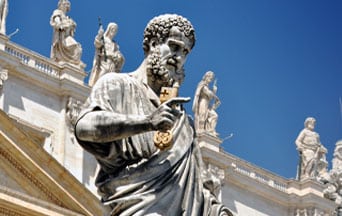
The Barque of Peter, the Holy Catholic Church, has been sailing the seas of history for two thousand years.
Sometimes the sea is calm, the wind is favorable, and the barque glides smoothly over the waves. At other times, the sky darkens and becomes threatening. The winds rage and a terrible storm begins. It seems as if the barque will break up and sink. Many abandon ship and plunge into the dark sea in the vain hope of finding a safer boat. They are lost among the raging waves.
However, although seemingly asleep, the supreme helmsman, Our Lord Jesus Christ, watches over the barque. Startled, the crew wakes him up, saying: “‘save us, Lord; we are perishing.’ And he said to them, ‘Why are you afraid, O men of little faith?’ Then he rose and rebuked the winds and the sea, and there was a great calm” (Mt. 8:25-26).
Thou Art Peter
Jesus Christ is the foundation stone (Eph. 2:20; 1 Pet. 2:4) upon which the Church is built. However, before rising to heaven and disappearing from sight, He determined to join that stone to another, visible to men.
Addressing Simon the apostle, He changed his name to Cefas (from the Aramaic Kepha, meaning “stone” or “rock”) and said:
Thou art Peter, and upon this rock, I will build my Church, and the gates of hell shall not prevail against it. And I will give thee the keys of the kingdom of heaven. And whatsoever thou shalt bind upon earth, it shall be bound also in heaven: and whatsoever thou shalt loose upon earth, it shall be loosed also in heaven (Mt. 16:17-19).
Eternal and Natural Law: The Foundation of Morals and Law
One must see in this visible rock—Saint Peter and his successors, the popes—the invisible rock on which the Church rests: Our Lord Jesus Christ. Peter is the human rock supported by Jesus Christ, the Divine rock.
The Church: a Full and Perfect Monarchy
From the words above, it follows that the connection between the pope (the Church’s visible head) and Jesus Christ (her invisible head) is direct and immediate, that is, without the mediation of any person or institution. That is what Cardinal Louis Billot explains, based on St. Robert Bellarmine and Suárez:
For authority [in the Church] comes directly from God through Christ, and from Christ to his Vicar, and from the Vicar of Christ it descends to the remaining prelates without the intervention of any other physical or moral person.1
The Church’s form of monarchy is pure, not mixed or tempered, he explains, because the pope’s authority over the Universal Church is total and direct; it is not limited. The only authority above the pope is that of God Himself.
Nevertheless, the Church is not an absolute monarchy, as Cardinal Billot explains, since bishops are not mere delegates of the pope. Bishops enjoy an ordinary and immediate authority over their dioceses, though in submission to the Sovereign Pontiff.
He concludes: “[By] divine institution, the Church’s form of government is that of a full and perfect monarchy.”2
 Learn All About the Prophecies of Our Lady of Good Success About Our Times
This monarchy of the Church has its theological foundation in the primacy of Saint Peter. Father Salaverri attests to this: “On the institution of the Church as a monarchy: Christ specifically chose the monarchic regime for the Church and designated the person of Saint Peter as the subject of supreme authority.”3 Father Pesch likewise writes: “By establishing the apostolic college under the primacy of Peter with the authority of jurisdiction and order, Christ founded a religious, hierarchical, and monarchic society that we call His Church.”4
Limits of Papal Authority
That no earthly authority limits the pope’s authority does not mean it is discretionary or arbitrary. Like every man, the pope is subject to moral precepts, and especially to his office’s obligations. In other words, as Vicar of Christ, he may not impose his will on the Church but rather Christ’s will and doctrine.
He can only carry out the will of the One he represents. The will of Christ is clearly manifested in the Old and New Testament, in the writings of Church Fathers, and the documents of the ordinary and extraordinary Magisterium of the Church. It is made even more explicit by Catholic theology.5
What if a Pope Is Unworthy?
Our Lord did not confer on the popes, as He did on the Apostles at Pentecost, confirmation in grace by which a person becomes immune from mortal sin. Nor did He give the popes infused science, through which a person intuitively knows everything he should know in virtue of his mission. For example, Adam knew everything necessary for everyday life and to start civilization.
10 Razones Por las Cuales el “Matrimonio” Homosexual es Dañino y tiene que Ser Desaprobado
By virtue of his lofty office, the pope indeed receives special graces, called the grace of state or office, to govern the Church well and sanctify himself. But, as Church history shows,6 he is not immune to sin, even mortal sin.
However, the Church remains holy and sanctifies even when the pope fails to correspond to the graces received and becomes unworthy. The Church continues to confer grace through the sacraments, and we move forward on the way to salvation in union with her and submissive to her doctrine and morals, while receiving her sacraments.
No solution without Divine Intervention
Never in history has humanity known a crisis like the one affecting us. It goes beyond the purely religious realm and extends to all institutions and spheres of human action. It is the result of a centuries-old process, which Prof. Plinio Corrêa de Oliveira highlights in his essay, Revolution and Counter-Revolution.
Thus, although Pope Francis clearly has distanced himself from Catholic dogma and morals by words, gestures, and attitudes, he is not the immediate cause of the crisis in the Church but a bitter fruit of it. Consequently, it is an illusion to think that everything will be resolved merely by replacing the current occupant of the Chair of Peter in a future conclave. The situation of the Church and the world has reached such a magnitude of disorder that there is no human solution to the current crisis. It requires an extraordinary intervention of Divine Providence.
Even if Francis were the immediate cause of the crisis, under the pretext of his demolishing work, one cannot destroy what Our Lord has built. One cannot undo the Church as He established it. The reaction to an unworthy pope must not lead the faithful to destroy the papacy or plunge into heresy or schism.
Devotion to the Immaculate Heart of Mary
In traditionalist sectors, eliminating papal privileges and limiting the pope’s powers has been presented as a solution to the terrible crisis in which we find ourselves. That is the path of the often condemned errors of Gallicanism.
Gallicanism, a Multifaceted Error
Fr. M. Dubruel, in the Dictionnaire de Théologie Catholique, thus summarizes Gallicanism:
Gallicanism is a set of tendencies, practices and above all doctrines relating to the constitution and extent of spiritual power, widespread especially in ancient France and opposed in various measures to certain prerogatives of the pope with regard to the Church, and of the Church vis-à-vis the State.7
The Gallican tendency is as old as the Church and has given rise to schisms and heresies. More specifically, one finds it in King Philip the Fair (1285-1314). This unworthy grandson of Saint Louis IX, influenced by the legists that foreshadowed the Renaissance, sought to dominate the Church in France and clashed with Pope Boniface VIII.
This mentality spread across Europe and, in the seventeenth and eighteenth centuries, led Catholic monarchs infected by it to restrict the freedom of the Church and reject the authority of the Roman Pontiff.
Like the Eastern schismatics, religious Gallicanism preaches the superiority of the bishops and councils over the pope, an error condemned countless times by popes and councils. It was dealt a final blow when the First Vatican Council proclaimed as a dogma the pope’s immediate primacy over all bishops and faithful and his infallibility when speaking “ex cathedra,” under censure of anathema for anyone who denies this truth of faith.8
Is Ultramontanism to Blame for the Current Crisis?
Some in the same traditionalist sectors, not knowing how to resolve the difficult question of a wayward pope from the doctrinal standpoint, change their focus. Based on a distorted view of history, they go so far as to claim that the current crisis stems less from the Second Vatican Council than from the First, or at least the latter’s “spirit.” It allegedly exaggerated the pope’s authority by attributing powers that allow him to act at will to the detriment of the bishops’ authority.
Equality and Inequality Among Men
This would mean that the greatest representatives of this so-called “spirit of Vatican I” would be the ultramontanes, who became the target of attacks from these sectors, instead of the Modernists.
Such circles do not hesitate to denigrate the ultramontanes. They claim that, imbued with the “spirit of Vatican I,” they exaggerated (and still do) the scope of infallibility and papal primacy to the point of “papolatry.”
Therefore, it seems fitting that we rectify—even if summarily—this caricature of the ultramontane movement.
The Ultramontane Movement: a Grace Like the Counter-Reformation
The ultramontane movement is a current that emerged among the clergy and laity in the late eighteenth century and the early nineteenth century. It stood out for its courageous defense of the prerogatives of the Holy See and strove to have the truth of papal infallibility proclaimed as a dogma of faith.
There is a tendency among Catholic authors to study history and even Church history from a merely natural standpoint, ignoring the interventions of Divine Providence in historical events.
Accordingly, attempting to explain the ultramontane movement with merely natural criteria, whether political, social, or otherwise—as has been done—leads to a cross-eyed interpretation that sometimes borders on the caricatural.
In our view, such a movement of Catholic reaction against the then-dominant revolutionary trend was only possible with grace—a grace similar in magnitude to that of the Counter-Reformation.
This grace first began to appear during the horrors of the French Revolution and the oppression of Napoleon’s crowned dictatorship. It continued during the Restoration and beyond. It was mainly a grace of a combative reaction to the errors of that Revolution, coupled with a love of the papal monarchy and the desire for the Church to play a central role in public life as it did in the Middle Ages.
Embracing Christ and the Cross
In 1799, when Pope Pius VI was taken as a prisoner to France, where he died, Mauro Cardinal Capellari, the future Pope Gregory XVI (1831-1846), wrote a book upholding papal infallibility and the temporal sovereignty of the Roman Pontiff. Its title indicates its ultramontane character: “Il trionfo della Santa Sede” [The Triumph of the Holy See].
Suffering religious persecution, much of the French nobility returned to the faith. A new fervor led the clergy to abandon Gallican and Enlightenment ideas. New male and female religious congregations of a missionary or educational nature emerged under the invocation of the Sacred Heart of Jesus and the Immaculate Heart of Mary.
Laity Fighting for the Faith
Fervent lay people, many of whom were members of the nobility or professionals, formed societies that were secretive from persecuting civil authorities but not from the religious authorities, such as the Chevaliers de la Foi (Knight of Faith), to defend the faith and fight against Napoleon’s persecution. They strove to disseminate good books, especially to counter Jansenism and Gallicanism.
In Italy, the same fight was being waged by the similarly secret Amicizia Cristiana, whose main inspirers were Fathers Nicholas Albert von Diessbach (1732-1798) and Pio Brunone Lanteri (1759-1830).9 Count Joseph de Maistre belonged to Amicizia Cristiana (which at his suggestion became Amicizia Cattòlica) from 1817 until he died in 1821. During that time, he published Du Pape, his famous work defending papal infallibility.
Finding the Real Soul of the Apostolate
Louis Veuillot (1813—1883), a French writer and journalist, was undoubtedly the leading lay figure of the 19th-century ultramontane movement. Saint Pius X paid a lofty testimony on his struggle to defend the papacy against the errors of Gallicanism and Liberalism, addressed to a nephew of the great polemicist, François Veuillot:
Following the example of the two Popes who preceded Us in this Apostolic See, and especially of Pius IX, of holy memory, We are pleased to bear witness to this great man of goodness, an unyielding defender of the rights of God and of the Church… The whole of his illustrious career is worthy of being presented as a model to those who fight for the Church and holy causes.10
Ultramontanism Is Not Sentimental and Nostalgic Romanticism
In short, ultramontanism was a reaction against the various forms of Gallicanism, Jansenism, and Liberalism. It was a movement of fervor among Catholics, especially Catholic elites, who battled as champions to defend the privileges Our Lord conferred on the pope as the visible head of His Church, as the First Vatican Council infallibly proclaimed.
Ultramontanism has nothing to do with the sentimental and nostalgic romanticism of the nineteenth century, nor did it result from a lack of doctrinal knowledge on the part of simpletons.
Science Confirms: Angels Took the House of Our Lady of Nazareth to Loreto
This salutary trend was not restricted to Europe but spread throughout the Catholic world. In his memoirs, Prof. Plinio Corrêa de Oliveira says: “I can say I was already an ultramontane when I joined the Marian Sodality of Santa Cecília and began to participate in the Catholic movement.”11 While he dedicated his entire life to defending the Church and Christian civilization, his ultramontanism never prevented him, when necessary, from respectfully but strongly resisting Pope Paul VI.
One Cannot Fight an Error with Another
In conclusion, the crisis the Catholic Church now reaches the highest authority in the Church: the Papacy. Undoubtedly, it is the most serious crisis in her history. It is a consequence of a long and relentless process that culminated with the doctrinal, moral and liturgical reforms of the Second Vatican Council and continues unabated.
Though we fight to defend orthodoxy, morality, and the liturgy, we must do so as genuine Catholics who love the Church as Our Lord made her, and not as we might prefer that she be. Thus we avoid the risk of falling into schism or heresy.
Our Lord Jesus Christ Jesus Christ is watching over His Church: “Behold I am with you all days, even to the consummation of the world” (Mt. 28-20).
Let us ask Our Blessed Mother, Mediatrix of all graces, to obtain the strength, courage, and faith so we remain faithful to Jesus “until He comes” (I Cor. 11:26).
Photo Credit: © Savvapanf Photo © – stock.adobe.com
Footnotes
- Louis Card. Billot, S.J., Tractatus De Ecclesia Christi (Rome: Aedes Universitatis Gregorianae, 1927), Vol. I, 524.
- Op. cit., 524, 531.
- Salaverri, “De Ecclesia Christi,” in VV.AA, Sacrae Theologiae Summa, Vol. I, no. 162.
- Pesch, “De Ecclesia Christi” in Compendium Theologiae Dogmaticae, 145.
- J. M. A. Vacant, « Le magistère ordinaire de l’église et ses organes » (Delhomme et Briguiet, Libraires-éditeurs, 1887).
- See Arnaldo Vidigal Xavier da Silveira, Can a Pope Be . . . a Heretic? The Theological Hypothesis of a Heretical Pope (Caminhos Romanos, Portugal, 2018).
- Op. cit., col. 1096.
- See anathemas in Denzinger (30th ed.), 1826-1840. Saint John Bosco and Saint Antonio Maria Claret fought intensely for the approval of infallibility at Vatican I. See “Don Bosco e il Concilio Vaticano Primo” (Bollettino Salesiano, ANNO LXXXV. N.19 1° OTTOBRE 1961,); San Antonio Maria Claret, Escritos Autobiograficos y Espirituales (Biblioteca de Autores Cristianos, Madrid,1959), 498-501.
- Léon Cristiani, A Cross for Napoleon: The Life of Father Bruno Lanteri, 1759-1830 (St. Paul Editions, Boston: 1981).
- Pius X, « Bref du Pape saint Pie X à la louange de Louis Veuillot » (Oct. 22, 1913).
- Minha Vida Pública, Compilação de relatos autobiográficos de Plinio Corrêa de Oliveira (Artpress Editora, Sao Paulo, 2015), 17.