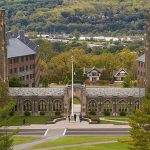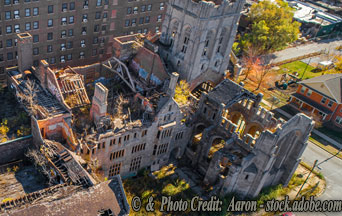
History records cases of ancient ghost cities that suddenly lost their populations and decayed. No one knows what happened to them or where the people went. All they know is that the buildings lie in ruin; they are overgrown and abandoned. The sites are intriguing mysteries and a matter for speculation.
However, these ghost cities are not limited to the ancient past. They can be found inside postmodernity. In fact, they appear in many places throughout the United States. Whole neighborhoods lie abandoned, decayed and even overgrown with vines. This is not a mystery of history but a present-day reality. Every major city has its ghost neighborhoods that haunt the national landscape and drag down the economy.
The residents just left. Conditions reached a point where the areas were no longer livable. No one asked why and sought to prevent the exodus. It just happened.
Gary, Indiana—Hiroshima-style Abandonment
One concrete case among many American ghost communities is Gary, Indiana. A recent Wall Street Journal article tells its story. The city was once a thriving commercial hub and steel-making center. At its peak in the sixties, it had a population of some 180,000 with vibrant ethnic neighborhoods, churches and shops.
Since that time, it has lost half of its population and continues to decline. The downtown lies in ruins. Little tax revenue comes from the area. Gary suffers from a vicious circle of economic blight. The future is bleak unless something drastic is done.
Indeed, it is as if a nuclear bomb had been detonated in the area. Stefanos Polyzoides, a University of Notre Dame architect, has been recruited to change what he terms the “Hiroshima-scale abandonment” found in the city center. He has a plan.
Workers will soon be entering with explosives and bulldozers to eliminate 7,000 abandoned houses and businesses over time. Eighty million dollars has been earmarked for a blight-elimination campaign that will immediately include the landmark Gordon’s Department Store, a huge convention center built in 1981, and a crumbling church.
An Economic Crisis
Those working on the project attribute the devastation solely to economic factors associated with globalization. They explain that the city was too dependent upon its steel industry to withstand the shift when such jobs went overseas. Thus, when the factories closed, the city emptied.
Such an explanation accounts for only part of reality. People may lose their jobs, but healthy communities have the wherewithal to provide the social support needed to continue. When society flourishes, new economic possibilities naturally sprout.
What happened in Gary and so many other major American cities was not just individual decisions to leave but a total breakdown of the ties that bind people together.
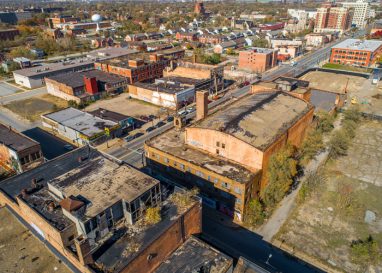
This breakdown was reflected in the city streets, which started to look run-down. Broken windows and damaged streetlights proliferated. Potholes appeared all over city streets. Criminal elements took advantage of the chaos. People lost their links with the community and let things crumble. This lack of a sense of community only made the exodus out of Gary worse.
Gary is not alone in its fight against blight. Detroit, Baltimore and New Orleans, for example,
have each destroyed thousands of homes. Data from U.S. government agencies reveals that there are an estimated 16 million vacant and abandoned properties in the United States.
A Moral Crisis Above All Else
Thus, economic problems were definitely factors in Gary’s decay. However, they were not the principal reasons that drove Gary down.
The economic crisis coincided with a moral crisis in the sixties. The Sexual Revolution exploded on the scene when Gary was at its peak. It detonated with a force and energy that resembled a nuclear bomb, causing immense damage to the family and community.
A thriving community is built upon the foundations of healthy families. The Sexual Revolution introduced broken families, fatherless homes, divorce, cohabitation and drugs into the community. The city’s devastated physical landscape is only a reflection of this moral wasteland.
This breakdown destroyed people’s loyalty to the place. People no longer cared about making the community beautiful and agreeable to others. Abandoned places easily become ghost cities.
A Spiritual Crisis
The economic crisis also coincided with a spiritual crisis inside the Catholic Church as well as in other religious groups. The Church normally unites people together in community and supernatural charity. These powerful bonds provide the means for communities to grow and flourish despite the economic problems they face.
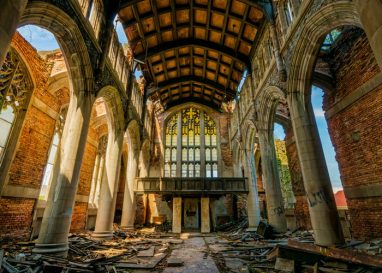
However, the same devastation evident in the statistics documenting Gary’s decline can be found within the Church. Parishes are slowly disappearing. People are abandoning the Church and living broken lives without purpose and meaning.
Had the Church not entered a crisis, communities like Gary would have had a better chance of recovering. Indeed, when things are not oriented toward God and sanctification, they will tend toward sin and vice. Instead of building a more beautiful and perfect civilization, the savage rules of survival and brutality prevailed.
An Incomplete Solution
In the face of such a situation, the city government of Gary is taking what it sees as the only option. Hiroshima-style abandonment will be met with the Hiroshima-style demolition of 7,000 structures. Large chunks of the city center must be gradually taken down so that everything can start anew.
However, this option is only an economic solution, not the needed spiritual and moral ones. The mayor hopes to attract young people looking for cheap land and housing, which the city aims to promote in this now-depressed zone. He is adding a new train station for commuters and a trendy bike-and-hiking trail along the lakefront to the mix. Indeed, some new growth has already appeared.
A Doomed Effort
However, the effort is doomed to fail without a moral and spiritual revival. Bringing in individuals looking for opportunities will not necessarily create the healthy families needed to regenerate the city. Pumping money into the area can never instill in people the spirit of self-sacrifice needed for communities to flourish. If the crisis in the family is not addressed, the new Gary will soon be filled with yet more broken families, starting a new cycle of economic blight.
Above all, the new Gary needs Christian morality to safeguard its efforts to rebuild the community. It needs God’s blessing on its efforts to correct the secular errors that gave rise to its crisis.
Indeed, the problems in Gary should provoke a discussion about America’s ghost cities, now found everywhere. If a wildfire had destroyed 7,000 structures, people would demand answers. Someone needs to ask the question: How is it possible that so many cities in America are devastated by a Hiroshima-style abandonment and no one seems to care?
Photo Credit: © Aaron– stock.adobe.com