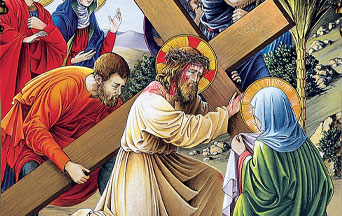
Among all the figures in the Passion of Our Lord, Simon of Cyrene stands out for his simplicity. He is neither an apostle nor a well-known disciple, but an ordinary man. This outsider from North Africa comes to Jerusalem to observe the Passover. He is taken from the crowd and unexpectedly thrust into the center of salvation history.
Some historical and traditional theologians suggest that Simon and his sons, Alexander and Rufus, later became associated with the early Christian community. While this identification cannot be established with certainty, the mention of these names in the Gospels and epistles indicates that Simon’s household was remembered among the first generations of believers.
Simon’s acceptance of the Cross stands as a lasting model of Christian discipleship. Indeed, Christian life cannot be understood apart from the Cross. Yet every age is marked by a spirit that resists it.
The Revolutionary Rejection of the Cross
As explained by Prof. Plinio Corrêa de Oliveira in Revolution and Counter-Revolution, Christian civilization gradually decayed under what he called the Revolutionary spirit: a centuries-long movement that seeks to reject God’s order in favor of human autonomy, equality, and a liberty detached from truth. This mentality advocates a life without suffering, sacrifice, or the Cross. It promises comfort without discipline, freedom without obedience, and fulfillment without responsibility before God.
By contrast, the Catholic faith has never offered a life without the Cross. It offers grace to carry it joyfully and manfully as a means of salvation. Prof. Corrêa de Oliveira referred to the faithful restoration of Christian order and the rejection of this Revolutionary spirit as the Counter-Revolution, which is a spiritual, moral, and cultural return to order and the reign of Christ.
Simon of Cyrene is placed directly within this dynamic clash of mentalities. He is not asked, nor prepared, but compelled to carry the Cross of Christ. In this, he reflects a fundamental truth: Christians do not choose all their sufferings. Rather, they are called to respond faithfully when the Cross is laid upon their shoulders.
The question is never whether suffering will come, but whether it will be borne in union with Christ or resisted in spirit.
Following Christ Means Following Behind Him
Saint Luke provides a detail unique among the evangelists: Simon carries the Cross behind Jesus.
This detail is not merely descriptive but deeply theological. It reflects the essence of discipleship: the Christian does not precede Christ or choose an independent path, but follows behind Him. The Lord Himself declares: “If anyone wishes to come after Me, let him deny himself, take up his cross daily, and follow Me” (Luke 9:23). Simon becomes a visible enactment of this command as he walks behind Christ.
This also reflects a broader truth of Christian life. Not all are called to visible leadership or outspoken public action within the Church. Many are instead called to faithful obedience and quiet perseverance.
Even the Apostles were not self-appointed; they were called out of their ordinary lives by Christ, plucked from the seas where they labored, and molded through grace. The foundation of Christendom rests not on human initiative alone, but upon correspondence to God’s call and the action of divine grace. Furthermore, as the Apostles exemplified in their martyrdom, they demonstrated the willingness to make sacrifices, even unto death.
The Cross as the Center of Counter-Revolutionary Life
The Cross stands at the center of the Christian faith because it reveals the true order of reality centered upon Christ. For this reason, the Counter-Revolution begins not merely with external action, but with the interior acceptance of the Cross and restoration of the soul to God’s order.
The revolutionary spirit regards suffering as an evil to be eliminated and a burden to be avoided. Yet Christian teaching affirms that suffering, when united to Christ, becomes a path of sanctification and grace. As Saint Paul writes: “Now I rejoice in my sufferings for you, and I fill up in my flesh what is lacking in the afflictions of Christ for His Body, which is the Church” (Colossians 1:24).
Christ’s redemption is complete in itself, yet He permits the faithful to participate in His saving work through their own sufferings united to His Passion. Simon’s experience illustrates this mystery in concrete form. What begins as forced labor becomes a moment of intimacy with Christ Himself as Simon is drawn into the sacred mystery of redemption.
The revolutionary spirit seeks a world without sacrifice, often accompanied by a practical independence from the supernatural order and a rejection of God’s authority. The Counter-Revolution responds by embracing the Cross as the path through which Christ restores both souls and society.
Simon of Cyrene does not resist when chosen. He does not flee and attempt to blend back into the multitude. He accepts his place and walks where Christ leads. In doing so, he becomes a living contradiction to the illusion that man can avoid the Cross and still find fulfillment and redemption. Salvation is found through the Cross, not around it.
The Cross Leads to Resurrection
Simon may not have entered the events of the Passion willingly. However, according to tradition, his proximity to Christ leaves a lasting mark upon him and his household.
His journey does not end in suffering alone. The Cross leads to Calvary, which then leads to the Resurrection. Christian hope sees suffering, when united to Christ, not as the final word. God transforms it into a means of salvation and glory. Saint Paul expresses this hope clearly: “If we suffer with Him, we shall also be glorified with Him” (Romans 8:17). And again: “If Christ is not risen, then our preaching is in vain and your faith is in vain” (1 Corinthians 15:14). The Resurrection gives meaning to the Cross, and the Cross leads to participation in the Resurrection.
Conclusion
Simon of Cyrene remains one of the most profound images of Christian discipleship precisely because of his simplicity. He does not choose the Cross, but he carries it. This event in Simon’s life demonstrates that no Christian is exempt from the Cross, but every Cross, when borne with Christ, becomes a path to salvation.
The Cross will be encountered by all. The decisive question is how every soul will receive it. Some may reject the Cross by embracing the revolutionary and sinful spirit of the age in its many manifestations. Others may seek to avoid it by disappearing into the massified, lukewarm crowd and its pursuit of earthly comforts.
Those who carry the Cross, however, participate in the Counter-Revolution described by Prof. Plinio Corrêa de Oliveira, not merely by opposing the errors of the age, but by conforming themselves to Christ. Filled with the holy and raging fire that fuels this return to order, they step out from the crowd for all to see and, whether willingly or when unexpectedly called upon, carry the Cross behind Christ as Simon of Cyrene did.