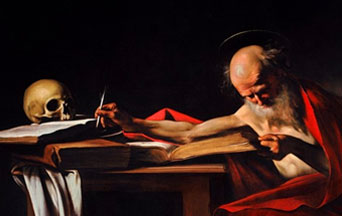
Saint Jerome was born around the year 347 in Stidon, near Dalmatia. He was the son of wealthy Christian parents. Initially, he studied at home under the guidance of tutors. Soon, however, his parents sent him to Rome to satisfy his intense desire for intellectual knowledge. There, he studied and excelled in grammar, Latin, Greek, rhetoric and philosophy.
During these years, he also led a raucous and materialistic life together with his fellow students.
Saint Jerome was baptized when he was a teenager. Persons were customarily baptized upon completing their education. After his conversion, he spent many years traveling. He developed a particular interest in studying monastic life.
A Pioneer of Monastic Life
In the spring of 375, Saint Jerome’s life took a sudden turn. He became seriously ill and had a dream that made a deep impression on him. In it, a voice accused him of following the teachings of the early Roman philosopher Cicero and not being a Christian. Awakening, Saint Jerome promised God never to read pagan literature again, even for pleasure. He withdrew from society and left to live as a hermit in the desert, to atone for his sins and to devote himself to God.
Without experience of monastic life and lacking any guide to accompany him, Saint Jerome suffered greatly and was often very ill. He was terribly tormented by carnal desires and imposed severe penances on himself to suppress them. As an additional penance, he began to study Hebrew under the tutelage of a Jewish convert. When a disagreement arose among his fellow monks in the desert about the diocese of Antioch, Saint Jerome fled to avoid the tension of the situation.
Saint Jerome established a reputation as a renowned scholar and ascetic. He was ordained a priest at the insistence of Bishop Paulinus. He accepted ordination on the condition that he would be allowed to continue his monastic lifestyle and would not be obliged to take on any pastoral duties. In 382, he was appointed secretary to Pope Damascus. Recognizing the depth of his intellect, the Pope encouraged him to create a Latin translation of the Bible, based on the original Greek and Hebrew texts.
The Lion and the Donkey
A legendary occasion from this time sheds light on the undeniable holiness of Saint Jerome. One evening, he was listening to a reading from the Holy Scriptures with his brothers. Unexpectedly, a crippled lion stumbled into the monastery. The brothers fled in panic, but Saint Jerome received the animal as if it were a guest. The lion showed Saint Jerome that his leg was injured. Saint Jerome sent for his brethren and ordered them to assist him in healing the wound. They discovered a thorn, removed it, and lovingly cared for the lion. The animal became tame and henceforth lived with them as if it were a pet.
Saint Jerome saw God’s intention in this. The lion should not only be healed, but also serve the monastery. The lion’s task was to guard the donkey as it carried wood from the forest. The lion faithfully accompanied the donkey every day. One day, however, a caravan of merchants stole the donkey while the lion slept. Sad and ashamed, the lion returned to the monastery without the donkey. The brothers suspected that he had devoured the donkey. From that point, they gave the donkey’s work to the lion, who carried the wood himself.
After a while, however, the lion discovered his lost companion in a caravan. With a roar, the lion chased the merchants who had stolen the donkey to the monastery, where they had to confess their guilt. Saint Jerome received them kindly, washed their feet, and initially refused their gifts. When they insisted, he accepted their gift of perfume on the condition that they and their heirs would bring the same gift annually. The brothers then understood that the lion was innocent and that they had wronged him. Fortunately, the animal returned, jumping around, playing and wagging its tail as a sign of forgiveness. Thus, the lion continued to live faithfully at the monastery—no longer as a feared beast of prey, but as a humble servant and faithful friend, sent by God to strengthen their community.
Establishing Monasteries in Bethlehem
After the death of Pope Damascus, Saint Jerome left Rome. He journeyed to the Holy Land with a small group of virgins led by his close friends, Sts. Paula and Eustochium. Under his leadership, Paula founded a monastery for men in Bethlehem and three more monasteries for women. Saint Jerome remained in this monastery until his death around 420, leaving it only occasionally for short journeys.
Today, Catholics venerate Saint Jerome as the patron saint of librarians and translators.
Originally published by the “My Immaculate Heart Will Triumph” campaign of the Civitas Christiana Foundation on September 30, 2025.