This article is the fourteenth part of a series about Purgatory, a topic that is rarely discussed today. A knowledge of Purgatory is essential if souls are to avoid the pains of this place of expiation. The previous article can be found here.
* * *
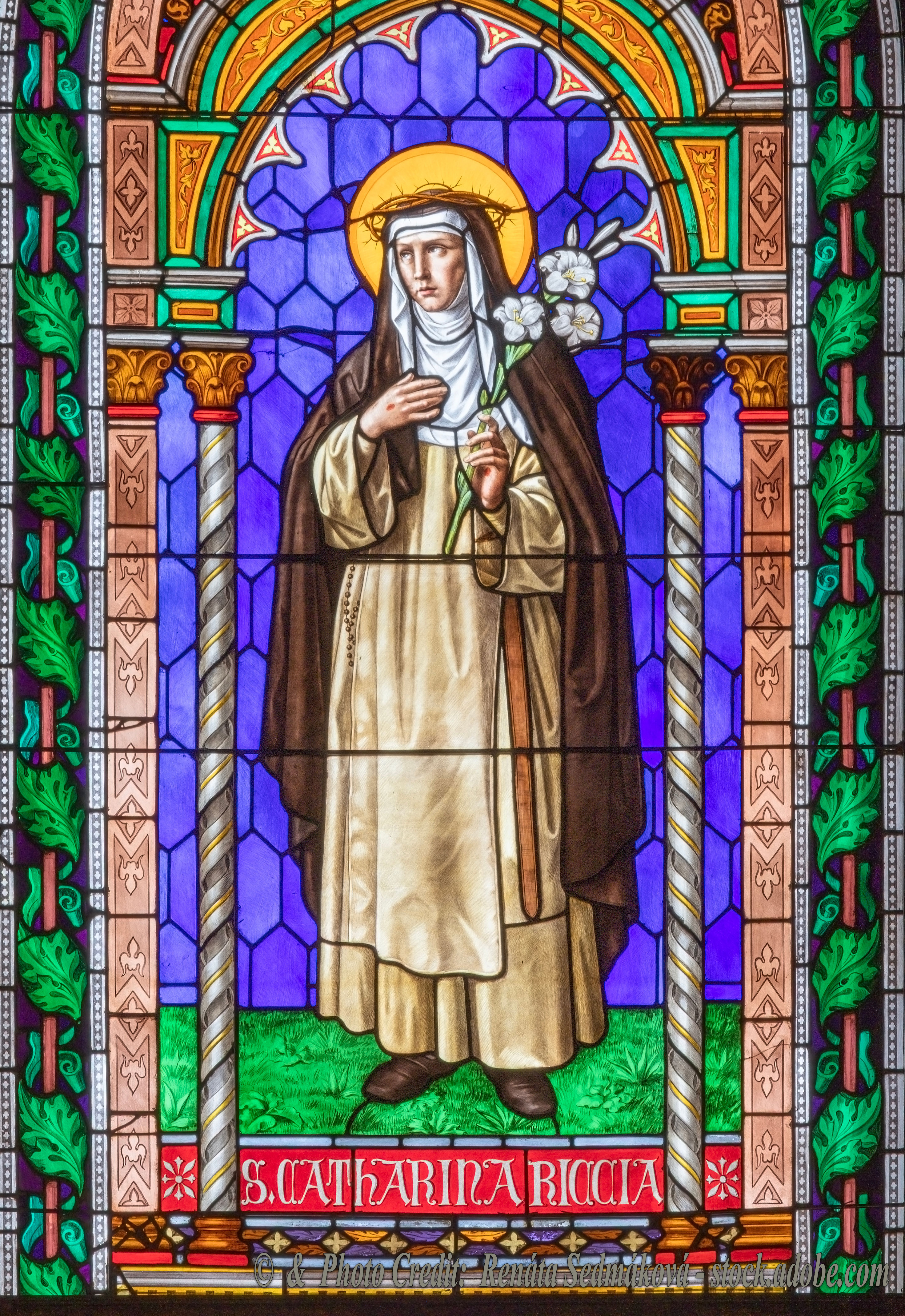
While not well known today, Saint Catherine de Ricci participated in the pains of Purgatory during her lifetime by suffering for the liberation of another from that place of penance.
A Little Rich Girl
Alexandrina de Ricci (1522-1590) was born in a powerful Tuscan banking family. When she lost her mother in infancy, her care was assumed by another godly woman who was, according to some sources, her godmother and others her stepmother. She went to a convent school where her aunt taught. Her father intended that she would one day assume a high position in Tuscan society.
However, God often had other plans. Even as a child, she often went off to isolated corners of the family’s grand home for intense prayer. Alexandrina thought convent school was a heaven. When her father bade her return home, she did so, but she longed for convent life. She convinced her father to allow her to take the veil as an enclosed third-order Dominican at the age of fourteen. She professed one year later, taking her mother’s name, Catherine, as her name in religion.
She lived a holy life full of penance and prayer. One particularly edifying episode of her life is her suffering for an unnamed prince so that he might be released from Purgatory.
The Worldly Prince
Father Schouppe, in his book Purgatory, states his belief that the prince’s conduct was so outrageous that his name was unrecorded out of consideration for his family. All that the good father said directly was that the prince “led a worldly life.”1
Nonetheless, Sister Catherine was determined to do what she could to save the prince’s soul. She “offered many prayers, fasts, and penances that God would enlighten him as to the condition of his soul, and that he might not be condemned.” Those sacrifices were effective, for shortly before his death, the prince underwent a sincere conversion.
In prayer and meditation, Sister Catherine learned that he was in Purgatory. At that point, she could easily have congratulated herself for helping him to escape Hell. However, she, in humility, saw her task as only half completed. She offered to endure special pains so that Divine Justice could be satisfied, and the prince received into Heaven. Cognizant of her previous penances and virtues, Our Lord accepted her offer.
Incredible Pains
These pains, as recorded by other sisters, were severe. At first, Sister Catherine’s body was covered with blisters. However, these did not resemble blisters that form after a severe burn, which heal within a few days. The source of heat seemed to be Sister Catherine herself. The blisters were so inflamed that Sister Catherine’s skin sometimes resembled boiling water. Occasionally, the boiling would cease momentarily, and her skin would look like roasted flesh. Even those respites were short, because soon the blisters arose once again.
Nor were the pains limited to her skin. Her tongue resembled a piece of red-hot metal. Her body emanated heat to such an extent that her cell seemed to be filled with it so that no one else could remain there for more than a few moments.
While undergoing the pains of Purgatory, her attitude was serene and peaceful. Some noted that she seemed to rejoice in her sufferings. Remarkably, as Father Schouppe records, “When her sister Religious told her that she seemed to be on fire, she replied simply, ‘Yes,’ without adding anything more.”
A Serene Attitude
At another point, one sister admonished her for requesting such extreme sufferings. Her response was an entire homily in two sentences.
“Pardon me, my dear sisters, if I answer you. Jesus has so much love for souls that all we do for their salvation is infinitely agreeable to Him; that is why I gladly endure any pain, whatsoever it may be, as well for the conversion of sinners as for the deliverance of the souls detained in Purgatory.”
After forty days, Catherine’s pains and all outward signs abated. The prince’s relations, having heard of the nun’s sufferings on behalf of their noble but wayward kinsman, came to her to inquire as to the current state of his soul. Her response was both uplifting and simple. “Have no fear, his soul is in the enjoyment of eternal glory.”
Implications
This little narrative contains at least three significant lessons.
The first is to illustrate Purgatory’s horrible pains. Many, in the naïve trust that a loving God could never inflict such pain, think of Purgatory as a kind of safe resting place before eventual entrance into Heaven. They never really examine their souls and only go to confession when they are certain that they have committed a mortal sin. Growth in holiness, if they think about it at all, is something they can take care of after death. Their plan, if it can be called that, may keep them out of Hell—but the pains they will suffer en route to Heaven will be at least as bitter as Saint Catherine de Ricci’s, and probably last far longer.
The second lesson is that the prayers of the living can help those already suffering in Purgatory. Not all such prayers will meet the severity of Saint Catherine’s request. Hers was an extraordinary spirituality, one which God had tested long before the death of the wayward prince. However, regular prayers, Masses and other small sacrifices will assist in getting loved ones through the pains of Purgatory much more quickly than they would otherwise.
Father Schouppe presented the third lesson as he completed this chapter.
“This example teaches us many things, but we have cited it to show that the greatest sufferings are not incompatible with interior peace. Our saint, whilst visibly enduring the pains of Purgatory, enjoyed an admirable peace and a superhuman contentment.”
May all who read this little article embrace such an attitude when life’s inevitable pains come their way!
Footnotes
- All quotations in this article (unless another source is mentioned) use the 1905 version of Father F. X. Schouppe’s Purgatory, published in Great Britain by Burns, Oates and Washbourne, Ltd. It is in the public domain and available through the Internet Archive. The spellings of certain words may have been Americanized.