
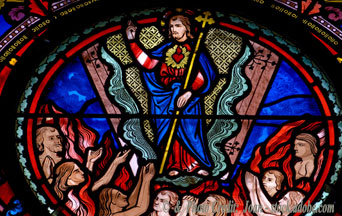
This article is the thirteenth part of a series about Purgatory, a topic that is rarely discussed today. A knowledge of Purgatory is essential if souls are to avoid the pains of this place of expiation. The previous article can be found here.
* * *
Modern Christians who accept the existence of Purgatory see it as a place of terrible but necessary punishment. This view is correct but incomplete.
A true vision of Purgatory must see it as a creation of God’s mercy. By its purifications, those dying with venial sins can eventually enter Heaven. However, souls entering this place of mercy experience great consolation and hope.
Divine Consolation
This article will summarize how God consoles the poor souls in Purgatory and gives them hope.
“‘God,’ says Saint Catherine of Genoa, ‘inspires the soul in Purgatory…, the more she loves God, the more she detests the least stain that displeases Him…. Thus, if she could find another Purgatory more terrible than the one to which she is condemned, that soul would plunge herself therein, impelled by the impetuosity of the love which exists between God and herself, in order that she might be the sooner delivered from all that separates her from her Sovereign God.’”1
By modern human standards, such an act, which entails more suffering, is unthinkable. The overriding human tendency is to avoid all suffering as much as possible. If this is not possible, the modern man negotiates to get the greatest advantage (by licit or illicit means) at the lowest possible cost. He would try by all means to escape.
Willingness to Suffer
Those who want to gain Heaven desperately desire to come into the Presence of the Almighty, yet understand that the stains of sin must be expunged. Inspired by their love for God, they yearn to be cleansed of their guilt so ardently that they are willing to amplify their own punishment.
Such intense suffering might seem intolerable. Indeed, from a natural point of view, it is impossible to endure such torments.
Yet the poor souls are content because they have supernatural assistance—that of the Holy Ghost. Father Schouppe explains with an accessible metaphor. “This Divine Spirit, by means of faith, hope, and charity, puts them in the disposition of a sick person who has to submit to very painful treatment, but the effect of which is to restore him to perfect health. This sick person suffers, but he loves his salutary suffering. The Holy Ghost, the Comforter, gives a similar contentment to the holy souls.”
A King and A Bishop
To drive home this explanation, Father Schouppe recounts the story of a miracle that occurred in 1070.2 It concerns the great Saint Stanislaus, patron saint of Poland. At the time of the story, Stanislaus was the Bishop of Krakow. His piety contrasted sharply with that of his king, Boleslaus II.
Father Schouppe relates that Boleslaus wanted to create a scandal arising from land that Stanislaus had purchased a few years earlier from a man named Peter Miles, who subsequently died. Boleslaus convinced the man’s heirs to give evidence in court that Stanislaus had taken the land, but never paid for it. Stanislaus defended himself by saying that he had paid the agreed price.
In the presence of a group of witnesses to the contrary, Stanislaus stood alone. It appeared that Boleslaus’s ruse successfully brought discredit on both the bishop and the Church. Boldly, Stanislaus asked for a three-day delay, promising to bring in the three-years-dead Peter Miles to testify. Astonished, Boleslaus mockingly agreed.
For those three days, Stanislaus fasted, went sleepless, and prayed. On the third day, he led the clergy and the faithful to the churchyard and ordered the grave opened. The gravediggers dug, and only Peter Miles’s bones remained. Stanislaus touched the tip of his crozier to the bones and ordered the dead man to rise “in the name of Him who is the Resurrection and the Life.” To the amazement of the crowd, the bones became once again knitted by muscle and then covered by flesh. Peter Miles rose, climbed out of his grave, and walked with Stanislaus to the court, where he testified in Stanislaus’s favor.
Choosing Purgatory
Remarkable as the story is, this is not the end. Something more pertinent to a discussion of Purgatory was yet to come.
Stanislaus thanked Peter Miles, saying that, if Peter wished, God would grant him a few more years of life. He replied in the negative, explaining to the bishop and the amazed onlookers that he had been suffering in Purgatory since his death. However, a return there was preferable to a return to life, which could, after all, carry the risk of sin and Hell. So, he walked back to his grave, lay down, and his body instantly returned to its state as a pile of bones.
Stanislaus prayed intensely for Peter Miles’s soul, for Father Schouppe concludes the narrative, “We have reason to believe that the saint soon obtained the deliverance of his soul.”
Friction between the king and the bishop continued. Indeed, on April 11, 1079, Boleslaus killed Stanislaus with his own hands while the bishop said Holy Mass. Pope Innocent IV canonized Stanislaus in 1253.
The Hope of Heaven
Peter Miles’s story is worth considering. Without question, had he chosen life on earth, his last years would have been pleasant. It is altogether possible that his old friends would have competed to buy him food and drink. Perhaps the bishop would have arranged a pleasant little cottage and a source of support as he aged. On the other hand, he could have traveled the width and breadth of the kingdom, regaling the crowds with his unique adventure.
But Peter Miles didn’t stay on earth. He chose Purgatory. He knew the risks of perdition that lay before him and the prize of Heaven that stood in front of him. He decided in a moment that it was better to re-assume his natural (and supernatural) state.
That is the most important point of this story. For all of its pains and tortures, Purgatory contains the God-given consolation of hope. Few people go straight to Heaven. Others spend only a few hours or days in Purgatory; for many others, the sentence is years, decades, or even centuries. However, all share a common knowledge and hope that they are saved and destined for Heaven.
To read the next article in this series, please click here.
Photo Credit: © Joan– stock.adobe.com
Footnotes
- All quotations in this article (unless another source is mentioned) use the 1905 version of Father F. X. Schouppe’s Purgatory, published in Great Britain by Burns, Oates and Washbourne, Ltd. It is in the public domain and available through the Internet Archive. The spellings of certain words may have been Americanized.
- Most sources state that Saint Stanislaus did not become the Bishop of Krakow until 1072, after holding other important posts in the diocese. Father Schouppe has made a minor and unimportant error. Either Saint Stanislaus was in a slightly lower office, or this event happened in 1072 or later.