
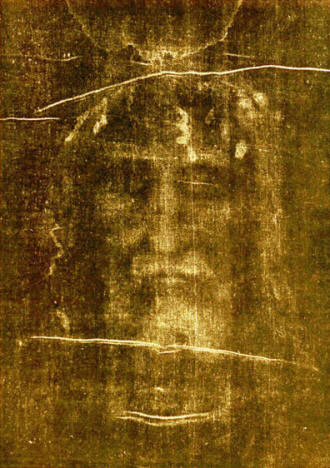
The Shroud of Turin has always been shrouded in mystery. Now, intriguing new evidence reveals additional details that support the origins of Our Lord’s two-millennium-old burial cloth.
A DNA study of the Shroud of Turin, conducted by researchers at the University of Padova, Italy, found a vast array of genetic material from around the globe on the Shroud. DNA analysis supports the relic’s trajectory from the Middle East to Europe.
However, scientists were surprised to find material indicating that 40 percent of the human DNA on the cloth can be traced back to Indian lineages, alongside a strong presence of Middle Eastern genetics, particularly among the Druze, a secretive, Arabic-speaking ethnoreligious offshoot of Shia Islam in Syria, Lebanon and Israel.
In a study done by Dr. Gianni Barcaccia, Professor of Genetics and Genomics at the University of Padua, scientists have confirmed the presence of a genome predominantly from the Middle East. They have also detected microorganisms that thrive in extremely saline environments, similar to those of the Dead Sea.
The study details these investigations, which were conducted on material provided by Professor Pier Luigi Baima Bollone at the University of Turin, Italy. Baima Bollone is the renowned forensic expert who, in the eighties, famously identified human AB blood type on the Shroud.
Silk Roads and Sacred Linens
There should be no surprise that the Shroud is contaminated by many sources of DNA, given the many hands that have touched the Shroud over the centuries. Tests indicate that over 55 percent is from the Near East, around 38 percent from India and less than 5 percent from Europe.
The significant presence of Indian DNA offers a fascinating historical perspective. It is easily explained by the use of fine Indian linen at the Temple in Jerusalem, which was used for the garments worn by the High Priest during the afternoon rituals of Yom Kippur, a day of atonement.
The authors of the new study note: “The presence of approximately 38 percent of Indian ethnic lineages could result from historical interactions or from the Romans importing linen from regions near the Indus Valley, associated with the term ‘Hindoyin’ in rabbinical texts.”
The word “Shroud” is derived from the Greek “Sindôn,” meaning fine linen and could be linguistically linked to Sindh, a region previously celebrated for its high-quality textiles. Historical evidence firmly supports commercial trade between India and the Mediterranean. As biblical scholar Father Ceslas Lavergne points out, the term “Sindôn” directly refers to a highly valued fabric of Indian origin. In short, the DNA traces suggest the cloth had broad exposure across the Mediterranean and that the yarn itself may very well have been spun in India.
The Levantine Connection
These genetic footprints offer invaluable insights into the geographic origins of countless individuals who interacted with the Shroud during its long journey across empires, populations and eras.
The new research also confirms the presence of DNA from haplogroup H33, a genetic marker prevalent in the Near East and common among the Druze. Researchers note that the Druze population shares a common genetic ancestry with both Jews and Cypriots and has historically intermixed with other Levantine populations, including Palestinians and Syrians.
Adding to the complexity, the reconstructed microbiome of the Holy Shroud reveals a wide variety of microorganisms commonly found on human skin, along with fungi, molds and halophilic archaea. These halophilic archaea—microorganisms that thrive in highly saline environments—strongly indicate that the cloth was once conserved near a highly saline body of water, such as the Dead Sea.
Defying the Laws of Nature
Additional biological findings have retraced the Shroud’s historical journey, adding yet another compelling piece to the mosaic of its scientific authenticity. Tracking its historical movement is the easy part.
The enduring mystery—the one that genuinely keeps physicists up at night—is how a brutalized body seemingly vanished from its linen cocoon without a trace of disturbance. The cloth remained completely unaltered. There are no torn fibers, no smeared bloodstains—just a serene, impossibly pristine departure from a deeply violent reality.
How exactly does a physical form simply opt out of material existence without disturbing the fabric draped over it? To bridge the gap between this ancient anomaly and modern physics, researchers have had to venture into the realm of the extraordinary.
Scientists now propose a theory that sounds more like science fiction than first-century history: the corpse essentially vaporized. In this scenario, the body emitted an intense burst of radiation that seared its imprint into the linen, quite likely while levitating. Clinically speaking, the deceased became “mechanically transparent” to its own burial sheet. Will we ever know for certain? Perhaps not. But we can confidently say that no earthly process currently known to humanity can explain the Shroud’s defiance of the natural world. Consider what we do know:
- The image appears only on the uppermost fibers of the cloth, ruling out the possibility of chemical reactions forming it.
- Although the image shows the entire body, not all parts of the cloth touched the body.
- The image was not created by chemical vapors or by the corpse itself.
- The Shroud has a double image on both the front and back, but no image in the middle, suggesting that the cloth collapsed into a physically transparent body.
- The image reveals internal details of the body, resembling an X-ray effect.
For a normal physical body subject to the laws of nature, peeling a linen sheet off a sore-covered corpse without leaving any trace of mechanical disruption is impossible. No serious science denies this decisive fact. It can be explained only by a profound “dematerialization” of the body, allowing it to slip entirely off the sheet and beyond the bounds of natural physics. This, of course, is precisely what Catholics call the glorious body, present at the Resurrection.
A Permanent Miracle of the Holy Shroud
For those with faith, no explanation is necessary; for those without, none is possible. God allowed a photographic negative to reveal the Divine Face, long before photography was invented. This was a poetic gesture of mercy, perfectly timed for a modern, evidence-obsessed era. It is a profound miracle that continues to challenge modern understandings of history, science and the divine, baffling the most brilliant while enchanting the purest of hearts.