Pope Leo XIV has called the presidents of bishops’ conferences to Rome from Oct. 7—14 for a weeklong gathering on Pope Francis’s apostolic exhortation Amoris laetitia. He says: “In light of the changes that continue to impact families, I have decided to convene the presidents of the Episcopal Conferences from around the world in October 2026, in an effort to proceed, in mutual listening, to a synodal discernment on the steps to be taken in order to proclaim the Gospel to families today, in light of Amoris laetitia and taking into account what is currently being done in the local Churches.”1
It is surprising that the pope chose this document, which cardinals contested,2 to address the crisis that the family is going through, affected above all by the spread of divorce among Catholics.
For, instead of dwelling on the moral and social evils of divorce, as the popes of the past have done, Amoris laetitia3 sought to diminish, or even nullify, the gravity of the sin of divorce and remarrying.4
According to AL, in the “irregular couples”—which is how the document refers to the divorced and remarried—the factors that excuse people from the guilt of sin in the internal forum are such, that remarried divorcees and cohabiting couples should no longer be presumed to be public sinners, as we read in paragraph 301: “Hence it is [sic] can no longer simply be said that all those in any ‘irregular’ situation are living in a state of mortal sin and are deprived of sanctifying grace” (p. 232).
And, in no. 305 it states: “Because of forms of conditioning and mitigating factors, it is possible that in an objective situation of sin—which may not be subjectively culpable, or fully such—a person can be living in God’s grace, can love and can also grow in the life of grace and charity, while receiving the Church’s help to this end” (pp. 236—37).
No longer in a state of mortal sin? What is it that no longer permits us to assume that “irregular” couples are public sinners? Is it something new in relation to the traditional doctrine and pastoral practice of the Church?
Theologian Fr. Serafino Lanzetta commented in this regard: “How can Amoris laetitia formulate this new principle without contravening what has always been taught in the Church?”5
How can we explain this change, when we think of the words of the Divine Redeemer: “Heaven and earth shall pass, but my words shall not pass” (Matt. 24:35)?
Not Anymore, or in Some Cases?
But after saying that it “can no longer simply be said” that people living in adultery are in mortal sin (thus giving a general norm), AL contradicts itself, saying that “In certain cases, this [the practical pastoral care] can include the help of the sacraments” (no. 305, p. 237n351).
Now, if it can no longer be said that adulterers are in sin, they are free to receive sacramental absolution and communion, like any believer in the state of grace. This is one of the contradictions of AL that has not been explained.
The Unanswered Dubia
Because AL presents moral principles that clash with Catholic doctrine, four cardinals, Their Eminences Raymond L. Burke, Walter Brandmüller, Carlo Caffara, and Joachim Meisner wrote five dubia questions addressed to Pope Francis and Cardinal Gerhard Müller, asking if, after AL, they could still follow the traditional doctrine of the Church, based on Scripture, Tradition, and the Church’s Magisterium.
The illustrious cardinals asked: “3. After Amoris Laetitia (301), is it still possible to affirm that a person who habitually lives in contradiction to a commandment of God’s law, as for instance the one that prohibits adultery (Matt. 19:3—9), finds him or herself in an objective situation of grave habitual sin (Pontifical Council for Legislative Texts, “Declaration,” June 24, 2000)?”6
Has the Doctrine Changed?
To maintain AL’s contradictory assertions, the only logical answer could be that this document modified Church doctrine.
Such was, it seems, Pope Francis’s response, on the plane, during his return flight from Greece. He was asked by a journalist if there are now new concrete possibilities that did not exist prior to the publication of AL. The answer of the pope was emphatic: “I can say yes; period.”7
What are these “concrete possibilities” created by AL if not the change of Catholic doctrine?
No pope can change Church doctrine, though, as is obvious and was declared at the First Vatican Council, in the decree on pontifical infallibility: “For, the Holy Spirit was not promised to the successors of Peter that by His revelation they might disclose new doctrine, but that by His help they might guard sacredly the revelation transmitted through the apostles and the deposit of faith, and might faithfully set it forth” (Denz. 1836).8
Luther’s Shadow
In addition to the dubia from the cardinals, Catholic intellectuals, ecclesiastics, and lay people, wrote a letter to Pope Francis on July 16, 2017, entitled Correctio filialis de haeresibus propagatis (Filial correction concerning propagated heresies’).9
As explained in the Correctio’s Summary, the signatories, originally forty, then more than two hundred, state in their letter “that the pope has, by his apostolic exhortation Amoris laetitia, and by other, related, words, deeds, and omissions, effectively upheld 7 heretical positions about marriage, the moral life, and the reception of the sacraments, and has caused these heretical opinions to spread in the Catholic Church.”10
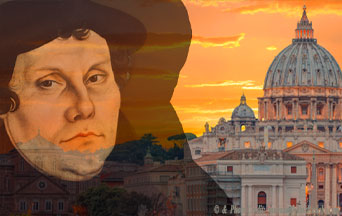
The Summary also shows the influence of modernism on AL, as well as Luther’s errors: “A second cause of the crisis is the apparent influence of the ideas of Martin Luther on Pope Francis. The letter shows how Luther, the founder of Protestantism, had ideas on marriage, divorce, forgiveness, and divine law which correspond to those which the pope has promoted by word, deed and omission. It also notes the explicit and unprecedented praise given by Pope Francis to the German heresiarch.”11
This shadow of Luther in AL was clearly recognized by enthusiastic supporters of the document, as can be seen from an article in Avvenire, the newspaper of the Italian bishops.
The title of the article by Luciano Moia summarizes the thesis: “Amoris Laetitia and Luther, those surprising crossovers.”
After synthesizing the heresiarch’s thoughts on marriage, the author comments:
Depth of thought and ability to interpret the conjugal value as a common path to salvation allow for a comparison between what Luther wrote and thought five centuries ago with what Pope Francis proposes today in Amoris laetitia. It may seem surprising, and some will consider the parallel inappropriate, but rereading the truly little-known texts of the father of the Reformation on marriage, a brilliant theologian like Fr. Francesco Pesce does not hesitate to write: “The post-synodal apostolic exhortation Amoris laetitia presents numerous elements that seem to open the possibility of structuring a dialogue with what emerged on marriage by and for Luther.”12
“Be a Sinner, and Let Your Sins Be Strong”
Faith, in Luther’s conception, is a mere confidence that we are already saved by the merits of Christ. And, opposing the principle of non-contradiction, he affirms that even sinning, the person remains holy. According to his famous formula, man is “simultaneously a sinner and just (simul justus et peccator).”13
Moreover, in Luther’s famous advice to his disciple Melanchthon in a 1521 letter, he states: “Be a sinner, and let your sins be strong, but let your trust in Christ be stronger.”14
Faithfulness in Marriage
This position of the late Argentine Pope, reiterated by his Augustinian successor, contrasts with traditional Church doctrine, as summed up in the wise words of Pius XI in the encyclical Casti connubii, extolling the fidelity of spouses in marriage:
The second blessing of matrimony which We said was mentioned by St. Augustine, is the blessing of conjugal honor which consists in the mutual fidelity of the spouses in fulfilling the marriage contract, so that what belongs to one of the parties by reason of this contract sanctioned by divine law, may not be denied to him or permitted to any third person; nor may there be conceded to one of the parties anything which, being contrary to the rights and laws of God and entirely opposed to matrimonial faith, can never be conceded. . . .
. . . For matrimonial faith demands that husband and wife be joined in an especially holy and pure love, not as adulterers love each other, but as Christ loved the Church. This precept the Apostle laid down when he said: “Husbands, love your wives as Christ also loved the Church,” that Church which of a truth He embraced with a boundless love not for the sake of His own advantage, but seeking only the good of His Spouse.15
Photo Credit: © muratart – stock.adobe.com
Footnotes
- Leo XIV, “Message of His Holiness Pope Leo XIV on the Occasion of the Tenth Anniversary of the Post-Synodal Apostolic Exhortation Amoris Laetitia,” Vatican.va, Mar. 19, 2026, https://www.vatican.va/content/leo-xiv/en/messages/pont-messages/2026/documents/20260319-messaggio-amorislaetitia.html. (All emphasis of this article’s author is in italics. Original emphasis is shown in bold.)
- See Luiz Sérgio Solimeo, “A New and Confusing Explanation of ‘Amoris Laetitia,’” TFP.org, Mar. 20, 2017, https://www.tfp.org/new-confusing-explanation-amoris-laetitia/.
- Pope Francis, post-synodal apostolic exhortation Amoris laetitia, Vatican.va, https://www.vatican.va/content/dam/francesco/pdf/apost_exhortations/documents/papa-francesco_esortazione-ap_20160319_amoris-laetitia_en.pdf.
- See Luiz Sérgio Solimeo, “Because of Its Grave Errors ‘Amoris Laetitia’ Should Be Rejected,” TFP.org, May 4, 2016, https://www.tfp.org/because-of-its-grave-errors-amoris-laetitia-should-be-rejected/.
- Michele M. Ippolito, “Padre Lanzetta (Francescani dell’Immacolata): “La correctio Filialis è un atto d’amore verso il Papa,” LaFedeQuotidiana.it, Dec. 28, 2017, https://web.archive.org/web/20190721215057/http://www.lafedequotidiana.it/padre-lanzetta-francescani-dellimmacolata-la-correctio-filialis-un-atto-damore-verso-papa/, accessed Sept. 30, 2026.
- Edward Pentin, “Full Text and Explanatory Notes of Cardinals’ Questions on ‘Amoris Laetitia,’” National Catholic Register, Nov. 14, 2016, https://www.ncregister.com/blog/full-text-and-explanatory-notes-of-cardinals-questions-on-amoris-laetitia.
- Pope Francis, “Conferencia de prensa del Santo Padre durante el vuelo de regreso a Roma,” Vatican.va, Apr. 16, 2016, https://www.vatican.va/content/francesco/es/speeches/2016/april/documents/papa-francesco_20160416_lesvos-volo-ritorno.html. (Our translation.)
- Henry Denzinger, The Sources of Catholic Dogma, trans. Roy J. Deferrari (Fitzwilliam, NH: Loreto Publications, n.d.) 456, https://thoughtfulcatholic.com/wp-content/uploads/2023/04/Denzinger-The-Sources-Of-Catholic-Dogma-reduced.pdf.
- See “Correctio filialis de haeresibus propagatis,” “Summary of the ‘Filial Correction,’” https://www.correctiofilialis.org/, accessed Sept. 30, 2026. See also “Correctio filialis de haeresibus propagatis,” https://www.correctiofilialis.org/wp-content/uploads/2017/08/Correctio-filialis_English_1.pdf.
- “Summary of the ‘Filial Correction.’”
- “Summary”
- Luciano Moia, “Amoris laetitia e Lutero, quegli incroci sorprendenti,” Avvenire, Dec. 12, 2024, https://www.avvenire.it/famiglia/amoris-laetitia-e-lutero-quegli-incroci-sorprendenti_83609. (Our translation.) See also: Stefano Fontana, “Luther Exalted by Italian Bishops’ Daily as Precursor of Amoris Laetitia,” NewDailyCompass.com, Dec. 16, 2024, https://newdailycompass.com/en/luther-exalted-by-italian-bishops-daily-as-precursor-of-amoris-laetitia.
- M. Luther, Werke, (Weimar Edition), 56, 272 & 513; See Erwin Iserloh, Joseph Glazik, and Hubert Jedin, Reformation and Counter Reformation, trans. Anselm Biggs and Peter W. Becker (London: Burns & Oates, 1980), 27, https://archive.org/details/reformationcount0005iser/page/n6/mode/1up.
- “Let Your Sins Be Strong: A Letter From Luther to Melanchthon,” Letter no. 99, August 1, 1521, from the Wartburg (Segment), translated by Erika Bullmann Flores, from: _Dr. Martin Luther’s Saemmtliche Schriften_, Dr. Johannes Georg Walch, Ed. (St. Louis: Concordia Publishing House, n.d.), 15:2585—90, https://www.projectwittenberg.org/pub/resources/text/wittenberg/luther/letsinsbe.txt.
- Pius XI, encyclical Casti connubii (on Christian marriage), Dec. 31, 1930, nos. 19, 23, https://www.vatican.va/content/pius-xi/en/encyclicals/documents/hf_p-xi_enc_19301231_casti-connubii.html.