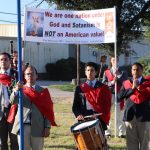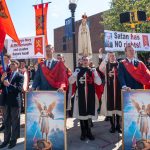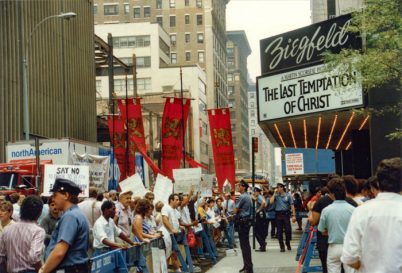
Back in 1988, the American Society for the Defense of Tradition, Family and Property (TFP) joined other Christian organizations to protest against a blasphemous film called “The Last Temptation of Christ.” The production caused outrage by attacking the person of Our Lord Jesus Christ in ways never before seen.
The protests against the film were very intense. However, those who participate in efforts like these often do not see the full impact of their actions. They imagine that their actions are local affairs. They may influence the debate by putting pressure on theater owners from the public offended by offensive “art.” Conversely, critics try to convince protesters that their rallies only give these works free publicity.
However, protests can have an amazing impact. The real story of what happens behind the scenes often only comes out later. People then realize that what might have seemed local or insignificant was, in fact, of capital importance. Protesters can make history.
A Film Made to Succeed
“The Last Temptation” uproar is a case in point. A recent article in The New Yorker tells the story of the film and its protests with the expressive title, “When the Religious Right Came for Martin Scorsese.”
“The Last Temptation of Christ” was a film that Hollywood did everything to produce. Although a low-budget film, the project relied upon the famous director Martin Scorsese, who was passionate about it. His name marked it as an almost certain candidate for success. Hollywood had high hopes for this film and was willing to brave controversy and financial risk to get it into theaters.
The only problem was that the film script was based on the blasphemous novel of the Greek author Nikos Kazantzakis. The plot features Christ on the Cross portrayed as undergoing the most extreme temptations laced with obscenity, nudity and sexual scenes. It immediately provoked the ire of the religious right, who rightly saw Our Lord offended by this outrage.
The Development of a Scandal
The New Yorker article is an excerpt from a just-published book, The Perfect Moment: God, Sex, Art, and the Birth of America’s Culture War. Inside the book, the fascinating story of this film is told from the Hollywood side of the massive protest lines. It details how America strongly reacted to this outrage while profit-sensitive Hollywood executives strove to keep its content under wraps as long as possible.
Indeed, author Isaac Butler acknowledges that “Universal knew the film was going to be a tough sell to the public and wanted help building inroads to the camp most likely to speak out against it.” The firm hired marketing consultant Tim Penland, who had deep ties to the Christian community. The idea was to market the blasphemy as a religion-affirming film that would enrich the Faith of viewers.
However, both sides saw through the ruse and prepared for war. Hollywood sought to turn the case into a free expression battle while delaying any screening. Christians turned the controversy into a moral battle and demanded an end to the secrecy around the film’s production. The studio would constantly edit out the leaked scenes that provoked outrage, while Christians concluded that the whole film and its plot were distorted and contrary to Biblical teaching.
What followed was an intense battle for the culture rarely seen before. It became clear that there could be no third way or compromise between the two sides. No one was fooled by the pious marketing or contrived delays in its release.
Universal Suddenly Releases the Film
In the end, Universal Pictures opted for a sudden early release of the film to avoid being overwhelmed by a more organized opposition. However, the religious right mobilized after the announcement.
On August 11, tens of thousands of outraged Christians protested at the headquarters of MCA, the parent company of Universal Pictures. Protests also materialized wherever the film premiered.
At that time, the American TFP campaigned on Fifth Avenue and demonstrated in front of the Ziegfeld Theater in Manhattan, where it debuted. It also published a full-page advertisement in The New York Times titled “On the Verge of a Public Blasphemy.” The American TFP was at the forefront of the Catholic reaction to the film that swept the nation.
Protests Work
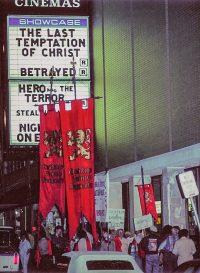
The protests changed the narrative entirely. The public then saw the film for what it was: a public blasphemy. The film’s director, Martin Scorsese, bitterly acknowledged this in an interview with the Spanish newspaper Ya! (Sept. 8, 1988) that the protests and controversy surrounding the film were effective in changing people’s perception of it. He stated:
“However, the problem is that after so much controversy, the public went to see my film already conditioned and convinced that it was sacrilegious and blasphemous. If the public debate around it had not occurred and the press had not given it so much attention, the public would have seen the film with other eyes…”
Indeed, protests work. The low-budget film struggled to break even. After the premiere, interest in the film shriveled due to public perception shaped by the intense debate.
A New Template Against Blasphemy
The “Last Temptation” protests were much more than just an episode in the culture war. It changed the way the war was fought. Mr. Butler notes that the experience gave rise to a “conservative playbook,” which set “the template for the culture wars that followed.”
The author explains that religious organizations would use this template over and over with success against the long train of outrageous creations masquerading as art. His narrative makes it clear that the left is not nearly as adept at mobilizing public opinion to its cause when it promotes blasphemy and sacrilege.
The battle continues to this day. Although biased toward the left, works like Mr. Butler’s provide rare occasions when those who fight for morality and the Faith can see the effectiveness of their methods. Those on the ground who protested at “The Last Temptation of Christ” did not perceive they were laying the groundwork for the culture wars to come. They had no idea that they were making history.
Photo Credit: American TFP Photo Archive