
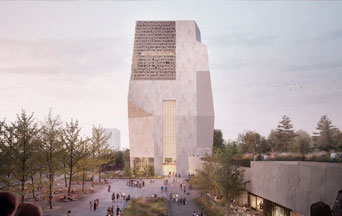
The Barack Obama Presidential Center will open to the public on June 19 and is already surrounded by controversy, primarily for its appearance. In fact, controversy has been a constant companion of the project since its announcement. To call it stark is an understatement. In fact, one admittedly right-wing source referred to it as “the tomb” and “a tower of doom.” Even The New York Times, which supported Mr. Obama politically, coined the term, “The Obamalisk.”
Clad in gray limestone, the tower, at a distance, gives the impression of bare concrete typical of the Brutalist style, which it resembles in other ways as well. It is fundamentally a gray, square, eight-story, windowless structure.
The Roots of Brutalism
For those who prize beauty, Brutalism is difficult—perhaps impossible—to understand. It is necessary to look at a previous architectural style and a world-shaking event.
The movement was known as Bauhaus, also known as the “International Style.” The Bauhaus originated in Germany after World War I. It has two primary elements — functional design and a near total lack of ornamentation.
While the Bauhaus emerged from World War I, Brutalism is largely a product of World War II. In 1945, a devastated Europe needed to rebuild quickly. Unadorned reinforced concrete proved a quick way to build large buildings and to reflect the sentiment of moral devastation that reigned at the time.
Brutal Materials and Stark Appearance
A Brutalist supporter tried to wax poetic. “Brutalism is often reduced to a surface treatment, raw concrete, and a severe attitude, but its real identity is deeper. At its core, Brutalism is a disciplined architectural logic.”
The so-called logic is found in its raw, unadorned materials, which it considers true and untarnished by ornament. It cultivates the stark appearance of forms, misinterpreting them as clarity of design. It represents a cult to ugliness that rejects the architectural beauty of past epochs.
Architects who specialize in the style enjoy its plasticity and practicality. Once designers position the main structural elements, they can create a wide variety of forms. They can put windows wherever they will be most useful. Walls can be curved or come together at non-standard angles. Cantilevered balconies can be placed wherever the architects wish. It is even possible to defy once-basic tenets of construction by making the lower stories smaller than those above them.
Burden for Decades of Occupants
However, the flexibility that the architects enjoy does not extend to the eventual users of the structure. The building eventually proved impractical.
Elements that cannot be made out of concrete, like windows, doors, curtains, cabinets and plumbing, are all manufactured and placed by the architect or builder. Once in place, they become entombed in poured concrete. They may look correct and work well when they are new, but as these materials deteriorate with age and use, they are often difficult or impossible to replace. Once installed, an inconvenient window must remain; the kitchens and bathrooms depend on immovable plumbing. Any alterations require heavy equipment and engineering skill, resources unavailable to most.
The nature of concrete also adversely affects eventual users. The unremitting grayness depresses the soul. In humid climates, they take on an undefinable damp smell. In cold areas, they are difficult to heat because the thick walls retain the cold. Their usually flat roofs are ill-suited to areas that receive substantial snow and rain.
Faux Brutalism?
As previously noted, the Obama Library is not, purely speaking, Brutalist because its architects clad it in smooth sheets of gray limestone. However, this finishing touch is largely invisible from a distance because it is gray, lacking even the minimal color and texture variations of unfinished concrete. Thus, the building follows most of the other Brutalist rules.
Peculiarly, there is a bulge about halfway up each side of the building. According to its designers, Ted Williams Billie Tsien Architects, it is meant to resemble “four hands, joining together, reaching skyward,” creating a square. The bulge represents the knuckles. Certainly, the image of clasped hands indicating unity is nothing new; however, instead of grasping each other, these hands are at ninety-degree angles. Does anyone actually join hands that way?
The only thing that could be called decoration is a series of letters that festoon the upper part of the southwest corner of the building. Dubbed “The Power of Words,” the letters form a quotation from one of President Obama’s speeches. However, from ground level, the words have no power because it is impossible to read the lines that wrap around the building. When asked about this, designer Michael Bierut embroidered a layer of pretentious verbiage.
A Fountain of Pretense
“Is legibility the primary goal here? Do we want people to be able to stand on the ground, look up at this tower, and read those words? And that was discussed on the client end, and the answer came back, ‘No, it should have the promise of meaning.’”
The purpose of words, whether spoken or written, is to convey understanding. To have power, those words must say something. To convey only the promise of meaning is useless. It is a meaningless waste. This feature is not art, but a brutal assault upon observers.
There is another disconcerting point. Typically, presidential libraries are repositories of the papers of the president they commemorate. Their primary function is to provide a space for researchers to examine the historical record through the original documents. Often, a museum is attached to provide the general public with an overview of that presidency, usually from the perspective of the president or his family.
However, the Obama Center does not include a presidential library. According to the National Archives, the original documents are currently housed “in a temporary facility,” and access to them will be through the internet. Only the museum will occupy the tower on Chicago’s south side.
Jackson Park
The Obama Center’s site is also controversial. It occupies 19.3 acres in the 551.5-acre Jackson Park, on the shore of Lake Michigan. The park is one of Chicago’s most historic sites, having been laid out by Frederick Law Olmsted and Calvert Vaux, who also laid out Central Park in New York City. In 1893, it served as the site of the World’s Columbian Exposition, timed to celebrate the 400th anniversary of Columbus’s discovery of America.
Scholars consider Frederick Law Olmsted to be the father of landscape architecture. He was renowned for his ability to take barren and unlovely landscapes and create mounds, streams, bridges, plantings and open spaces that appeared to have been in place since the beginning of time. Therefore, the entire site had long been listed on the National Register of Historic Places.
Unfortunately, Chicagoans will need to live with this ugly scar on that beautiful site. It is one more brutality among many.