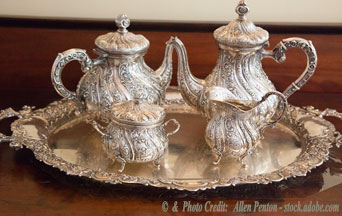
The expression “family silver” used to mean a household’s most prized physical assets. Such collections consisted of valued heirlooms gathered over generations, with strong historical and sentimental value in addition to their intrinsic worth.
Thus, families handed down the family silver for centuries, believing these things meant something. They were not taken lightly. They were used in times of festivity, rites of passage or even pawned when in dire need.
Handed Down or Melted Down
Such a view has now changed. Some children don’t want the family silver. They prefer to have it melted down rather than handed down.
Thus, aging parents face the dilemma of what to do with these assets that sit in boxes in their basements, taking up space. It is not only the children’s fault that they don’t value these things. Indeed, many parents themselves never used the heirlooms for their intended purpose during their lifetimes for special occasions. The children now see no purpose in keeping the collection intact.
However, the decision hurts some parents. One afflicted mother recently wrote: “[The] items in my collection aren’t just relics from a different generation but works of art that, once melted down, can never be reclaimed or replicated. Being complicit, however reluctantly, in their destruction seemed almost sacrilege.”
Other parents are only too willing to take the “stuff” to dealers who offer top dollar for old silver. The extra cash might come in handy for vacations, charity or distribution among the children. The cashing in of these objects gathered over generations might just pay for the next instant pleasure of a family cruise.
It’s Not About the Silver
Indeed, the problem of the family silver is not about the silver. It is about what happens when the notion of family continuity breaks down. The physical silver reflects long-abandoned “spiritual” silver, melted down years earlier.
The modern family lives in the context of the present. Its members see themselves as partakers of the family’s many benefits but do not feel particularly constrained or even defined by it. Each generation lives its cycle much like individuals live theirs. They are unencumbered by the past and not committed to a specific future. The modern family has no spiritual silver to hand down.
On the contrary, the notion of the family silver fits with a family seen as a social unit that includes past and future generations. The family was part of a timeline rich in meaning and purpose. The family was considered the sum of past ancestors, present members and future descendants. Measures were needed to honor those who came before and provide for those coming after.
Family Projecting over Generations
Thus, it was not only the silver that was handed down. Families handed down their name to be honored, defended and made better. They passed down status and high standards so present members could honor the benchmarks set by their forefathers. The silver was just a physical representation of these symbolic and intangible family goods that needed to be conserved.
These goods brought duties and responsibilities. Thus, families honored a duty to save money, work diligently, and keep themselves at a level befitting them. They sought to give their children a better life with each new generation. They did this not for their enjoyment or advantage but so that all might live lives full of meaning and purpose.
The most important thing in family life was to be truly Christian. The family must serve God first and foremost. Obligations toward the family name and tradition were secondary.
This resulted in an elevated, pious and tranquil life that satisfied the desires of the soul. It meant celebrating the simple, unpretentious, ordinary pleasures of life, as well as special occasions when the family silver became a natural complement to the intense joys of family life.
Saving the Family Silver
People sell the family silver today because they no longer have the traditions and uses that gave it meaning. They sense no need to uphold a family name or adhere to past standards set from time immemorial. In these individualistic times, the welfare of individuals trumps that of the family.
Thus, there is no reason to celebrate together with silvery splendor. Everything is so hollowed out that all can be questioned and doubted inside today’s postmodern nihilism. For many people, melting down the family silver is not even an issue.
Those who still feel some remorse or harbor longings for what the silver represents might take some measures. Perhaps they might give select pieces to their offspring with the promise of keeping at least some pieces, in anticipation of a day when it might be valued again. Another might take advantage of a special anniversary and hold a kind of Babette’s Feast with the family silver ablaze in all its splendor. Another might melt down a portion of the silver and make silver roses to place before a statue of Our Lady, imploring a return to an order that values family heirlooms.
However, one thing is obvious: coercion cannot solve the problem. A solution requires a change of heart. It will come only when people realize how the asphyxiating nature of a world centered on self leads to so much stress and despair. They must see how the frenetic intemperance of hurried lives, idolized money and pleasure, and shallow relationships creates a void that demands to be filled.
At a point of desolation, not unlike that of the Prodigal Son, God and His grace must fill that void with the joy that only truth, goodness and beauty can provide. Indeed, the enthusiastic, jubilant movement of some youth toward God and tradition today proves this can happen. Souls filled with joy will provide a reason to celebrate together again. That joy will call forth the tarnished family silver from dusty boxes and make it shine anew.
Photo Credit: © Allen Penton – stock.adobe.com