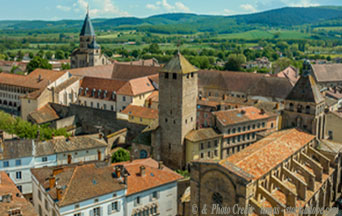
Cluny, the famous abbey in Burgundy, led the monastic reform of the High Middle Ages. Academic studies about Cluny have multiplied, and the monastery’s prestige has grown accordingly. Its glorious history, now better known, arouses an ever-increasing interest and even enthusiasm among researchers.
Cluny began when Blessed Berno (850-927) founded a small monastery in 910 on lands donated by William the Pious, Duke of Aquitaine. It had four great abbots: Saint Odo (878-942), Saint Mayeul (906-994), Saint Odilo (962-1049) and Saint Hugh (1024-1109). Their long tenures extended over two centuries. During that period, Cluny completely reformed monastic life in Europe, contributed effectively to the reform of the Church, largely formed Christendom and led it to the great achievements of the Middle Ages.
During the Rule of its four great abbots, Cluny gained the leadership of religious life in the West. It kept that leadership with glory and majesty. “With Cluny,” says a historian, “throughout these two centuries one has that impression of solidity and permanence in tradition which used to be expected of the Holy See; Cluny truly is a new Rome.”1
“I do not know,” says another author, “what enthusiasm, vogue or salutary fashion attracts everyone—popes, princes and monks—to Cluny as to the safest port. Spain and England are influenced [by this holy contagion]. Cluny became the official guardian of monastic regularity. When a monastery’s observance of religious discipline decays, the pope hands it over to Cluniac zeal. Hugh seems to be truly the abbot of abbots. Except for the pope, no one is comparable to him in Christendom.”2
During the early days of the Holy Roman Empire, Cluniacs led Empress Adelaide. They helped the first three Ottonians, Saint Henry II and Conrad, providing spiritual and political advice to restore Charlemagne’s Empire. During the Spanish Reconquista, Cluniacs helped fight against the Muslims. Cluniac monks contributed to raising the papacy from the opprobrium into which it had fallen in the ninth and tenth centuries. One of their monks eventually became Saint Gregory VII. The Cluniacs, then, collaborated with him in his gigantic struggle against Emperor Henry IV to affirm the primacy of the spiritual over the temporal.
In scholarship, Cluny interpreted the Canticle of Canticles. With all its prestige, Cluny composed, encouraged and propagated the epics of Christianity. Cluny was the creator of Catholic feudalism. In short, the history of this incomparable monastery has much to offer to those enthralled by Christendom in all its splendor.
Cluny undoubtedly had opponents, but it was so great that no one dared to deny its greatness. The abbey played an effective part in all the outstanding events of that time, gloriously influencing them. In today’s academic circles, arguments rage over the extent of the Cluniacs’ role in each. For example, an article by E. Delaruelle assessed Cluny’s role in forming the idea of the Crusade. Below, we transcribe the study’s initial topic, as it provides a picture of researchers’ strong interest in the history of the famous abbey.
“If Cluny’s role in the eleventh century was considerable from the standpoint of religious history, it may have been exaggerated regarding political, social, and literary history. Thirty years ago, a current that could be called a true ’pan-Cluniacism’ dominated among certain historians. They made attempts to explain that era’s vitality and fruitfulness through Cluny. They credited Cluny with having a decisive influence on the Gregorian reform, the development of pilgrimages to Santiago de Compostela, and the writing of the Songs of Songs. Just as we see a Church—predominantly spiritual until that time—organize itself as a legal and political society, and a holy pope like Gregory VII become a Kriegsmann and a Finanzmann, we also see the monastic institution become increasingly involved in the world, pressured by circumstances and responding to various appeals.”3
Nonetheless, no one denies Cluny’s contribution to every great achievement of the High Middle Ages. Instead, historians seek to specify Cluny’s influence on them more specifically. In his article, Delaruelle considers excessive the position taken by Anouar Hakem, who posits that Cluny “prepared the holy wars more or less as the encyclopedists prepared the French Revolution through a work to educate people’s minds.” Although this opinion, “perhaps attenuated,” is also shared by other specialists on the subject, such as Chalendon, Boissonade, and Joseph Bédier, Delaruelle adds that one can maintain that “Cluny contributed powerfully to the formation of the type of Christian’ miles’ [soldier], that new historical character and hero of the crusades. Instead of agonizing over the militia saecularis, militia, malitia, as was the case with earlier monks, the Cluniac writers celebrated the virtues of the knight who puts his sword at the service of the Church. They even showed appreciation for their sporting or worldly qualities. I might add examples cited elsewhere, the “Tibellus,” which glorifies Maïeul’s father, and the ’Jotsald’s Deploratio’.”4
Therefore, while deeming Anouar Hakem’s opinion exaggerated, Delaruelle does not deny that Cluny contributed powerfully to the formation of the combative Catholic knight. This representative character of the Middle Ages put his sword at the service of the Church, always ready to serve her and willing to shed his blood in every epic involving the Catholic cause.
Many similar examples exist. However, this example is sufficient to show that there is not the slightest doubt among historians about Cluny’s outstanding role in forming the Middle Ages.
Photo Credit: © tamas – stock.adobe.com
Footnotes
- Delaruelle, Latreille, Palanque, Histoire du Catholicisme en France, vol. I, 251.
- Msgr. Charles Poulet, Histoire de l’Église de France, t. I, 124.
- Delaruelle, L’idée de Croisade dans la littérature clunisienne du XIe. siècle et l’Abbaye de Moissac, Annales du Midi, n° 75, Toulouse, 1963, 419-420.
- ibid., 422.