
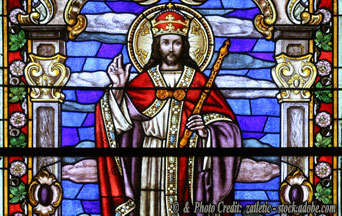
A debate is raging around some Christian rhetoric circulating among conservatives. Liberal critics are saying that right-wing extremists have weaponized particular Christian phrases, which everyone should therefore avoid.
The phrase now in the national spotlight is “Christ is King!” The liberal media say that the mere mention of this expression signals Christian Nationalist sympathies, Groyper support or anti-Zionist proclivities.
Abusing the Phrase Christ is King
It does not take much to trigger this labeling. Those who say that America is a Christian nation and owes allegiance to Christ are labeled right-wing extremists. When members of Congress include the phrase “Christ is King” in speeches and on social media, liberals imply that this is a step toward a right-wing theocracy. Others say that any affirmation of Christ’s kingship harbors a death wish for the State of Israel.
Certain figures on the right misuse the expression ‘Christ is King’ in ways that deliberately provoke these characterizations. Others treat the term as a convenient cultural identity marker while holding no true loyalty to Christ as King themselves and living as the Ten Commandments did not exist.
Indeed, some “cultural Christians” want the Christian identity but none of the obligations to follow God’s moral law that come with His kingship. However, such un-Christian people do not own the phrase. The Latin dictum abusus non tollit usum applies. The abuse of something is not a valid argument against its proper use.
Those who proudly and correctly hold the banner of Christ is King must not retreat in the face of those on the right who misuse the expression, or those on the left who defame those who enthusiastically proclaim it. However, in today’s largely unlettered and toxic climate, such brave Christians need to explain what the expression means and why it is important.
The Real Culprits
Those who misuse Christ is King the most are the liberals who attack it, not Christians. These liberals wrongly frame the debate by mutilating this kingship. They insist that the concept be reduced to a mere personal relationship with Christ, disconnected from the public square or the real world. They label any effort to expand Christ’s reign beyond the private sphere as an attempt to impose religion and establish a theocracy.
For liberals, the expression is treated as a cultural thing, or better, a subcultural thing that ghettoizes Christians into non-public spaces without any social projection. Such liberals are the least qualified to opine about Christ and His kingship. Yet, they insist upon constructing an official, secular narrative that explains religion as sentimental personal behavior, not public worship.
Dethroning Christ
Such a characterization effectively dethrones Christ as King. He is reduced to an exiled monarch with no influence over His rebellious subjects in civil society. He is only allowed a very circumscribed reign over individual, intimidated and closeted hearts.
This truncated liberal understanding of Christ’s kingship is false. Christians understand the phrase to mean that Christ is truly King over all of society, regardless of what others believe. The fact that some ignore or deny His kingship does nothing to alter it. As the saying goes, “the moon does not care if the dog barks at it.” What unbelievers think does not change the reality that Christ reigns over all.
This kingdom is not an imposed reign but one driven by God’s love. The king is not a tyrant but a loving Father who desires the best for His children. His rule demands nothing contrary to human nature, but proposes a moral law that assures the greatest possible happiness in this valley of tears. By affirming that Christ is King, Christians express the best possible outcome for individuals and nations. Christ’s kingship frees them from the shackles of their intemperance and unbridled passions.
The Position of the Church
For this reason, the Catholic Church instituted the Feast of Christ the King to celebrate this great benefit to humanity. The image of Christ the King has long been popular in Catholic devotions and invocations. Catholics have never made a secret of their acknowledgment of Christ as true King, especially in modern times.
In 1925, Pius XI issued his encyclical Quas primas to oppose the tyranny of modern secularism and the rise of anti-Christian regimes. The document outlines the many reasons why Christ is King. Four of these are worthy of special mention.
Why He Is King
The first is a recognition that Christ is King because he is God. All things were created by Him and for Him. His divine nature demands that He be justly honored and that all act in conformity with His will. Thus, Pius XI writes: “He reigns, too, in the wills of men, for in Him the will was perfectly and entirely obedient to the Holy Will of God, and further by His grace and inspiration He so subjects our free will as to incite us to the most noble endeavors.”
Secondly, Christ is King because He redeemed humanity, which belongs to Him through His sacrifice. This is no figurative right but an actual right of conquest. Consequently, humanity owes Him thanksgiving, praise and worship for this great favor.
Thirdly, because Christ is King, individuals and nations ignore Him to their detriment and peril. Pius XI notes that “As long as individuals and states refuse to submit to the rule of Christ, there will be no lasting peace among nations.”
The Social Kingship of Christ
Finally, Pius XI taught that Christ exercises a social kingship that extends from individual hearts to public life, politics and the legal systems of nations. His reign necessarily radiates outward into every aspect of human society, including the family, culture and even political matters.
The pontiff complains that the modern world follows a contrary course. “While nations insult the beloved name of our Redeemer by suppressing all mention of it in their conferences and parliaments, we must all the more loudly proclaim His kingly dignity and power, all the more universally affirm His rights.”
A Much-Needed Message
The encyclical’s central message proclaims Christ not only King of hearts but also King of nations. His moral law should guide political and economic life, because it is the most perfect path toward order and peace.
Catholics should be proud to deliver this message to the postmodern world that so militates against it. They should denounce those who abuse the expression for their self-interest. They should also lament those who have no faith and reject the benevolent kingship of a loving God.
Christ is King, no matter who says it or not. Regardless of the opinions that people hold, the truth is and will always be, “Christus vincit, Christus regnat, Christus imperat!” The Church has always taught that “Christ conquers, Christ reigns, Christ commands!”
Photo Credit: © zatletic – stock.adobe.com