
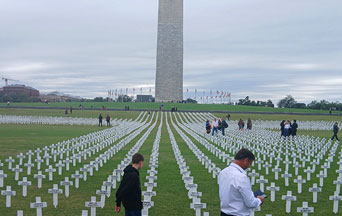
On September 25, 2026, the South African group Lex Libertas planted 3,000 white crosses on the Washington, D.C., Mall. The dramatic display was in honor of the victims of politically and ideologically inspired farm attacks that are instilling a reign of terror in rural South Africa. This violence prevents farmers from doing what they do best: farm and thereby feed a nation.
The two-day event consisted of a conference at the National Press Club and the planting of the crosses on September 25. The next day, there was a vigil and presentation in front of the crosses, with wreath-laying and recognition of victims whose names were on the white wooden crosses.
As a South African visiting America, I represented Family Action South Africa. Eager to hear news from my beloved country and to speak some Afrikaans once again, I braved the early-morning Washington traffic and attended both days of the event.
The conference included testimonies of farm attack victims living within an already crime-ridden country. There were presentations on the critical importance of private property, which is now being eroded in South Africa. During the conference, it became very clear to me that South African media outlets are underreporting and misrepresenting the victims of these attacks.
Samuel Samson of the U.S. Department of State’s Bureau of Democracy, Human Rights, and Labor presented the U.S. government’s position on seeking improved relations with South Africa. However, he noted that the South African government has not responded to the simple “5 asks” that America has requested to fully engage with South Africa.
One of these “asks” is to publicly condemn the atrocious chant, “Kill the Boer, Kill the Farmer!” Julius Malema, leader of the far-left group Economic Freedom Fighters (EFF), has led this chant at political gatherings and rallies. The chant is often accompanied by sounds imitating gunshots and the appropriate hand gestures. Speakers frequently shout out racial slurs against “whiteness” and the need to exterminate it.
This pernicious hate speech and incitement to violence have created a climate that has led to the brutal murder of many victims of farm attacks. The hard work of Lex Libertas and associated organizations has proven this link. However, the South African government continues to deny that any such problem exists and blatantly refuses to condemn the EFF chant. Even if the farm murders did not exist, the chant should still be condemned.
After the conference ended, we headed over to the Washington Mall. We then planted our 3,000 white crosses in a broad strip of lawn running through the city’s heart close to its most iconic sites. I was touched to see how many people pitched in to help with this sorrowful task. Members of Lex Libertas and the New York Young Republicans, the event’s sponsors, worked out all the logistics.
I also saw South Africans, whether refugees, U.S. residents, or visitors, get involved. However, what really moved me was to see American passersby who, upon inquiring what was going on, pitched in to help with a zeal to honor and mourn the senseless loss of these victims.
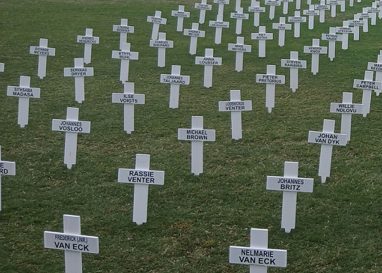
With so many willing hands, we planted all the crosses and prepared for the ceremonies the next day.
The murder of South African farmers started in the eighties and greatly increased in the nineties. The numbers remained high until the last couple of years. The rate decreased due to pushback from farmers who formed patrols and security groups to compensate for the South African Police Service (SAPS)’s inability to ensure rural safety. International exposure also helped bring the issue to the fore.
The sinister farm murders follow the classic communist tactic employed, for example, in Brazil in the sixties or the former Rhodesia in the seventies and eighties. The goal is the destruction of the institution of private property and the state ownership of all land.
In South Africa, where we have a diverse racial population, playing the race card is an easy way to incite violence and perversely try to justify these crimes. This race card is merely a smoke screen, used to eliminate social classes, seize wealth and property, and impose equality upon all, save the handful of cronies who remain at the top and profit from the “joy” of everyone’s newfound equality. They destroy anyone who stands in their way.
Such indiscriminate crimes were clearly evidenced by the large number of names on the crosses of South Africans of all ethnic origins, Afrikaner, Black, English, Coloured, and Indian. The idea that this campaign is solely focused on “white” victims is a lie. No South African is truly safe while such atrocities are tolerated.
The long-term implications of murdering farmers and seizing their land are indeed great. For if today it is justifiable to murder farmers, then what will prevent the murder of business owners tomorrow? If today one can target a certain race without fear of reprisal, what will prevent an attack on a different race or ethnic group tomorrow? And if land can be obtained through murdering the current owner and moving in, what protection would the murderer-turned-new-owner have against anyone else who takes a liking to the same piece of land and decides to become the next murderer-turned-owner…?
In a country like South Africa, where jobs are scarce and skilled people are needed, the murder of every farmer means the loss of employment for anywhere between 2 and 200 workers, depending on the size of the farm. Under such harsh conditions, those who survive often head overseas where things are safer. South Africa thus loses critical skills that it cannot afford to lose. The less fortunate ex-farm workers, however, must remain behind to join the ever-growing ranks of the unemployed.
Lex Libertas has taken the time and effort to verify the names and stories of every single one of the crosses. The veracity of the names cannot be doubted. And the stories are heart-rending. At the inauguration of the crosses and the vigil, Lex Libertas president, Dr. Ernst Roets, recounted a few of the stories, including that of a 12-year-old boy who was drowned in a tub of boiling water after the perpetrators had killed his parents.
Standing in front of 3000 crosses, each with a name and a story behind it, was a very sobering experience. These crosses represented people who were killed for no other reason than that they stood in the way of what Julius Malema called “the revolutionary process.”
What really surprised me is the vicious backlash this campaign has received from the left. We saw people focusing on small inaccuracies, lambasting the organizers as fear-mongers, and misreporting events. Some even went so far as to deny that the crimes took place, despite the vast amount of data proving otherwise.
Indeed, some people dismiss the murder as just an “ordinary crime” gone wrong or turned violent. To speak of ‘ordinary crime’ as if that were acceptable shows they already have no real feelings for the suffering of others.
For those who have any doubt about what is happening, I strongly recommend watching the documentary “Crossed Out,” released by Lex Libertas at the conference.
There are many reasons Lex Libertas is focusing on farm murders rather than rampant crime in general.
The first reason is that Lex Libertas has limited resources. Trying to represent all crime in South Africa would be impossible due to the scale.
Second, the farm problem has a solution. Bringing awareness about gang violence or stock theft has no immediate solution, largely due to the incompetence of the SAPS. Meanwhile, the farm murders can be largely solved by a condemnation by the South African Government of the “Kill the Boer” chant, providing financial aid to those involved in farm security, and several other solutions presented by Lex Libertas.
Third, the public in general should be very happy about the White Cross Project, because it helps spotlight South African crime in general, since farm murders are part of this trend. This exposure benefits all South Africans.
Fourth, the reason for the focus on farm murders is that they are the only crimes that are actually encouraged publicly. No political leader ever calls for further gang violence, car hijackings, or cattle theft. However, a major political party leader can be seen prancing on a stage in front of 90,000 people in a stadium, calling for the murder of farmers, and pronouncing racial slurs against “whiteness” and saying such things as “A revolution needs bloodshed.”
Fifth, all crime has a right to be exposed and denounced. Anyone who opposes such denunciations because they do not favor an agenda is implicitly favoring crime.
In conclusion, we must keep our focus on the bigger picture. We are a nation ridden by crime, facing enormous economic challenges. However, the real issue is how we as South Africans can survive as we try to make it in our beautiful country.
Especially as Catholics, we must remember that we must always be champions of what is good and true and oppose, everywhere, the forces of evil and error. This tragedy transcends a series of murders, a country ridden with crime, or a communist attempt to complete the destruction of what was once the most successful economy in Africa. It is ultimately another scene of the futile effort of Satan to depose God as King of Heaven and Earth, and try to force his own perverse rule of pride and vice on mankind. With this foremost focus, we can successfully concentrate our efforts on rebuilding Christian civilization with Jesus Christ as the ultimate authority. Unless man is repentant and follows God’s Law, he will always fall into error and suffering.
We must not be divided or distracted by those who wish to sow discord between us, and remember that first and foremost we desire to be one nation under God, where, through practice of the One True Faith of Jesus Christ, we may be “delivered from evil,” and attain “life everlasting.” May God bless our people, and God Bless South Africa!
Photo Credit: The American TFP