
Few Catholics have never heard of Our Lady’s apparition in Lourdes, France, to Saint Bernadette Soubirous in 1858. Most famous are the many thousands of miracles that have taken place there through the miraculous spring that Our Lady produced in the Massabielle grotto on the outskirts of the village.
It is perhaps the Marian apparition that most expresses Our Lady’s goodness, mercy and love for mankind in such a vivid, palpable way. Even today, in an age of unbelief and apostasy, Lourdes is one of the most popular pilgrimage sites in the world. Between 4 and 6 million pilgrims travel every year to the town nestled in the Pyrenees mountains seeking cures or spiritual favors. Miracles continue to take place there every year.
To some, it might seem unusual why the Mother of God would appear in such a remote, unknown place like Lourdes. Indeed, few villages in France are farther away from Paris. Why did Our Lady not appear in the capital, like with her apparition to Saint Catherine Labouré in 1830? God, of course, has reasons that transcend human understanding. “For my thoughts are not your thoughts: nor your ways my ways, saith the Lord” (Isaiah 55:8).
It turns out that Our Lady’s apparitions in 1858 were not the first miracles to take place there. Over 1,200 years before Our Lady appeared in the grotto on the banks of the Gave River, she performed another miracle that involved an Emperor, a major battle, and the conversion of a Muslim.
The story takes place in the eighth century. At that time, nearly all of Spain, except for the tiny Kingdom of Asturias in the mountainous north, had been conquered by the Umayyad Muslim caliphate. In 719, the Muslims (or Saracens as they were called) crossed the Pyrenees and invaded France. The invasion encompassed a large portion of southern France from the Mediterranean to as far north as Tours, just 150 miles south of Paris. Their advance was halted in 732, when a Catholic army led by the Frankish leader Charles Martel defeated them at the Battle of Tours. Though beaten back, the Muslims maintained control of southern France for another seventy years.
One of the towns occupied by the Saracens was the town of Lourdes. From their base of support in Spain, the Saracens would send raiding parties into France, killing, stealing, and kidnapping Christians to sell into slavery.
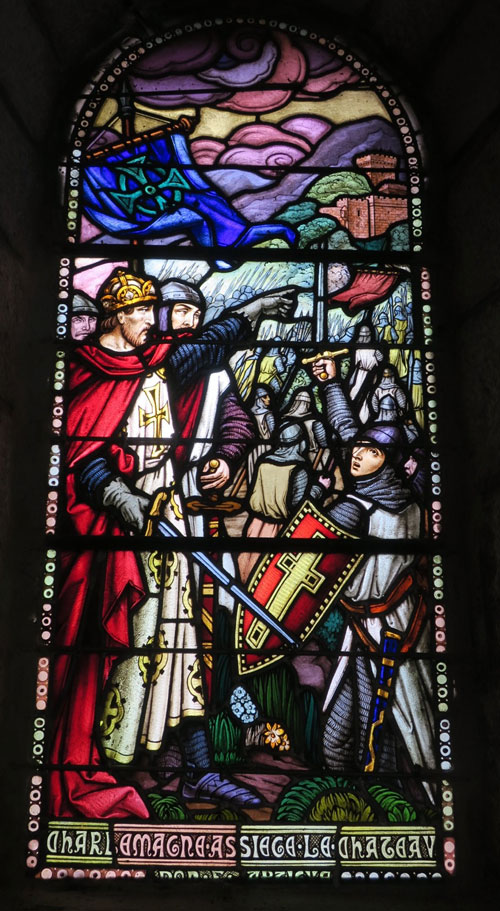
In 768, Charles Martel’s grandson, Charles, became King of the Franks. Charles I, better known to history as Charlemagne, was one of the greatest military leaders in European history. After suffering many years of Muslim attacks, he decided to end the Muslim threat to the southern border of his kingdom once and for all and push the Saracens back across the Pyrenees into Spain. He marched southward at the head of a large army, arriving at the city of Tarbes in Gascony. From Tarbes, his army commanded several main routes through the region and marched on the nearby village of Lourdes.
Lourdes was a strategic town located near one of the ancient Roman roads between Aquitaine in France and Spain. The Romans, seeing its strategic importance, built a stone castle there and named the settlement Oppidum Novum. When the Saracens conquered the region, they occupied and expanded the fort and placed a garrison of soldiers to block any Christian army from passing through.

The stone fortress is located on a steep crag that juts upwards in the center of the town, giving its occupants a commanding view of the town, the valley, the Gave river, and the mountain passes through the Pyrenees towards Spain. Charlemagne immediately saw its importance. He could not invade Spain, leaving such a strategic town in the hands of the Saracens.
Charlemagne’s reputation as a great conqueror preceded him, and many villages surrendered with little or no resistance. Oppidum Novum, however, was led by a strong and fierce Saracen chieftain by the name of Mirat. The castle’s size and location made it impossible to take by assault, so Charlemagne decided to starve out the defenders. After months of siege warfare, the Saracens’ food supply began to run out.
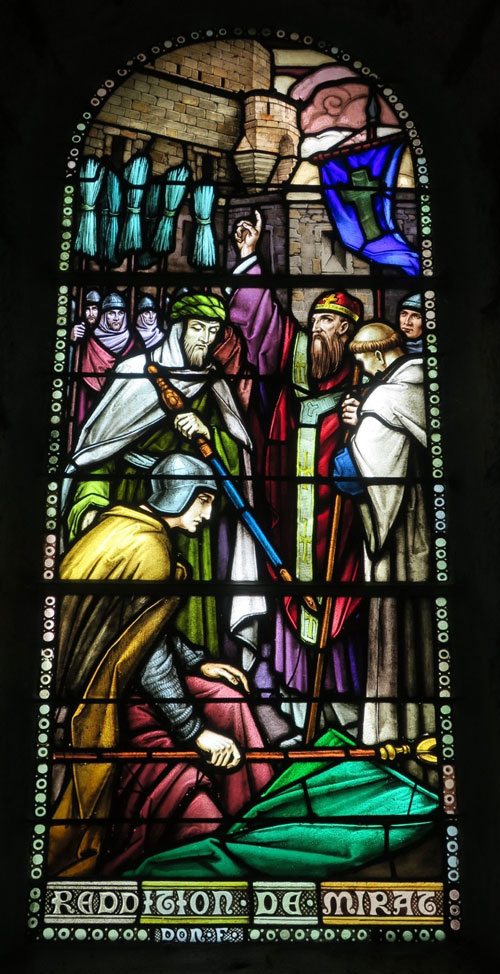
Charlemagne sent his envoy and advisor, Bishop Turpin of Puy-en-Velay. According to tradition, as they were negotiating, an eagle flew over the castle and dropped a large fish at the feet of Mirat. He sent it to Charlemagne to prove that he indeed had plenty of food reserves. Dismayed, Charlemagne was about to lift the siege when Bishop Turpin, inspired by a grace, decided to negotiate with Mirat. He offered him to surrender his arms, not to Charlemagne, but to the Queen of Heaven at her shrine in Puy-en-Velay. Mirat agreed and was baptized into the Catholic Faith, taking the Christian name Lorus, from which the name Lourdes derives. Later, he became a vassal of Charlemagne and remained a great devotee to the Mother of God.
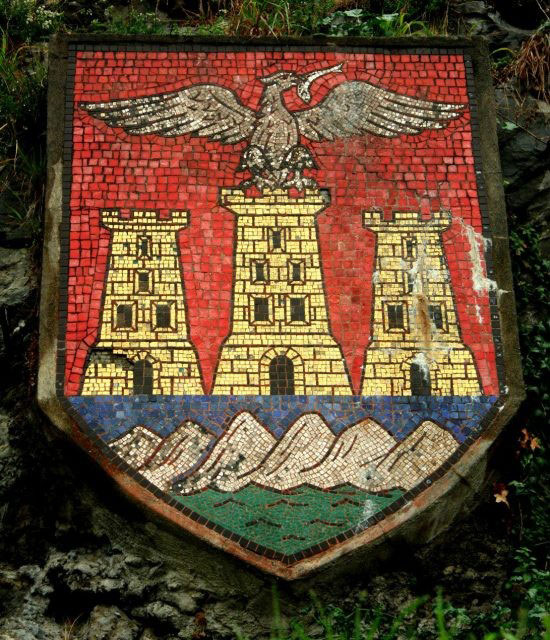
The coat of arms of the city of Lourdes is a shield with a castle, upon which is an eagle with a fish in its beak. After the battle, Charlemagne and his Peers went on to invade Spain, a story so beautifully told in the famous “Song of Roland.” But neither Charlemagne, the great Emperor, nor Mirat, the converted Muslim, could have imagined the plans of Divine Providence for the small town in the Pyrenees nearly 1,200 years later.