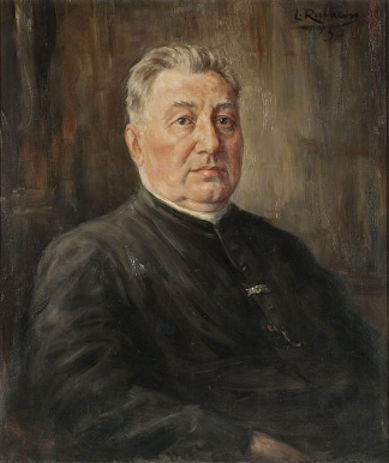
This article is a part of an historical series on the Catholic history of Holland. The last article, “Fr. Poels and the Origins of Modernism in the Netherlands,” tells the story of Fr. Poels’ liberal beliefs. This article reports on the tragic end of his academic career.
The pontificate of Saint Pius X marked a turning point in the modernist crisis. The concessions which Leo XIII had made to the modernist school of exegesis, particularly with the appointment of liberal consultors to the Papal Biblical Commission, were swiftly overturned by his successor.
This resulted in the removal of Fr. David Fleming O.F.M., the liberal secretary of the Papal Biblical Commission, who was then replaced by Fr. Henri Laurent Janssens O.S.B.1 Subsequently, the Papal Biblical Commission issued a decree on June 27, 1906, which affirmed that Moses was the author of the Pentateuch, the first five books of the Old Testament.2
This decree posed a threat to Fr. Henri Andreas Poels, a Dutch associate professor in Old Testament exegesis at the Catholic University of America, who had previously rejected the Mosaic authorship of the Pentateuch in an article he wrote for the theological magazine De Katholiek.3
His course on Hebrew Institutions, as seen in Law and History, which he had prepared for the upcoming semester, conflicted with the decree issued by the Papal Biblical Commission. Fr. Poels therefore decided to travel to Rome in the summer of 1907 to appeal his case to the Pope, who received him in a private audience together with Fr. Giovanni Genocchi M.S.C.:
“I could not and cannot conscientiously teach that Moses was the actual author of the first five books of the Bible, as we have them today. In this view I do not stand alone, for, as a matter of fact, the overwhelming majority of Old Testament scholars – yea, practically all the Old Testament critics, of any name, are agreed on this point. Therefore, to my mind, there could be no question of personal intellectual pride.”4
During his private audience, the Pope told him that due to his rejection of the Mosaic authorship of the Pentateuch, he was unfit to teach exegesis at the university and had to resign from his chair.5 But in spite of what the Pope had ordered, Fr. Poels continued his lectures in Washington upon his return without informing the board of directors about his audience with the Pope.
On February 12, 1908, Fr. Poels wrote a letter to Fr. Janssens O.S.B., in which he deceivingly claimed that both Fr. Janssens O.S.B. and Fr. Genocchi M.S.C. were entrusted by the Pope to judge his case.6 A few months later, Fr. Janssens O.S.B. answered that although Fr. Poels could no longer continue his lectures, that he could retain his chair at the university.7
The tide turned for Fr. Poels in the summer of 1908, when Bishop Denis J. O’Connell, the rector of the Catholic University of America, was received by Saint Pius X in an audience, during which the Pope had again ordered the resignation of Fr. Poels.8
After Bishop O’Connell had ordered the lectures of Fr. Poels to cease, his case was discussed during the second annual meeting of the board of directors on April 21, 1909. After examining the testimonies of Bishop O’Connell and Fr. Poels, the board judged the affair to be a misunderstanding and exonerated Fr. Poels of all charges.9
However, as of July 1909, Bishop Thomas Joseph Shahan, the newly appointed rector of the university, further discussed the case of Fr. Poels with Saint Pius X.10 The Pope then confirmed in an autograph memorandum that he had ordered Fr. Poels to resign from the university and never entrusted the matter to the judgement of Fr. Genocchi M.S.C. and Fr. Janssens O.S.B:
“The Holy Father, after admiring and praising Poels’ sincere frankness, declared to him that if he remained firm in these ideas he could no longer continue in that professorship, because he would not be able to teach students what he himself was not convinced of; and furthermore he would fail in a very serious duty if he taught what was not in conformity with the teaching authority of the Church. Since it then seemed that this decision had saddened him, the Holy Father, turning to Father Genocchi, said: ‘Does it seem to you that this judgment is too severe?’ And Father Genocchi added: ‘The response is logical and entirely just.’ And with this the audience ended, without the Holy Father advising him (as is natural) to listen to anyone else.”11
Subsequently on July 17, 1909, Cardinal Rafael Merry del Val, the Secretary of State, then informed Cardinal James Gibbons, the chancellor of the university, that Fr. Poels had to sign the decrees of the Papal Biblical Commission in order to occupy his chair at the university:
“His Holiness wishes me to inform Your Eminence that if Dr. Poels cannot bring himself to make a written statement sub juramento that he accepts and will faithfully teach the doctrine and conclusions given by the Pontifical Biblical Commission, he must necessarily resign his chair… the Holy Father cannot permit a Catholic Professor in a Catholic University to occupy a chair of Sacred Scripture unless he holds and teaches that which is held and taught by the Holy See. If Dr. Poels cannot do so, it is impossible for him to occupy the chair of S. Scripture, nor can the Holy See allow him to do so.”12
On September 11, 1909, Fr. Poels was received in Rome by Cardinal Merry del Val, where he told the cardinal that he was willing to sign the oath which the Pope had issued,13 provided he was allowed to add his own interpretation to “sincere accepturum et fideliter traditurum”.14
This was not enough for Cardinal Merry del Val, whose sharpness saw through Fr. Poels and his deceptions. The cardinal told him that he had to sign the oath without any additional conditions, which meant the submission to the decrees of the Papal Biblical Commission in both the external and internal forum, which Fr. Poels refused to do.
During the meeting held by the board of directors on November 17, 1909, Fr. Poels was summoned. After he had given his testimony, both Cardinal Gibbons and Archbishop Patrick John Ryan asked him if he was willing to sign the oath, to which he again replied that he wanted to add his own interpretation to it.15
After Fr. Poels kept answering in different ways that he wanted to add his own interpretation to the oath, Archbishop Ryan demanded a categorical answer. Finally, Fr. Poels replied that if the oath had to be understood in the most obvious sense, that he couldn’t sign it.
Cardinal Gibbons then asked him solemnly if he would refuse “in the presence of this illustrious gathering” to sign the oath “which the Holy Father has sent,” to which Fr. Poels replied that he couldn’t possibly sign it while remaining an honest man.16
Two days after the meeting, Cardinal Gibbons wrote to Cardinal Merry del Val that the board had decided that the university could no longer retain Fr. Poels as an associate professor in exegesis. Cardinal Merry del Val then replied on December 8, 1909, that the Pope fully endorsed the dismissal of Fr. Poels:
“His Holiness has approved and confirmed everything that Your Eminence reported concerning the matter of Professor Poels, who was present at the Catholic University of America this past September. Therefore, since the said Professor refused to subscribe to the decisions of the Biblical Commission, Your Eminence and the other aforementioned prelates rightly decided that the same Professor should be removed from his teaching office as of next June. Nevertheless, until that time, it will be necessary to keep careful and appropriate watch over both him and his teaching, lest the students suffer any harm.”17
This was the end of his career in the field of exegesis. Upon his dismissal in 1910, Fr. Poels returned to the Netherlands, where the bishop of Roermond appointed him as a chaplain. He never recanted his errors and died on September 7, 1948.
Footnotes
- Kübel, J. (1909). Geschichte des katholischen Modernismus. Tübingen, Germany: Verlag von J.C.B. Mohr (Paul Siebeck), p. 160.
- Denz. 1997-2000, taken from the thirtieth edition (pre-1963) of Fr. Henry Denzinger’s Enchiridion Symbolorum et definitionum (1954).
- Poels, H. A. (1898). De oorsprong van den Pentateuch. De Katholiek, 114, p. 366-367.
- Prof. Frans Neirunck republished the written testimony of Fr. Poels in 1982 and accompanied the original text from 1910 with external sources: Poels. H. A. (1910). A Vindication of My Honor. Washington, D.C., the United States: Press of Judd & Detweiler, Inc., p. 15.
- Ibid., p. 24-28.
- Ibid., p. 46-47.
- Ibid., p. 48-49.
- Ibid., p. 2-6.
- Ellis, J. T. (1952). The Life of James Cardinal Gibbons, Archbishop of Baltimore II. Milwaukee, the United States: The Bruce Publishing Company, p. 172.
- Poels. H. A. (1910). A Vindication of My Honor. Washington, D.C., the United States: Press of Judd & Detweiler, Inc., p. 24.
- Ibid., p. 27-28.
- Neirynck, F. (1982). A Vindication of My Honor, by Henry A. Poels D.D. Leuven, Belgium: Uitgeverij Peeters Leuven, p. 34-34.
- The full profession of faith can be found in A Vindication of My Honor (1910), p. 25: “Ego, Henricus Poels, spondeo, voveo ac juro super sancta Dei Evangelia me sincere accepturum et fideliter traditurum omnes doctrinas ac conclusiones quas hucusque promulgavit aut de futuro promulgabit Commissio Biblica Pontificia. In Cujus fidem manu mea subscripsi.”
- Poels. H. A. (1910). A Vindication of My Honor. Washington, D.C., the United States: Press of Judd & Detweiler, Inc., p. 29-30.
- Ibid., p. 43-44.
- Ibid., p. 45.
- Neirynck, F. (1982). A Vindication of My Honor, by Henry A. Poels D.D. Leuven, Belgium: Uitgeverij Peeters Leuven, p. 37.