
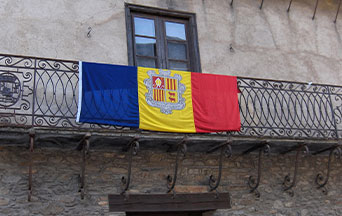
The Catholic Church’s unflinching teaching on the sanctity of life and the protection of the unborn has not changed. Yet, in one tiny European nation, the Church is offering its diplomatic support to moves which will see abortion decriminalized.
The wheels of Vatican diplomacy tend to move slowly and quietly, away from the public eye, seeking results without fanfare. This is true of the Holy See’s relationship with the Principality of Andorra, the tiny nation caught between Spain and France. Yet in this instance, the outcome may very well be that the Vatican has aided Andorra in advancing laws that will lift the penalties that may be levied for abortion.
Andorra’s political and constitutional setup is both complex and unique. The microstate is predominantly Catholic and has two co-princes as joint heads of state. In an arrangement dating back seven centuries, the co-princes are the bishop of the diocese of Urgell and the French head of state. This means that Bishop Josep-Lluís Serrano Pentinat and President Emmanuel Macron share joint responsibility.
Under the microstate’s constitution, the co-princes may exercise certain powers unilaterally, while other powers may be exercised only in conjunction with Andorra’s parliamentary government.
But herein lies the problem. Abortion is currently illegal in the nation, but activists are exerting growing pressure to decriminalize it via an act of parliament. Normally, the signature of only one of the co-princes is required, but it is reported in some outlets that on this occasion, Bishop Pentinat would also be involved in signing.
The move to decriminalize abortion has been underway in Andorra for a number of years. Already in 2014, Bishop Joan Vives i Sicilia announced he would abdicate as co-prince and bishop of Urgell rather than sign the law. The attempt, which was underway at the time, did not come to fruition, yet now it seems the abortion activists might have more success.
Andorra’s head of government, Xavier Espot, is seeking to move forward with a parliamentary bill to decriminalize, though not technically legalize, abortion. Abortions would not be performed in Andorra, and would still be formally prohibited, but in removing the criminal nature of seeking an abortion, the nation would begin the slippery slope already witnessed in many states.
Currently, anyone who procures an abortion for a woman without her consent can be punished with a jail term of between 4 and 10 years, while doing so with her consent can lead to a term of between 3 months and 3 years. In both cases, the medical professional is to be disqualified from practicing for 10 or 5 years, respectively.
The woman who has her baby aborted is also to be penalized with a fine.
The proposed decriminalizing arrangement is one that the Vatican is understood to have been heavily involved in. Vatican Secretary of State Cardinal Pietro Parolin has been negotiating with Andorran officials on the issue for a number of years.
In 2023, the cardinal visited Andorra and stated that for the Holy See, “the principle of defending life at all its stages is fundamental. And this principle is accompanied by the desire to be close to, and to help, all those who are in difficulty.”
Commenting on the proposed abortion legislation, he stated that “we are working, we are reflecting; we are further studying. These are things that cannot be resolved overnight; they require a great deal of participation, a great deal of commitment, and a great deal of effort.”
“We hope,” he said in 2023, “to find a solution that is satisfactory for everyone.”
In more recent meetings, Cardinal Parolin appears to have found room for a compromise on the Holy See’s firm opposition to abortion. Receiving Xavier Espot at the Vatican in July, the cardinal continued the recurring discussions on the topic with both sides welcoming the “climate of trust and discretion” governing the meetings.
Reports suggest that the government’s bid to decriminalize abortion could take its next step in September.
Scrutiny is therefore being raised regarding the Holy See’s role in the discussions, in particular as to why the Vatican is even considering any diplomatic agreement instead of firmly refusing the Andorran proposal. If the Holy See were to fully demonstrate its teaching on the sanctity of life, then no discussions would be necessary, other than firmly informing the Andorran government that the Vatican would offer no support for its proposals.
But as it is, Cardinal Parolin is leading efforts to seek a diplomatic solution, which gives the impression that the Church is open to compromise when it comes to the life of the unborn.
Bishop Pentinat—the sitting ordinary of Urgell and ecclesiastical co-prince—was appointed as coadjutor by Pope Francis in July 2024, acceding to the see in May last year. If he left the signing of any bill to the French president, as is normal, then he would not be able to stop the law from passing.
Yet the fact that the Vatican is so intimately involved in discussions reveals that the Holy See is attempting to somehow approve the bill, allowing for Bishop Pentinat to sign it.
Though framed as a nuanced and delicate diplomatic procedure for the Holy See to handle, it appears to boil down to a subtle surrender on the Church’s teaching regarding the sanctity of life and Her firm opposition to abortion.
What is at stake, however, is the integrity and inviolability of Church teaching. Should the Holy See come to a compromise in Andorra, then its diplomatic power and moral compass are rendered hollow.
Michael Haynes is an English journalist in the Holy See Press Corps. He serves as Vatican Correspondent for the The Catholic Herald, while readers can follow him at Per Mariam and on X @MLJHaynes.