
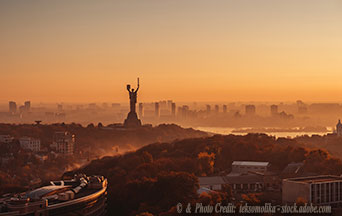
When Vladimir Putin sent his columns rolling toward Kyiv in February 2022, he was certain of victory in a few short weeks. He picked the wrong target.
For the first time since early 2023, the initiative has shifted to Kyiv, and the momentum in the Russo-Ukrainian war is on Kyiv’s side,” U.S. Under Secretary of State Jeremy Lewin said in late June, describing Ukrainian forces on the offensive while “Russia appears to be in a holding pattern.”1
The battlefield data supports Secretary Lewin’s observation. In June 2026, the front line was effectively frozen, with Russia gaining only 11.5 square miles—and even those “gains” were mostly older incursions, belatedly reclassified as advances by Russian propaganda.2
The Center for Strategic and International Studies (CSIS) calls Russia’s offensive the slowest in any war in the past century, with troops advancing in some sectors at less than 180 yards per day. The Institute for the Study of War underscored the absurdity with a bit of math. At June’s casualty rate, Russia would have to lose more than 6.5 million soldiers to capture the rest of Donetsk Oblast alone.3
The Price Paid to Achieve Multipolarity
The price Russia has paid is staggering. CSIS estimates roughly 1.4 million Russian combat casualties since February 2022, including 400,000 to 450,000 killed—a toll that one analysis notes is nine times greater than the combined Soviet and Russian fatalities across all conflicts since World War II.4
The trend line is most telling. For most of the war, the casualty ratio was about 2-to-1 or 3-to-1 against Russia; in 2026, it has widened to 8-to-1 in Ukraine’s favor, largely driven by Kyiv’s drone campaign.
Russia is now bleeding faster than it can replenish, as monthly losses of 30,000 to 34,000 exceed the roughly 27,000 recruits per month.5 An army that loses more men than it can replace is running out of time. This is what happens when a leader treats his own soldiers as mere cannon fodder to feed an insane objective.
The War Comes Home to Russia
Putin assumed the fighting would stay far from home. Instead, Ukraine has carried the war deep into Russia. In a sustained campaign targeting the Kremlin’s energy revenues, Ukrainian drones have struck refineries across the country—even hitting the Kapotnya facility inside Moscow’s ring road, just miles from the Kremlin, demonstrating that even the capital’s dense air defenses could not keep the drones out.6
Ukraine’s reach has become taunting. In early July, Kyiv said it struck the Gazprom Neft refinery in Omsk, Russia’s largest, located some 1550 miles from the border, calling it “the last of the 11 largest gasoline producers in Russia that have been hit.” Putin, who once promised his people a swift and painless “special military operation,” has now been forced to admit publicly that Russia faces a significant fuel deficit. Russia is now importing gasoline.
An Economy Running Out of Steam
Behind the front lines, the war economy, which has absorbed shock after shock, is nearing its limits. Russia’s sovereign wealth fund, its shock absorber since 2022, saw its liquid assets fall from about 6.5 percent of GDP at the start of the war to roughly 1.8 percent by April 2026. In the first four months of 2026 alone, the budget deficit reached 5.9 trillion rubles.
A joint report by the Kiel Institute and the Stockholm Institute of Transition Economics, bluntly titled “Endgame,” concludes that Russia’s economy has entered a fragile phase—marked by slowing growth, shrinking reserves, rising financial risk and deepening dependence on communist China.7 With the front frozen, the sanctions the West spent years assembling are finally taking effect.
Russia’s Attack Only Succeeded in Enlarging Its Enemies
Russia has inverted every aim it set for itself. It invaded to halt NATO’s expansion and shrink the alliance’s presence along its borders. Instead, it doubled it. Finland’s accession alone added nearly 808 miles of NATO frontier along Russia’s northwest, prompting NATO’s then-secretary general to declare that Russia’s attempt to “slam NATO’s door shut” had “failed”—that it got “more NATO,” not less.8
As one analysis put it, Putin sought the “Finlandization” of NATO and instead achieved the “NATOization” of Finland.9 A war meant to weaken his enemies has made them stronger, larger and more united.
Here is the cruel logic of the position Russia created. On the board, it is checkmated. Its offensive is the slowest in a century; casualties outpace recruitment; the economy is burning through its last reserves; the war has come home to Russian cities; its invasion has enlarged the very alliance it set out to shrink. Every rational calculation declares defeat.
Yet conceding would require admitting that the whole enterprise was a catastrophic failure and that Russia is not a multipolar power commanding a global sphere, as it cannot even conquer a border nation one-quarter its size.
At the St. Petersburg forum in June, Putin flatly rejected Zelensky’s offer for direct talks, declaring his war goals unchanged and peace negotiations pointless. Days later, he insisted that any talks proceed only on the terms of Russia’s 2022 ultimatums—in the words of the Institute for the Study of War (ISW), “his view of the maximalist position from which he will start any renewed peace talks.”10
He clings to the fiction of an imminent breakthrough, invoking “battlefield realities” and falsely claiming that his forces are on the verge of collapsing Ukraine’s defenses, even though the evidence shows only incremental, brutally painful advances. He even stages cynical stunts, such as the six-hour “ceasefire” in Kostyantynivka, ostensibly to return bodies, as cover to portray Ukraine as unwilling to make peace.11 Zelensky’s response was to call his bluff: “Let’s meet there.”
The Tragic Conclusion
The tragedy, for Russians and Ukrainians alike, is that the war drags on not because Putin can still win it, but because he bit off more than he can chew. The bully’s gambit was supposed to end with a quick, humiliating lesson for a small country that had gotten “too big for its britches.”
Instead, he has brought humiliation to Russia; hundreds of thousands of his own soldiers are dead, his economy is collapsing, his borders are ringed with more NATO forces than ever, and his refineries are burning from Moscow to Siberia. Despite all of Russia’s propaganda and bravado, it doesn’t appear to be the global player it imagines itself to be in its multipolar dream.
Photo Credit: © teksomolika – stock.adobe.com
Footnotes
- https://euromaidanpress.com/2026/07/06/russia-now-loses-more-soldiers-than-it-recruits-but-the-war-wont-end-because-of-that/
- https://www.euronews.com/my-europe/2026/07/03/ukraine-frontline-frozen-in-june-as-russian-momentum-falters-june-analysis-shows
- https://newsukraine.rbc.ua/news/russia-s-offensive-is-the-slowest-of-any-1782972877.html
- https://nypost.com/2026/07/02/world-news/russia-losing-8-troops-for-every-1-ukraine-solider-killed-report/
- https://newsukraine.rbc.ua/news/russia-s-offensive-is-the-slowest-of-any-1782972877.html
- https://carnegieendowment.org/russia-eurasia/politika/2026/06/russia-new-refinery-strike
- https://freepolicybriefs.org/2026/06/12/russian-economy-2026/
- https://www.cnn.com/2023/04/04/europe/finland-joins-nato-intl
- https://theconversation.com/finland-joins-nato-in-a-major-blow-to-putin-which-doubles-the-length-of-the-alliances-border-with-russia-203217
- https://understandingwar.org/research/russia-ukraine/russian-offensive-campaign-assessment-june-23-2026/
- https://understandingwar.org/research/russia-ukraine/russian-offensive-campaign-assessment-july-5-2026/