
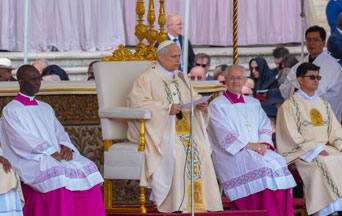
Among the criticism and remarks by ecclesiastics about the current Synodal Process underway in the Church, the Open Letter to His Holiness Pope Leo XIV, by Bishop Rob Mutsaerts, Auxiliary of the Diocese of ‘s-Hertogenbosch, in the Netherlands, stands out for its simplicity and clarity.1
“The Salvation Of Souls Is The Supreme Law”
The August 16 letter’s reasoning is based on the fundamental point of the Church’s primary mission, which is “a concern that ultimately transcends every other ecclesial consideration: the salvation of souls. Salus animarum suprema lex—the salvation of souls is the supreme law.”2
On this basis, Bishop Mutsaerts asks: “My question is a simple and earnest one: does the Synodal Process actually help bring souls closer to Christ and to eternal salvation? That is the decisive question for me.”
The answer to this question is fundamental because “Christ himself has given us a simple criterion for this: ‘By their fruits you shall know them.’ Therefore, I believe that after years of synodal consultations, meetings, reports, and documents, the time has come to openly inquire about those fruits.”
Has the Synodal Process Led to More Conversions?
“It is necessary to have clear and objective answers to the following questions: “[H]as faith become stronger? Has Christ been proclaimed more clearly? Has Catholic identity deepened? Have more people come to convert? Is Sunday Mass better attended? Are there more priestly vocations? Has catechesis become more powerful? Has greater reverence for the Eucharist emerged? Has the moral teaching of the Church become clearer? Has missionary courage increased?”
It is not enough to just answer “how many meetings were organized, ” “how many reports were written,” and “how many people participated, ” while leaving aside the most important thing, which is the salvation of souls.
Bispo Mutsaerts warns that conversion is “[t]he great absentee” of the Synodal Process.
And the letter continues: “Here lies the deepest weakness of the entire project. The Church does not exist primarily to affirm people in what they already are. It exists to bring them to Christ. The first words of Jesus’ public preaching are not: “Tell Me first how you feel about the current church structures.” But: “Repent and believe in the Good News.”
The Sad Reality That Can’t Be Denied
The Open Letter thus summarizes the sad situation of the Church that cannot be denied:
“Churches are emptying. Parishes are being merged. Monasteries are disappearing. Religious orders are aging. Knowledge of the Catholic faith is declining. Confession has virtually disappeared for many Catholics. The number of priestly vocations remains low in many places. Many baptized people hardly believe in the essential truths of faith anymore. Among large groups of Catholics, the sacramental life has been severely weakened. Against that, one would expect a global church operation to primarily address one question: How can we win the world back for Christ?”
The Deepest Problem: Ecclesiology
Bishop Mutsaerts rightly states that the Synodal Process is an ecclesiological process, an attempt to change the essence of the Church:
“Ultimately, therefore, the discussion is not really about gathering. It is about the question: What is the Church? Is it primarily a community that collectively seeks what it is to become? Or is it primarily a divine reality that has received what it is to be?”
The Catholic Church Does not Need a Permanent Synod: It Needs Saints
It is not constant meetings that will overcome the crisis in the Church, but holiness. The Open Letter continues:
“Ultimately, the Catholic Church has no need for a permanent synod about itself. It needs saints. (…) For ultimately, Christ did not send His Church into the world with the words: Go forth and organize synodal processes everywhere. He said, “Go out into the whole world and proclaim the Gospel to all creation.” With that, the Church began. And whenever she was truly renewed, she began there anew.”
Holy Father: Give us Clarity
In the face of the enormous confusion surrounding Synodality, Bishop Rob Mutsaerts concludes his Open Letter with an appeal to the Pope:
“My prayer to you is therefore simple: give us clarity. When the world speaks with uncertainty, let Peter speak clearly. When the Church grows weary of internal discussions, point us back to Christ. When we lose ourselves in processes and structures, remind us of our mission. When we become afraid to proclaim the Gospel in its fullness because it might offend modern man, remind us of the words of Peter himself: ‘Lord, to whom shall we go? Your words are words of eternal life.’”
Footnotes
- Open Letter to His Holiness Pope Leo XIV, by Bishop Robert Mutsaerts. At https://rorate-caeli.blogspot.com/2026/08/open-letter-to-his-holiness-pope-leo.html
- Cfr. CIC canon 1752.