

Self-appointed reformers always arise in times of crises offering “brilliant” solutions that attempt to demolish the Church’s most venerable traditions.
Priestly celibacy, a glorious trait of the Latin Church, has been a constant target of these so-called reformers.
Curiously enough, abolishing priestly celibacy comes hand-in-hand with destroying the indissolubility of marriage. This is easy to understand since it is based on the idea that chastity is impossible to observe. Thus, not only celibate continence is cast aside but also conjugal chastity and fidelity in marriage. Historically this happened with Eastern Orthodox schismatics, Protestants, Anglicans and others. The total or partial abolition of priestly celibacy either came together with or was preceded by permission to divorce.
Pseudo Arguments Against Celibacy
The present sex scandals, so trumped up by the media, have served as a pretext to intensify the campaign against priestly celibacy. Sectors of the media, as well as organizations of married priests and liberal Catholics, are insisting on this matter.
In addition to pseudo-scientific arguments used to prove the impossibility of observing chastity, we often find the claim that celibacy is a purely disciplinary policy introduced only later in Church legislation. It can therefore be abolished. Others say that it should at least be made optional.
Actually there are many studies, some very recent, totally debunking this supposedly historic-canonical argument.
Let us cite three among the most important studies: Apostolic Origins of Priestly Celibacy, by Fr. Christian Cochini, S.J. (Ignatius, San Francisco, 1990); The Case for Clerical Celibacy, by Alfons Maria Cardinal Stickler (Ignatius, San Francisco, 1995); Celibacy in the Early Church, by Fr. Stefan Heid, (Ignatius, San Francisco, 2000).
Early Church Tradition
Based on solid documentation, these authors show that although one cannot speak of celibacy in the strict sense of the word (not being married), it is certain that since apostolic times the Church had as a norm that men elevated to the deaconate, priesthood and the episcopate should observe continence. If candidates happened to be married — a very common occurrence in the early Church — they were supposed to cease, with the consent of their spouses, not only marital life but even cohabitation under the same roof.
Let us limit ourselves to the short yet substantial book by the late Cardinal Stickler (1910-2007), a well-respected Canon Law historian, expert on Roman Congregations, and former head of the Vatican Library.
He explains that both the apostolic and early Church did not require that a man be single or widowed in order to be ordained priest or designated bishop.
10 Razones Por las Cuales el “Matrimonio” Homosexual es Dañino y tiene que Ser Desaprobado
Since a large number of Christians were adult converts, (a typical example is Saint Augustine, who converted at 30), it was common for a married man to be ordained priest and made bishop. However, the Epistles of Saint Paul to Titus and Timothy clearly state a bishop had to be a “man of only one woman” (I Tim 3:2; 3:12; Titus 1:6). According to the interpretation commonly adopted in the early Church (and attested to by the Fathers of the Church), a candidate could not be married more than once. Thus, a widower who remarried was ineligible.
Moreover, Church officials believed a person in those conditions would hardly have sufficient strength to halt marital relations and live under the same roof. Cardinal Stickler emphasizes that because of the mutually self-giving nature of matrimony; a separation would always take place only with the full consent the wife, who, for her part, would make a commitment to live in chastity in a community of women religious.
The Apostolic Tradition
Among the Apostles, only Saint Peter is known to have been married due to the fact his mother-in-law is mentioned in the Gospels. Some of the others might have been married but there is a clear indication that they left everything, including their families, to follow Christ.
Thus, in the Gospels, one reads that Saint Peter asked Our Lord, “What about us? We left all we had to follow you.” The Divine Master answered: “I tell you solemnly, there is no one who has left house, wife, brothers, parents or children for the sake of the kingdom of God, who will not be given repayment many times over in this present time and, in the world to come, eternal life” (Lk 18:28-30, cf. Mt 19:27-30; Mk 10:20-21).
Early Church Councils Reaffirm Practice
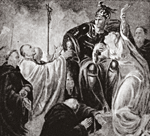
This brief overview does not allow us to look at the whole history of celibacy amply documented by Cardinal Stickler. Let us present some of the most outstanding cases. The Council of Elvira in Spain (310) dealt with priestly chastity (canon 33), and presented perfect continence as a norm that must be maintained and observed and not as an innovation. The lack of any revolt or surprise attested to its widespread practice.
At the Council of the Church of Africa (390) and above all at the Council of Carthage, (419), which Saint Augustine attended, similar norms were adopted. These councils recalled the ecclesiastical praxis of the obligation of perfect chastity, affirming that such praxis is of apostolic tradition.
Pope Siricius answering a specific consultation about clerical celibacy in 385 affirmed that bishops and priests who continue marital relations after ordination violate an irrevocable law from the very inception of the Church that binds them to continence.
Eternal and Natural Law: The Foundation of Morals and Law
Several other popes and regional councils, particularly in Gaul, present day France, continued to recall the tradition of celibacy and punish abuse.
Saint Gregory VII (1073-85) when struggling against the intervention of the Holy Roman Emperor in church affairs, had to fight simony – the purchase of Church posts – and Nicolaitism – the heresy that preaches, among other things, priestly marriage.
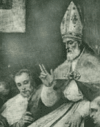
Some mistakenly conclude that Saint Gregory VII introduced the law of celibacy into the Church. Quite the contrary. What Saint Gregory VII, and later the Second Lateran Council (1139) did was not to “introduce” the law of celibacy but simply confirm that it was in force and issue regulations for its observance. Since most recruiting for the priesthood was already among the unmarried, the Second Lateran Council forbade priestly marriage, declaring it null and void in the case of priests, deacons or anyone with a solemn vow of religion.
The Case of Paphnutius
The main argument of those who deny the apostolic tradition of priestly continence comes from an incident during the first Council of Nicea (325). Paphnutius, a bishop from Egypt, was reported to have protested in the name of tradition when the Conciliar Fathers tried to impose priestly continence. Because of his protest, the Council is said to have refused to impose such continence.
Cardinal Stickler adeptly deals with the case. He points out that Eusebius of Cesarea, the Council’s historian, was actually present during the whole event. He makes no reference to any such protest, which he certainly would have noted had it really happened.
The story of Paphnutius only appears almost a century after the Council of Nicea in the writings of two Byzantine authors, Socrates and Sozomen. The first cites as his source his conversation as a young man, with an elderly man who claimed he was at the Council. The veracity of this story is questionable since Socrates was born more than fifty years after the Council. His interlocutor had to be at least seventy years old when he was born and practically in his nineties at the time of the supposed conversation.
The story of Paphnutius’ protest was also always held in suspicion because his name was not on the roster of Fathers who came from Egypt to participate in the Council of Nicea. This was affirmed by Valesius, editor of the works of Socrates and Sozomen in the Greek Patrology of Migne.
 Learn All About the Prophecies of Our Lady of Good Success About Our Times
However, Cardinal Stickler claims the decisive argument against the Paphnutius story comes from the second Council of Trullo (691). During this council of the Eastern Church, the Council Fathers, under pressure from the Emperor, allowed matrimony for priests (not for bishops) — going against the tradition both in the East and West. These same Fathers failed to present the testimony of Paphnutius to justify their break with the tradition of priestly continence even though they had everything to gain by doing so. Instead of citing Paphnutius, they sought to justify their position, never recognized by the Western Church, by invoking the Council of Carthage.
However, this Council clearly ruled in defense of the apostolic tradition of continence. Thus, they resorted to falsifying its decrees, a fact even schismatic historians now recognize.
Cardinal Stickler laments that historians of weight like Funk, at the end of the nineteenth century, accepted the story of Paphnutius as valid even as his contemporaries had already rejected it as false. One of the people responsible for spreading this error was the Frenchmen, E. Vacandard, through the prestigious Dictionnaire de Théologie Catholique.
An Identity Crisis
Finally, Cardinal Stickler argues that the reason for priestly celibacy is not a functional one. Unlike the Old Testament, where the priesthood was merely a temporary function received by way of inheritance, the priesthood in the New Testament is a vocation, a calling that transforms the person and confiscates him entirely. He is a sanctifier, a mediator.
Above all, the priesthood in the New Testament is a participation in the Priesthood of Our Lord Jesus Christ, the High Priest. And, therefore, the priest has a mysterious and special bond with Christ, in whose name and by whose power he offers the bloodless sacrifice (in persona Christi). The most profound reason for priestly celibacy comes from this supernatural bond with the Savior.
The Cardinal points out that the main reason celibacy is in question today is because the clergy faces an identity crisis. Only by restoring the true identity of the priest, can the profound reasons for celibacy be understood and practiced.
This identity crisis cannot be resolved by returning to “the origins of the Church,” a solution proposed by proponents favoring married priests and their sympathizers. Those origins would simply not allow them to cohabit with their wives and continue to exert their priestly ministry.
Let us hope that, with the help of grace, the true identity of the Catholic priest will be restored soon so that all the present-day madness may come to an end.
Read this article’s follow-up: The Wiles and Guiles of a Campaign Against Priestly Celibacy.