
Perhaps no industry is more inherently prone to gigantism than energy production. Locating the raw materials, be they coal, oil or natural gas, is speculative and expensive. Refining and transporting those raw materials makes them even more costly. Turning them into electric power requires massive boilers and other machinery. Then, distributing this energy to a vast network of consumers requires a giant infrastructure.
A Globalist’s Delight
Even worse is the prospect of running out of energy. Controlling the supply means supervising a massive portion of the world’s commerce —and the lives of those who consume that energy. That power presents enormous temptations to globalists.
The energy industry is burdened by an interconnected and bewildering network of bureaucrats employed by governments, corporations and non-government organizations. Any attempt to chart the entire network would only create mass confusion among the uninitiated.
The International Energy Agency
One non-government organization is called the International Energy Agency (IEA). Its website launches into bombastic prose that would be laughable if it were not so ominous. “We are leading a new era of international energy cooperation.” It continues, “We provide authoritative analysis, data, policy recommendations and solutions to ensure energy security and help the world transition to clean energy.”
Eternal and Natural Law: The Foundation of Morals and Law
The IEA gets its power because forty-six nations, including the United States, China, Japan and most of Europe, are its members or associates. Interestingly, most non-U.S. oil-producing countries—Russia, Venezuela, Saudi Arabia and Kuwait—among others—are not officially affiliated with it.
A Network of Like-Minded Bureaucrats
The head is Executive Director Dr. Fatih Birol. According to the brief biography on the organization’s website, he has led the agency since 2015. “Under his leadership,” the biography assures the inquiring reader, “the IEA has moved to the forefront of global efforts to reach international climate goals, safeguard energy security and manage the social and economic impacts of clean energy transitions.” He also chairs the World Economic Forum’s Energy Advisory Board.
Such responsibility has its rewards. Dr. Birol is a member of the Legion of Honor (France), the Order of the Rising Sun (Japan), the Order of the Polar Star (Sweden) and miscellaneous other honors from Austria, Germany and Italy. He is also a “foreign member” of the Chinese Academy of Engineering.
Lest readers get the idea that Dr. Birol runs a one-man show, the “About” page on the NGO’s website shows pictures of eight other executives with the IEA, including directors for “Sustainability, Technology and Outlooks” and “Energy Markets and Security.”
Making Word Salads, but Nothing Else
And these people work hard. They are currently preparing for “COP28,” sometimes known as the 2023 United Nations Climate Change Conference. It begins on November 30 and lasts until December 12. and will take place in Dubai. On December 2, the IEA will host a “High Level Dialogue on Building a 1.5C-Aligned Energy Transition.” This is the first paragraph of the description of this world-changing event.
“The COP28 Presidency-designate and the IEA, in conjunction with IRENA and supported by the UNFCCC Secretariat, have convened a series of High-Level Dialogues to build momentum between countries and companies on the energy transition in the run-up to COP28 and 1.5°C compatible energy transition pathways.”
 Learn All About the Prophecies of Our Lady of Good Success About Our Times
If that “word salad” proves to be indigestible, don’t worry. The folks at COP28 have the world’s problems well in hand. Reuters recently reported that it will launch “the world-first climate “loss and damage” fund designed to address the destruction caused by climate change. COP28’s CEO, Adnan Amin, said that they hope to raise “several hundred million U.S. dollars.” The European Union promises a “substantial financial contribution,” but declined to state just how substantial that contribution will be. The United States “climate envoy” former Senator John Kerry promised the Bloomberg New Economy Forum in Singapore that the U.S. would donate “several millions” to the fund.
How COP28 will distribute the millions was left unmentioned. Doubtless, many “experts” will earn exceptional commissions, helping to create an “equitable” distribution model for whatever funds that the experts don’t spend on their own salaries and expenses.
Three Scenarios, Each Less Likely than the Last
With such massive amounts at stake, one should always appreciate the ability of bureaucrats to convince themselves that their ideas actually work. Consider the IEA’s World Energy Outlook 2023.
The first problem with the Outlook is that it offers three different scenarios. First is the Stated Policies Scenario, referred to by the acronym STEPS. (Don’t ask where the “E” comes from—why let actual words ruin a great acronym?) It assumes that every country will pursue its current policies indefinitely. The second is the Announced Pledges Scenario (APS). That one assumes that all nations will meet their stated energy use reduction targets in full and on time. The third is the Net Zero Emissions (NZE) scenario, which assumes that global warming will not exceed an average of one and a half degrees Celsius above pre-industrialized averages.
The chances that any of the three scenarios will play out are scant. STEPS would require political stability in every nation of the world. Every day’s newspaper refutes such an idea. Wars, revolutions, and political unrest are constant. Even without unrest, normal political processes ensure that many nations’ policies will change.
Pseudo-Intelligence Mixed with Naiveté
The APS is even less likely. Anyone who assumes that every nation will do everything that each promises has no understanding of human nature. Every person, much less every country, sometimes makes promises that ultimately go unfulfilled. As a rule, politicians and bureaucrats are the worst offenders.
10 Razones Por las Cuales el “Matrimonio” Homosexual es Dañino y tiene que Ser Desaprobado
However, the first two scenarios appear inevitable when compared with the third. The Net Zero goal of containing global warming to 1.5 degrees over the “pre-industrial average” is improbable. First, IEA admits that the present reading is already up to 1.2 degrees. The remaining breathing space is only 0.3 degrees. Second, no one has any idea what the pre-industrial average temperature was. According to Encyclopedia Britannica, the Industrial Revolution began about 1760. The earliest reliable weather statistics only go back to about 1880. However, climate historians know that the mid-eighteenth century was during a period called “the Little Ice Age,” during which world temperatures were far lower than during the “warm period” of the Middle Ages.
Despite the confident rhetoric, even the most knowledgeable person in the IAE, COP28 or anywhere else has no real idea what the goal should be or how bad it will be if missed. Experts cite unusual weather patterns, but any connection between them and climate change is purely speculative. Even worse, there is no discussion of the advantages that longer and more productive growing seasons could bring.
The Same Tired Answer
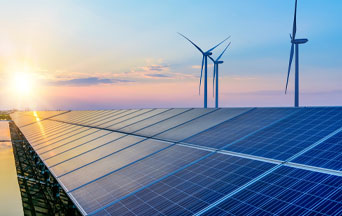
So, what are the IEA’s solutions to the world’s energy puzzle? Most readers could probably recite them in their sleep—wind and solar. The IEA’s Outlook asserts, “We are on track to see all fossil fuels peak before 2030.” According to its charts and graphs, coal, oil and natural gas have provided roughly 80 percent of the world’s energy for decades. However, it breathlessly reports that by 2030, it will be down to 73 percent. They say this “is an important shift.”
Of course, that shift has yet to happen. So far, it is only a projection. The engineers have been working on solar and wind power for a quarter-century and have yet to make a serious dent in the problem. Of course, that situation may bring a sigh of relief to the folks at the IEA. After all, if they actually solved the problem, they would go out of business. What a disaster that would be.
Photo Credit: © hrui – stock.adobe.com