
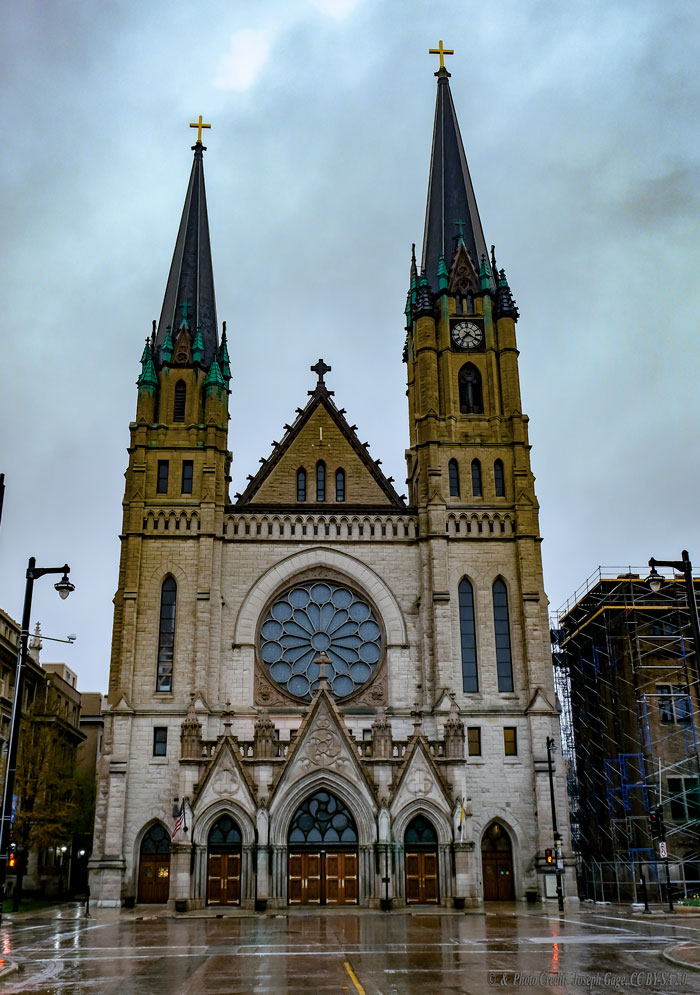
Attacks against the Catholic Church often take the form of physical violence, whether by arson, vandalism, destruction of property, or direct violence against the faithful. The recent attack at Milwaukee’s Church of the Gesu stands out, leaving locals reeling in shock.
In the early morning of March 18, the community woke to the news that the church had been desecrated. A parishioner praying in the main part of the church heard loud noises coming from the lower chapel. When the person went to investigate, the person saw a man wreaking havoc—breaking statues, pulling down Stations of the Cross from the walls, and thrashing pews and vigil candles. The parishioner called the police and waited in the chapel, praying out loud to warn the intruder that he was being watched. The man, however, was undeterred.
In total, he destroyed nine statues, seven Stations of the Cross, four pews, two kneelers, and several votive candle displays. Seeing sacred objects profaned is always shocking, but realizing that several statues were intentionally beheaded is particularly jarring. The beheaded statues included one of the Blessed Virgin Mary and another of the Infant Jesus. Such a targeted attack indicates an unusual degree of hatred toward the holy, since the attacker focused his malice toward the most noble part of the statues.
In response, members of the American Society for the Defense of Tradition, Family and Property (TFP) organized a Rosary Rally of Reparation for this deplorable sacrilege. The event coincided with a special youth weekend program. Despite 30-degree temperatures and 25-mph winds, nineteen participants of the TFP’s Call to Chivalry weekend prayed the rosary on their knees. For the last decade, the participants held their arms outstretched in the form of a cross as an additional sacrifice. This was a spiritual practice favored by Saint Francisco of Fatima.
Public reaction to the sacrilege was swift. Almost 400 comments on one local news report on Facebook expressed distress at seeing the pictures of the beheaded statues. One person commented that there is no more respect for the house of God. Another news post garnered over 1,500 comments. A user noted, “This act of vandalism is wrong on so many levels.”
Though the man was caught at the scene and charged with felony destruction of property, his motivation remains unknown.
A Marquette University administrator commented, “Regardless of the mental state of the vandal, this was another in an increasing number of attacks against the Catholic Church and—more importantly—Jesus Christ. What does that say about the state of modern society?”
When pictures of the beheaded statues were shown to the young participants in the Call To Chivalry program, one boy asked whether the person was possessed. It was a logical question. Who could hate the sacred as much as the devil or one influenced by him? This seemed to be on the minds of the general public as well. One Facebook commenter wrote, “It always happens the most during the holy weeks. The demonic spirits are more triggered this time of year. It really just proves how real God is.” Others expressed the same opinion: “The devil made him do it.”
A shocked Marquette student commented that the person who “vandalized the house of God has a disturbed soul.”
Evan Olwell, organizer of the youth program, said, “I’m glad we were able to do an act of reparation. The media, and even the parish priest, do not label this an act of hate. But it is evident hate was involved just looking at the scene of destruction.” To his point, many Facebook commenters also labeled it as a hate crime.
Addressing the modern tendency to misplace sympathy after such acts, he added, “It doesn’t make sense that when God is attacked, some people are more concerned with the attacker than the One offended. This act of reparation was intended to publicly console God for this horrible sacrilege.”
Photo Credit: © Joseph Gage, CC BY-SA 2.0