
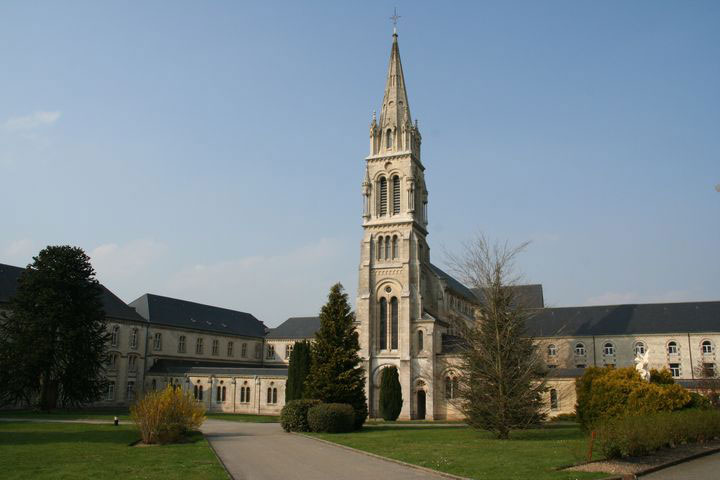
During the eighth and ninth centuries, the Vikings frequently plundered monasteries across Europe because they were isolated, poorly defended and held vast wealth, artifacts and livestock. With prayer and penance, the monks eventually prevailed and converted the Vikings.
Today, something different is happening. A new round of sackings is underway. However, no Vikings or barbarians are pillaging the convents and abbeys. The monks and nuns themselves are, perhaps unwittingly, the agents of their self-destruction.
The Devastation of Modern Spirituality
It is easy to trace the origins of this new enemy. Modern spiritualities popularized after the Second Vatican Council attacked traditional forms of worship, hollowed out everything of substance and left countless communities devastated. “Viking” theologians trashed everything in their paths.
Like the Viking lightning raids of old, monastic traditions were overturned. Schedules, fasts and prayer vigils were abandoned. Churches were stripped of their ancient adornments, “wreckovated” in a manner far more thorough than ever done by unlettered Norsemen. Social justice causes replaced the focus on Saint Benedict’s ora et labora, prayer and work.
Today, a few aging monks and nuns are left in sacred places that were once home to flourishing monastic communities, with nobody to replace them. One by one, these communities are collapsing, and their properties are put to other purposes. In France, two monasteries or convents close each month.
The Demise of La Grande Trappe

The seriousness of this crisis was recently made dramatically clear when the monks of La Trappe Abbey in Normandy announced that they may leave their monastery in 2028. The shock was so great that Pope Leo XIV held an immediate, confidential meeting with the abbot after the announcement.
This Cistercian abbey is not just any abbey. It is a storied monastery that has housed monks for 900 years. It is known as the “La Grande Trappe,” since it was the place where Abbot Armand de Rancé carried out the Trappist reform of the Cistercian order in 1662. As a result, all Cistercians of the Strict Observance are informally known as Trappists.
The Trappist community, after “following a long discernment,” decided that the lack of vocations and the heavy burden of maintaining the property forced it to consider abandoning their motherhouse in 2028. Where once a hundred monks flourished, barely twenty aging ones live today. Thus, their decision to walk away.
A Long History
This is not the first time that La Trappe has faced an existential crisis. The abbey was founded in the twelfth century, around 1122, in honor of the granddaughter of William the Conqueror. It survived wars and plagues, the French Revolution, and everything that the devil could throw at it. The abbey was even closed for a while and given up for lost. However, fervent abbots and monks always saved it from destruction.
Its story is inspiring.
Fervor and Turmoil
During the Middle Ages, La Trappe united itself with the reform of the Benedictine Order initiated by Saint Robert, abbot of Cîteaux. It was part of the vast network of abbeys associated with Saint Bernard of Clairvaux, which flourished in that golden age of great fervor and holiness.
During the fourteenth and fifteenth centuries, however, things changed. The abbey was prey to English troops during the Hundred Years’ War between France and England. Thus, it suffered greatly due to its location close to the fighting.
In the sixteenth century, the abbey was held in commendam, meaning it was considered vacant and administered by someone who did not live in it but benefited from its revenues. The abuse of this canonical state often led to mismanagement of properties like La Trappe, where the monks barely survived.
Glory and Defeat
Everything finally changed for the better when Abbot Armand de Rancé initiated a reform of the abbey by returning to the austerity and purity of a rule of silence, prayer, manual labor and seclusion from the world. The community rapidly grew and soon gained the fame of sanctity everywhere.
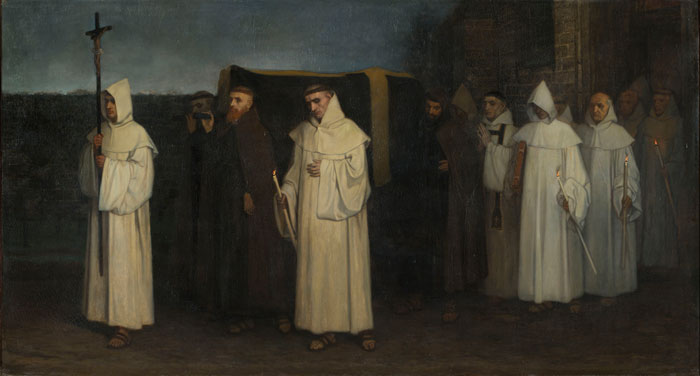
With the coming of the French Revolution, the government expelled the monks and confiscated their abbey in 1792. Some eighty monks accepted the inevitable by moving to other accommodations or returning to the world. Their names are lost in history.
However, Abbot Augustine de Lastrange, with 24 other monks, went into exile at Val-Sainte in Fribourg, Switzerland, where they resolved to observe the Rule of St. Benedict and Cistercian usages in all strictness and fidelity. Despite the desperate conditions of this exile, they overcame all obstacles because they were consumed with the love of God and the Cross.
With Val-Sainte as its base, the community attracted so many vocations that the abbot sent monks out to found new establishments in Spain, England, Belgium and Piedmont.
An Incredible Odyssey
When the anti-Catholic French revolutionaries invaded Switzerland in 1798, they expelled the Trappists. Thus began an incredible odyssey, in which the monks roamed the globe in search of a permanent home. The trek took them to America, Germany and even Russia. Amid incredible suffering and hardships of their wanderings, their numbers grew all the while.
Indeed, in 1813, the Trappist abbot purchased from the Jesuits the land on Fifth Avenue where St. Patrick’s Cathedral in New York City today sits, to create a school and orphanage. Their stay was cut short by the fall of Napoleon, which allowed the much-augmented group of monks to return to France, only to find their beloved La Trappe in ruins.
The monks rebuilt the abbey atop the old one. By the time of the abbot’s death in 1827, 700 monks had joined the once-roving and now restabilized order. This new reform, as it was called, soon led to the establishment of twenty additional monasteries in the United States, Canada, Syria, and other places.

As long as the monks maintained their fervor, penances, silence and fasts, they prospered. The more difficult the life, the more the monasteries were filled. As long as they were focused on a love for God and the Blessed Mother, they had no recruitment problems, quite to the contrary.
Tragic Ending
The final chapter in this long saga is the reform of the sixties that modified the fast, simplified the rule and suppressed the perpetual silence. The reform, notes the Encyclopedia Britannica, “placed greater emphasis on individuality, [and] has resulted in diversity among the various Trappist monasteries, whereas previously all abbeys observed a uniform set of rules and traditions.”
These were the new “Viking” spiritualties, novelties and theologians, who overturned everything and wrought great havoc. Whereas the exiled and roving Cistercian monks of the strict observance attracted hundreds, the postmodern monks of “individuality” and “diversity” saw hundreds flee their cloisters. The noise that replaced the silence kept out souls called to and seeking sublime truths.
The lesson of this story is very clear. If the monks of La Grande Trappe wish to see their abbey revived, there is no need for “long discernment.” All they have to do is re-embrace their ancient traditions and usages, in all their awesome and splendorous rigor. What will attract the young GenZers, now converting, will be an appeal to the sublimity of religious life, not an “emphasis on individuality.”
It is high time to expel the barbarian spiritualities with their Viking theologians that wreck and destroy the abbeys—and so many parishes. Above all, it is time to return to the all-consuming love of God and the Blessed Mother that makes all things possible.
This article was originally published in Crisis Magazine on March 25, 2026