
Over the last three years, the Ford Motor Company did a very intelligent thing. It rehired human engineers to correct errors caused by its reliance on Artificial Intelligence (AI). The results have been remarkable.
In 2025, according to the technology website Fast Company, Ford “set new records for the most safety recalls.” Conversely, in 2026, Ford vehicles took first place—up from tenth a year earlier —in the JD Power Initial Quality Study. Specifically, that survey measures owner-reported problems after the first ninety days of new-vehicle ownership. It is an effective measure of which companies build better cars.
A Complex and Expensive Product
The modern automobile is an incredibly complex machine. That fact is obvious to anyone who has ever looked under the hood, but the reality is far more daunting. NAPA, the auto parts retailer, estimates the number of parts in a car at “about 30,000.” A popular auto enthusiast website, Motor Biscuit, estimates that electric vehicles have twenty to thirty percent fewer parts, but that still leaves a minimum of 21,000. Every one of those parts has to function flawlessly; otherwise, the car cannot operate efficiently or run at all. Additionally, each vehicle must satisfy volumes of safety and emissions regulations.
The design of each part requires highly-trained and experienced professionals. The services of those capable few are not inexpensive.
The auto industry is also highly competitive. All cars do, fundamentally, the same tasks in much the same way which make all models similar.
While many consumers have nurtured preferences for a brand or a dealer, the biggest factor when choosing a particular vehicle is price. In the price calculation, one of the largest factors is the labor of those who designed and built the car. Saving on labor can help the manufacturer lower prices and sell more cars.
Not as Good as it Looked
Under such circumstances, the use of AI is appealing. Its massive (and ever-growing) computing power can, doubtless, assist in many engineering tasks. Thus, many manufacturers decreased the size of their engineering staffs and increased the number of high-powered computers to compensate.
Obviously, this did not sit well with the company’s legions of human engineers. Some were fired, others left in frustration and disgust. The prospect of going from a highly respected specialist to being assigned to assist a machine was, to say the least, unpleasant.
The massive investment in AI didn’t work out as well as the company had hoped. While the price of getting the work done right is high, the cost of mistakes is even higher. Fast Company reported that warranty repairs cost Ford $4.8 billion in 2023 alone.
Ford’s vice president of vehicle hardware engineering, Charles Poon, explained the problem to business news giant Bloomberg.
“Artificial intelligence is a fantastic tool, but it’s only as good as the information you use to train it…. Mistakenly we thought that just introducing artificial intelligence and ingesting the design requirements that we had would produce a high-quality product. We recognized that for us to enhance some of our automation and machine learning and artificial intelligence tools we needed to ensure that they were trained by the most experienced individuals.”
Translation—the people who run the machines are still more important than the machines themselves, even if the machine is a supercomputer.
Correcting Course
Yahoo Finance summarized the corrective measures. “Ford has reversed course in the last three years and hired, promoted or rehired 350 experienced technical specialists as part of a sweeping effort to shore up vehicle quality control.”
The result has been gratifying. Jim Farley, Ford’s chief executive, allowed himself a moment of jubilation, telling auto enthusiast site CarScoops, “We’ve worked really hard for four years to be an overnight success story. It’s been an incredible journey over the last several years. We have completely transformed all of our plants and our quality operating system.”
Of course, on complex products, all of the mistakes of a decade cannot be fixed in a single year. Problems persist but the solutions are now much clearer.
The overall lesson is simple. Neither human knowledge nor Artificial Intelligence can catch every possible defect. Both systems catch some problems and miss others. AI is a tool. Tools assist people in completing tasks that would be difficult or impossible without them. At the same time, no tool is better than the person who uses it. Ford’s experience proves conclusively that over-reliance on AI is disastrous.
First published on returntoorder.org.
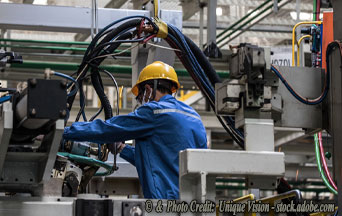
Photo Credit: © Unique Vision – stock.adobe.com