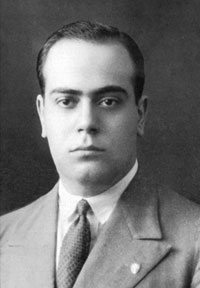
| Plinio Corrêa de Oliveira: His Early Years |
|
On the tenth anniversary of the death of Plinio Corrêa de Oliveira, founder of the Brazilian TFP and inspirer of TFP sister organizations around the world, the American TFP web site offers its readers a biographical sketch of this man who was truly a “crusader of the twentieth century.” Written in the 1970s, this biography was originally intended as the outline for a book. Hence it has no conclusion. It was still a work in progress. Nevertheless, it describes the circumstances in which the young Plinio’s character was formed and offers an early overview of the future Catholic leader whose life goal was to serve the Church and Christian civilization. (Ed.)
Plini
In addition to religious concerns, young Plinio felt attracted to the marvelous and sublime aspects of life as handed down by tradition. He had a vivid interest in religious, political and social issues even before he could read. In his mind’s eye, Plinio saw ideas should not be hidden in books gathering dust, but weaved into the tapestry of human life. For Plinio, social context gave life to ideas, which in turn influenced mindsets.
Proud Atheists at Home
At home there was much discussion about the political situation of Brazil. Even in this traditional family there were “bold spirits” who flaunted their atheism and socialistic leanings. They tended to dominate the discussion, presenting themselves as heralds of the future while the practicing Catholics who opposed them often appeared confused and on the defensive. Although Dona Lucilia would remain silent during these arguments, Plinio rejected the temptation to betray his inclinations. He chose to defend tradition.
The Era of Transformation
Rapid mechanization favored this process. Already São Paulo was entering the dizzying industrial boom that would transform the small aristocratic city of the twenties into the largest industrial hub of South America, with more than eight million inhabitants [in the 1970s –Ed.]. The budding feminist movement, which promoted masculine fashions for women, and the introduction of more casual manners also contributed to this “new world” which increasingly conflicted with Plinio’s mentality.
If people were fascinated with the first highways, radio stations and commercial aircraft, they were even more enthralled with the cinema. Hollywood films captivated the multitudes and declared that the post-war changes were irreversible. Caught up with the euphoria of peace, prosperity and progress, virtually everyone was swept along in this process and gave no thought to the bitter fruits it might bring in the course of the century.
At age ten, Plinio observed these changes around him and rejected them. He began to debate their merit, at first with the “bold spirits” at home. Above all, he developed the habit of reflection, seeking to understand the events around him. The more life changed, the more Plinio was convinced that certain things should never change, and that others should change in a direction diametrically opposed to the trends he witnessed. Plinio’s rejection of this process crystallized into a conscious resistance, a position that he adopted for life.
Hollywood Fans at School
Prior to his enrollment in the Academy, Plinio and his sister were tutored by a Bavarian governess, Fräulein Mathilde Heldmann, an experienced and talented teacher. Fräulein Mathilde had worked in Europe for several noble families. She came to Brazil in 1913 at Dona Lucilia’s invitation, bringing with her memories of the aristocratic and brilliant European belle époque that World War I destroyed. During French and German classes, Fräulein Mathilde spoke to Plinio and his sister of that world, emphasizing its aristocratic ceremony, manners and good taste.
At school, Plinio felt the shock of an atmosphere vastly different from the one in which he had been reared. The students were already caught up in the Hollywoodian transformation of Brazilian life. For Plinio’s classmates, the word “Hollywood” was sacrosanct. It meant modernity, dynamism, self-realization, pragmatism, contempt for culture and reflection, enthusiasm for agitation and spontaneous action, egalitarianism and sensuality. It promoted a simplistic and deformed image of the United States in movies that Brazilian schoolboys universally esteemed.
The challenge posed by the “bold spirits” at home was repeated at school. Plinio would have to resist or he would capitulate and adhere to changes his soul rejected. His efforts to find classmates who thought like he did invariably ended in failure.
Alone in his way of thinking, Plinio resolved not to partake in a quixotic opposition to everything and everyone. He would never say or do anything contrary to the convictions maturing in his soul but, would voice them only on those occasions when he judged he had a chance of prevailing in an argument. After serious reflection, Plinio followed this line of conduct until he was twenty. Like every serious fighter, he was learning strategy.
The Task: Rebuilding Christian Civilization Through his experiences at the academy, Plinio understood that the battle for or against God and His Church is the main motivating factor of all history. In fidelity to the Church, the world has the means to secure its best ideals to a firm rock and reject all error and evil. On the contrary, if the world rejects God and His Church, social mores, institutions, peoples and civilizations head inevitably for destruction. He saw the new order of things around him, based on secularism, as empty, inconsistent and perishable. He realized that only Christian civilization produces a perfect order capable of inspiring authentic progress that is tempered, just and diametrically different from the crazed gallop toward immoderate prosperity and pleasures that the new order promised.
The Study of History and Catholic Doctrine
From his earlier studies of European history, Plinio had some knowledge of the Christian civilization of old, remnants of which still surrounded him. Above all, he had seen the Catholic Church still untouched by the new order and bathed in a heavenly, regal aura.
As he studied European history more deeply now, he tried to compose a global picture of what the Church was and what Christian civilization had been, all the while seeking to answer a question both idealistic and practical: What could be done to contain the wave of destruction advancing from all fronts? Next he wondered: What could be done to renew fidelity to the doctrine and tradition of the Christian West? He was searching for a means of renewal that would preserve the timeless values of the Church and tradition, and uplift all men by spreading these values throughout the world.
The Thought Process of a Young “Thinker”
As the desire for a total restoration of Christian civilization grew in his soul, Plinio kept asking himself if it were attainable. What could a single man do? Were there others who might join him in this mission?
Searching for Allies
Plinio continued to search as he finished high school and entered the São Paulo Law School. Its secularist faculty and student body shared the mindset of the students he had known at the Academy of Saint Louis. Interiorly isolated once again, he remained faithful to his resolutions, and continued to search for allies. Just when it seemed they would never come, they came in an unexpected way and in unexpected numbers.
The “bold spirits” had spread the notion that religion was a good thing for respectable women, because it kept them virtuous, but not for men. According to them, religion sapped masculinity. In such an atmosphere, if a Catholic man practiced his religion openly, he faced discredit and sarcasm.
Though false and contradictory, this popular notion bore witness to the Catholic Church’s influence as the real adversary of the errors that Plinio opposed. It also demonstrated how the acceptance of these errors was pressuring men to become militant followers of the “Revolution.”
Consequently, when Plinio saw a banner inviting Catholic men to attend a Catholic Youth Congress in 1928, he sensed in it a spirited challenge to the influence of the “bold spirits.” He signed up immediately. Hundreds of fervent young Catholics attended this congress, and among them, Plinio found what he had been looking for.
Plinio Emerges as a Catholic Leader
Most of the youth of the Marian Congregations came from the lower and middle classes, and displayed an intense thirst for Catholic spirituality. They had a serious concern for social issues, yet were avidly anticommunist. In an effective though diffused way, they also opposed the anti-Christian character of the French Revolution with its ideological and cultural ramifications.
As the work of the Marian Congregations expanded, Plinio became a frequent speaker at public gatherings of all types throughout São Paulo and Brazil. With his fervor, oratory and organizational skills, he became the best-known Marian leader in Brazil.
In 1929, when the law-school students appeared receptive to religious renewal, Plinio founded the University Catholic Action Group, which grew rapidly.
Catholic Sectors React to a Brazil in Crisis
In 1932, the upper classes from the state of São Paulo rebelled in an attempt to stop this political slide. Their movement failed, but Getulio Vargas found it necessary to convoke a constitutional assembly to review the country’s political organization.
Given the importance of the constitutional assembly, Plinio and two good friends—Alceu de Amoroso Lima (whose pen name was Tristão de Athayde), a writer and recent convert to Catholicism, and Heitor da Silva Costa, architect of the world-renowned statue of Christ the Redeemer in Rio de Janeiro—conceived the idea of founding the Catholic Electoral League. Its purposes would include providing voter guides so Catholics would know which candidates were more favorable to the Catholic cause. Cardinal Sebastião Leme, Archbishop of Rio de Janeiro and recognized leader of the Brazilian bishops, sanctioned the plan, and soon the League was thriving all over Brazil.
The Success of the Catholic Electoral League
Many Brazilians wondered how a young, inexperienced lawyer fresh out of school would fare among longtime politicians, most of them with views contrary to those of the Catholic Electoral League. The League wanted the reintroduction of obligatory religious instruction in public schools, the banning of divorce, civil recognition of religious marriage and the establishment of chaplaincies in the armed forces and prisons. Plinio’s activity on the Assembly floor and among fellow representatives contributed decisively to the inclusion of the League’s platform in the constitution of 1934. Plinio was consequently seen as one of the most brilliant and efficient Catholic leaders of the constitutional assembly.
The new constitution was implemented in God’s name and made possible the founding of private universities approved by the state. This provision opened the door for Plinio to teach at universities. In 1934, he gained the chair of history and civilization at the university attached to the law school where he had graduated five years before. Soon, Plinio began teaching modern and contemporary history at Sedes Sapientiae College and São Bento College, which grew into the Pontifical Catholic University of São Paulo. Plinio was also appointed director of the Catholic weekly Legionario. His field of action was now vast.
There was a growing schism within Catholic public opinion that was beginning to separate Plinio from many of the Catholics best suited to work with him. It was caused by progressivism, which Plinio fought from its inception.
Progressivism Divides Catholic Opinion
Immediately, Plinio noticed that priests and nuns recently arrived from Europe were quietly disseminating strange doctrines within the ranks of Catholic Action. Certain groups within the movement were adopting these errors with a zeal that bordered on fanaticism. Plinio tried to expose the subversive elements, but his efforts were met with indifference. Even the bishops ignored him.
Plinio’s growing apprehension resulted from his certainty that the crisis within Catholic Action was not only local but worldwide and could become the heresy of the century. Thus, in 1943, he wrote In Defense of Catholic Action, warning of this progressivist infiltration. The Apostolic Nuncio to Brazil, Dom Bento Aloisi Masella, later cardinal and camerlengo of the Holy Roman Church, wrote the book’s foreword.
Plinio was never an intellectual moved by merely speculative reasoning, and never wrote just for other intellectuals. He was a fighter and the pen was his weapon. In less than six months, In Defense of Catholic Action had divided Brazilian Catholic opinion profoundly. Bishops and priests spoke publicly for or against the book, and Catholic Action, now a stronghold of progressivist ideas, never fully recovered from the blow.
Plinio’s book struck home, and in response, enraged progressivists made Plinio the target of a vicious slander campaign. From acclaimed Catholic leader, he became one of the most controversial Catholic figures in Brazil. Invitations to speaking engagements dwindled, and the circulation of Legionario dropped, as many readers canceled their subscriptions. Plinio was left with a group of less than ten friends, known as the “Legionario Group.” In 1947, when Legionario changed hands, Plinio and his friends lost even the name by which they were known.
Providence and the Holy See Intervene
What most pained Plinio and his friends in this persecution, brought on by their defense of the Faith, was the Holy See’s apparent indifference. But neither Providence nor Pope Pius XII was asleep. After a few years of silence, the Catholic circles of Brazil were amazed to hear that Father Sigaud had been named bishop of the Brazilian diocese of Jacarezinho. Speculation about his appointment had not died down when Monsignor Mayer was made bishop of Campos, Brazil. Rome had intervened on behalf of Plinio and his friends. As mentioned above, these bishops went their separate ways many years later.
In 1949, Plinio received the following letter written in the name of Pope Pius XII and signed by Monsignor Giovanni Battista Montini, then the Holy See’s substitute secretary of state:
Regrouping Around Catolicismo
Plinio’s group had used the intervening years for serious study in common. Their daily contact had strengthened their spiritual bonds and mutual understanding. As a result, they were now a true family of souls.
In 1949, a group of young men from some of the best families of São Paulo joined this family of souls after realizing that their adherence to the principles of Legionario left them alienated from the Marian Congregation of the Academy of Saint Louis. Enthusiastic and militant in their faith, these young men traveled all over Brazil looking for others willing to join them in spreading Catolicismo and fighting for the Faith.
To coordinate their nationwide efforts, they instituted an annual Week of Studies in 1953. By 1961, the Week of Studies had developed into the Latin American Congress of Catolicismo, with four hundred participants from Brazil, Argentina, Chile and other South American countries. After 1961, to better accommodate the growing number of participants, regional gatherings took place instead of the national Week of Studies.
The participation of those from Argentina, Chile and other countries was due to the efforts of Catolicismo’s members, old and young, to find kindred spirits throughout South America.
Such was the immediate affinity among them that they had no doubt they belonged to one family of souls in Christ. With the passing years, this family of souls extended to Bolivia, Colombia, Ecuador, Peru, Venezuela, and Uruguay, then Canada, France, Portugal, Spain and the United States. (Sister organizations now also exist in the Italy, Germany, Austria, Poland, Lithuania, The United Kingdom, Peru, Paraguay, Australia, Ireland, South Africa and the Philipines –Ed) The growth of this family of souls called for defined juridical structures. Consequently, in 1960 the Brazilian Society for the Defense of Tradition, Family and Property was founded. In 1967, the Argentine and Chilean groups, while remaining legally autonomous, also became TFP associations. Other groups followed, including the American TFP in 1974.
“Most Faithful Echo of the Supreme Magisterium of the Church”
The darkness surrounding the small beacon of his modest achievements grew daily. So did the progressivist crisis in the Church which was the greatest affliction for Plinio and the TFP. Pope Paul VI referred to this crisis as the Church’s “self-destruction” and the spreading of “Satan’s smoke” within the sanctuary.
Due to his formation, spirituality and study, Plinio was above all a servant of the Papacy. Cardinal Giuseppe Pizzardo, prefect of the Congregation of Seminaries and Universities, once wrote a letter praising one of Plinio’s studies, The Church and the Communist State: The Impossible Coexisteence. The cardinal termed the work “a most faithful echo of all the documents of the Supreme Magisterium of the Church.” On reading the letter, Plinio remarked that he could wish for no loftier title than a “most faithful echo” of the Church. As the years went by, Plinio’s love for and unconditional obedience to the Vicar of Christ and the Holy See only increased.
We may well imagine therefore his grief and dismay at Pope Paul VI’s policy of détente toward communist regimes. This policy cornered him and all the TFPs into a painful decision: to cease opposing Communism or to declare their disagreement and resistance in relation to the Vatican’s policy. Plinio chose a position of filial resistance, which he explained in a document that is a hymn of fidelity to the Pope and the Papacy.
Endorsed by the TFPs around the world, this “Declaration of Resistance” was published in major newspapers of Canada, South America and the United States, and many Catholics feel that it expresses their own thoughts. Although several ecclesiastical authorities in different parts of the world voiced their personal disagreement with the TFPs’ position, none contested its legitimacy from a canonical standpoint. They would have done so if the slightest infraction had been committed.
Reading this incomplete draft gives us a glimpse into the personal struggles of a great soul. These struggles were the one constant in a turbulent life. From his years of tender innocence until later years when he rightly gained the title, “crusader of the twentieth century,” Plinio Corrêa de Oliveira was above all a man who ceaselessly fought the good fight. In homage to him on this tenth anniversary of his death, it behooves us to pickup his standard and continue marching towards the triumph of the Immaculate Heart of Mary. (Ed.)
Footnotes1. 1. In Portuguese, the term "dona" is used as a respectful title for a married woman. [back] |
| Last Updated on Wednesday, 18 November 2009 14:22 |


o was born in Brazil, a country encompassing half of South America. Discovered in 1500 by the Portuguese, Brazil was named “The Land of the Holy Cross.” This predominantly Catholic country was ruled by a monarchy until the republican coup of 1889. Plinio’s parents, João Paulo Corrêa de Oliveira and Lucilia Ribeiro dos Santos, were born in the twilight of the monarchy. Both came from the old rural aristocracy—his father from the sugarcane aristocracy of Pernambuco in northern Brazil, and his mother from the coffee aristocracy of São Paulo in central-southern Brazil. In fact, their social situation mirrored that of the antebellum old plantation families of the American South. Plinio’s parents lived in São Paulo, where Plinio was born in 1908 and where he resided his whole life. Rosée, an older sister, was his only sibling.