
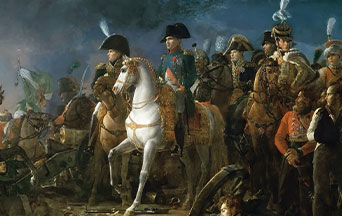
On December 2, 1804, Napoleon was consecrated emperor by Pope Pius VII in Notre Dame Cathedral in Paris. The new Emperor’s consolidated power appeared permanent. He had defeated two coalitions of the leading European powers. At that point, only England dared to fight him openly. Even so, despite the naval force at its disposal, the English government was less aggressive than before. Public opinion no longer supported resistance to Napoleon’s exploits with the same determination. Napoleon’s revolutionary errors were sown everywhere the French army marched.
Taking advantage of these favorable conditions, the French emperor decided to invade the British Isles. He immediately began preparations to cross the English Channel. While his navy was insufficient to transport the troops, the Spanish King Charles IV, who had become Napoleon’s ally, consented to lend him the Spanish fleet to help in the invasion. Napoleon’s dream of defeating England, which he always cherished, now seemed to have a chance of success.
Why America Must Reject Isolationism and Its Dangers
In the end, though, the Franco-Spanish naval disasters of 1805 breathed new hope into the countries opposing Napoleon. Austria, Russia, the Kingdom of Naples, and Prussia formed a third coalition against France. However, on October 15, 1805, the Austrian army was defeated at Ulm. This victory left open the gates of Vienna, which Napoleon quickly conquered. Six days later, however, Napoleon suffered a severe setback. Admiral Nelson destroyed the French fleet at the Battle of Trafalgar, making the conquest of England impossible. Encouraged by the English victory, Austria, aided by the Russians, continued to resist despite the loss of Vienna. The allied countries were again defeated on December 2 at Austerlitz.
Forced to negotiate peace, Emperor Francis II managed to recover his capital but had to renounce all influence in Germany. He ceded Venice to the newly-formed Kingdom of Italy and consented to Napoleon’s deposing of the Bourbon rulers in Naples. Napoleon placed his brother, Joseph Bonaparte, on the Neopolitan throne. Already weakened, the Holy Roman German Empire thus lost the domains it still held outside Austria and the Hungarian territories. Napoleon dissolved the Empire the following year. Francis II abandoned the title of Holy Roman Emperor and assumed that of Emperor of Austria. In a short time, the Revolution had successfully destroyed the empire the Church had established a thousand years earlier with Charlemagne’s coronation.
Eternal and Natural Law: The Foundation of Morals and Law
These grave events had catastrophic repercussions on the Amicizie sodalities, all of which were located in the affected regions. Although they were secret, their counter-revolutionary actions attracted the invader’s attention, forcing them to be more cautious in their apostolate.
Furthermore, the disorder the French army spread raised pressing issues. These issues caused the Christian Friends to waste energy, diverting them from their primary objective. Father Luigi Lanteri coped with the situation in the Italian peninsula, where political events less affected the sodalities. In Vienna, however, the consequences were catastrophic for both the apostolate and Amicizia’s inner life. Its meetings could no longer continue with the same frequency, regularity, and enthusiasm.
Saint Clement Mary Hofbauer’s testimony can help modern readers gauge Father Luigi Virginio’s value. Here is how the Redemptorist saint referred to him in a letter to his superiors:
“The priest of God, whose letter I am sending along with this one, is a most worthy man of our times. In truth, I do not know him personally, but I maintain an assiduous correspondence with him. For years, we have had a profound union dealing with Church interests. His zeal is excellent, his prudence admirable, and his knowledge remarkable. His humility—a virtue seldom found in literati—is highly worthy of imitation. His knowledge of philosophy, especially theology, is so profound that hardly anyone in Europe can surpass him. He is a sincere friend, benefactor of our Congregation, and a great devotee of our Venerable Father.”
Unfortunately, the evils Napoleon brought upon Vienna culminated in Father Luigi Virginio’s death.
 Read About the Prophecies of Our Lady of Good Success About Our Times
Along with the invading army, hospitals were set up in the Austrian capitol to treat French soldiers wounded in battle. Following Father Diessbach’s example in Nice, Father Virginio volunteered to care for the wounded soldiers’ bodies and souls. The dire hygienic conditions prevalent in those field hospitals favored the outbreak of epidemics. Struck by a typhus outbreak in the hospital where he worked, Father Virginio died on December 31, 1805. The Christian Friends buried him at Maria Enzersdorf’s cemetery, where his master, Father Nicholas Diessbach, had been laid to rest.
Father Luigi Virginio’s early death at the age of 49 left the work begun by Father Diessbach incomplete. To these labors, Father Virgino had dedicated his entire life. Everyone knew his excellent theological training, untiring zeal for the Church, and virtues. The members all recognized that he was one of the leading Amicizia promoters and responsible for all the good it had accomplished.
Father Virginio was a “missionary” from the association’s very beginnings. His reports and insights on the possibilities of founding nuclei in various cities were crucial. He did stellar work preparing the ground for the apostolate and founded flourishing Amicizie in Milan and Florence. L’Ape (The Bee) magazine, one of Europe’s first Catholic periodicals, owes much to his stimulus and the enthusiasm he transmitted to its founders. His modesty led him to write a brief account of his stay in Paris, where he developed a remarkable apostolate. Besides founding the French Amicizia, later destroyed by the Revolution, he also effectively collaborated with Father Pierre Joseph de La Clorivière, S.J., still well known in the history of nineteenth-century French Catholicism. When the Revolution prevented him from continuing his work for Amicizia, Father Virginio joined the underground priests who faced revolutionary hatred and continued exercising their ministry.
Father Virginio left as his successor in Vienna a Father Wagner, about whom little is known.
Prior Ricasoli informed Father Virginio shortly before his death that Florence’s Amicizia was in serious financial difficulties. In his will, Father Virginio left a certain amount to be shared by it and its Turin confrere.
10 Razones Por las Cuales el “Matrimonio” Homosexual es Dañino y tiene que Ser Desaprobado
Baron Joseph von Penckler wrote Father Pio Brunone Lanteri to report Father Virginio’s death. The two men established a correspondence which, for unknown reasons, grew more distant until it ceased altogether. Perhaps Napoleon’s continuous wars, lasting until 1815, prevented a joint action of nuclei in the regions of Europe divided by those conflicts. The Viennese Amicizia soon disappeared, but its seed in Austria bore fruit. Later, the admirable apostolate of Saint Clement Mary Hofbauer, a disciple of Father Diessbach and a former Christian Friend, flourished in Vienna. Through this organization, Father Diessbach’s work, as well as that of Father Diessbach’s efficient collaborator, Father Luigi Virginio, continued.