
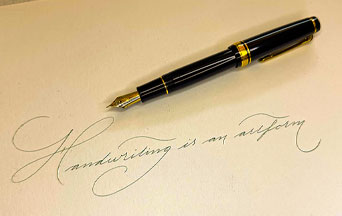
In a world where everything is digital and most people spend their days typing on computers, laptops or smartphones, does handwriting have a place?
The answer is yes. Handwriting wins first place as a learning and cultural tool for adults and youth today. Science and the Academic world confirm this conclusion.
For thousands of years, handwriting has been used for so many purposes. If it were not for handwriting, there would be no Bible. Teaching would have been much more difficult in the past, and the ideas and lessons of the great minds of history would have been lost to future generations.
Why America Must Reject Isolationism and Its Dangers
The first notions of philosophy were preserved because of handwriting. Aristotle and Plato would have been lost without it. Imagine a world without the Confessions of Saint Augustine or the masterful way he pioneered theology in the early centuries of the Church. Saint Thomas Aquinas’ theology classes would be reduced to a few imprecise stories in oral tradition instead of the great Summa Theologica.
Handwriting, whether on papyrus, tablets, parchment or paper, is one of the most fundamental hallmarks of civilization. It was a major step in the process that led primitive tribal communications to advance toward civilization. One of the first things many Catholic missionaries did on their missions was to create a written language for the numerous tribes they brought into the fold of the Church. Innumerable catechisms and prayers were then translated into the Indian languages.
In today’s hyper-technical society, handwriting has significantly suffered. The idea of handwriting seems obsolete and unnecessary. Why handwrite something when one can simply type it on a computer, smartphone or the like?
Eternal and Natural Law: The Foundation of Morals and Law
However, handwriting, especially cursive handwriting, has many benefits. First of all, handwriting is an art form. Handwritten notes, letters and documents can be very beautiful. Imagine if King John’s Magna Carta had been printed from a computer? Beautiful script increases this beauty, as can be seen in the original Book of Kells or a medieval manuscript of the Divine Office.
Imaginative scribes developed many beautiful fonts over the centuries. These handwritten fonts ranged from the simple eighth century to the ornate and beautiful Gothic script.
Another superior aspect of handwriting, especially cursive, is its personalizing effect. Anything written in cursive is personal. No two persons’ handwriting on the planet is exactly the same. A handwritten letter is truly an extension of oneself to the other. Handwriting conveys so much about a person.
For example, a thank-you note is something special. Traditional etiquette would never permit a typed or computer-printed thank-you card. In an age of unbridled egalitarianism, standardization of fashions and gaudy fads, cursive handwriting is a refreshing alternative.
Science confirms that handwriting is a superior method of learning. Recent experiments prove that handwritten notes are superior to typed ones. Norwegian neuroscientists Frederikus Ruud van der Weel and Audrey van der Meer found that handwriting stimulated brain activity linked to memory and learning more than when one types.
 Read About the Prophecies of Our Lady of Good Success About Our Times
Another researcher, Abraham Flanigan, found that students who took notes by hand achieved more A’s or B’s than those who typed them. In addition, Daniel Oppenheimer and Pam Mueller produced a 2014 study, “The Pen is Mightier than the Keyboard,” which confirms this conclusion.
Shelby Foote, a well-known Civil War historian, used a quill to write his books. Was he from the nineteenth century? No, he actually passed away in 2005. He said the quill gave him time to think about the following line while he dipped his pen in the ink. Considerations like these are missing from the frenzied world of quickly typed and texted messages. There needs to be a return to the simple wisdom of doing things right.
Perhaps it is the case to invoke the four writers of the Gospels, Saints Matthew, Mark, Luke and John, and pray for an end to the “typed gospels” of the postmodern world.