
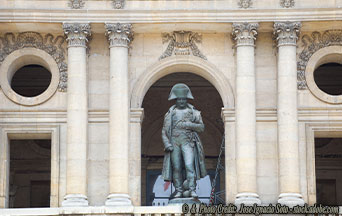
As seen in a previous article, the French ultramontanes sent Father Pierre Perreau to Rome to learn about the actual state of relations between the Holy See and France shortly before Pius VII’s arrest. Father Perreau met Cardinal Pacca and his secretary, Monsignor Pedicini. Most likely, they gave him documents laying out the Holy See’s procedure if the Pope could not communicate with the faithful, a possibility which his Secretary of State deemed imminent. Father Perreau’s valiant efforts helped spread the news of Napoleon’s excommunication throughout France and Italy. However, Father Perreaus’ efforts did not end with that one brave act. He continued working with Amicizia to spread communications from the imprisoned Pope Pius VII to the Chruch at large.
During Pius VII’s trip to imprisonment in Savona,1 the Pope’s chamberlain, Andrea Morelli, was able to have a short meeting with His Holiness. After this session, the chamberlain quickly passed the posters announcing the emperor’s excommunication to Duke Mathieu de Montmorency.
Eternal and Natural Law: The Foundation of Morals and Law
However, that action raised an ever more vexing question. How could Chruch leaders in Italy and the nation ever see the voluminous manuscript prepared by the also-imprisoned Bartolomeo Cardinal Pacca, the Vice-Secretary of State? This communication contained important documents about the relations between the Holy See and France that led Napoleon to imprison Pope Pius VII. Knowing of the people’s piety, Napoleon was eager to cut off communications from both the Pope and Cardinal Vacca with the rest of the Church. These documents needed to be circulated without arousing suspicion from the police.
Not only did Father Perreau and Amicizia succeed, but this text was already printed and circulated before the Pope reached Savona.
 Learn All About the Prophecies of Our Lady of Good Success About Our Times
Ever since, historians have sought to unravel the mystery of this publication and distribution. In the French police archives in Paris, scholars located evidence indicating that the documents were circulating from hand to hand in Livorno, Pisa, and all along the Italian coast from Rosignano to Piombino by mid-June 1809. They were seen in Toulon and Marseille as early as August. Those historians published the following letter dated September 2, 1809, which Prince Camillo Borghese (Napoleon’s brother-in-law and Governor of French Piedmont) sent from Turin to Napoleon:
“Sir, the Prefect of the Po Department sent me yesterday a copy of a book found in Turin, titled Correspondence authentique de la Cour de Rome avec la France depuis l’invasion des Etats Romains jusqu’à l’enlèvement du Souverain Pontife [Authentic correspondence of the Court of Rome with France from the invasion of the Roman States until the Sovereign Pontiff’s kidnapping]. This work, written in French and Italian, has the characteristic note of the partisan spirit that dictated it. It even contains a letter, dated from Genoa, which tells of the Pope’s journey from Rome to Savona in such detail that it may serve as a clue to identify its author. This work has not been disseminated so far. I have no difficulty recognizing that it was printed in the province under my government. The mayor referred it to the Minister of Police.”
Thus, the printed manuscript circulated in Turin shortly after Pius VII arrived at his prison in Savona. This shows that the ultramontane societies’ underground network in Italy and France had obtained all the documents Cardinal Pacca prepared in case there was a coup d’état against the Pope.
10 Razones Por las Cuales el “Matrimonio” Homosexual es Dañino y tiene que Ser Desaprobado
Naturally, the assumption is that they used various channels to spread these documents. We want to point out the one which Father Candido Bona, with his historical intuition, proposes in his book about Amicizie,2which is perhaps the most informative book on the subject.
Father Bona published two letters, one from Father Lanteri to Prior Ricasoli of Florence, dated July 2, 1809, and the other from Father Perreau to Father Pio Brunone Lanteri, dated August 13, 1814. The first contains this passage:
“A French gentleman of great merit will pass by in a few days, a certain Mr. Perreau. He is a man of letters whom I still have not had the pleasure of meeting, but who is known to a very good friend of mine. He will introduce himself and ask you for an order. You would do me a great favor by giving him a copy of the manuscript you prepared this year, as I only have two memos from January. I don’t think you have had time to send me another one. Through him, you can freely write whatever you want.”
Despite the encrypted language Amicizia members used in their correspondence, it is easy to see that Father Lanteri asked Prior Ricasoli for news of the association in Florence. It was not easy to obtain such news because of Italy’s political situation. Obviously, Father Lanteri placed great trust in Father Perreau. Even if Father Lanteri had not met Father Perreau, Father Lanteri knew Father Perreau was a member of the underground network.
Science Confirms: Angels Took the House of Our Lady of Nazareth to Loreto
The second letter, written when Father Perreau was released from prison after the fall of Napoleon, is more revealing:
“Sir and respectable confrere: I have learned with much pain about the punishments and persecutions you suffered, perhaps because of my arrest. When I exited prison, I was astonished to learn that God had deigned to test you, as neither the police nor I ever mentioned your name. Therefore, I assumed that you would not be disturbed. God has allowed it. Let us love His design and be thankful with all our hearts for what He has done. He has deigned to visit you in His mercy. I will tell you nothing of my country and our affairs. I only wish that yours are better off.”
In a post-scriptum, he adds, “I have only indirect news of Mr. Jujardy, who is still in Marseille.”
Besides showing the good relations between Venerable Lanteri and Father Perreau, this letter indicates Father Perreau’s role in delivering the documents he was carrying to Turin’s Amicizia. This fact explains their rapid diffusion throughout Italy.
Eternal and Natural Law: The Foundation of Morals and Law
Another excerpt explains how the imperial police, seeking to prevent the publication of those documents, portrayed Mr. Jujardy, a little-known participant in the history of nineteenth-century Catholics.
“This man, of an atrabiliary3 and concentrated character, once exalted principles of liberty in the early years of the Revolution. He was known for these opinions in Aix and Brignoles (Bouches-du-Rhône), where he was born. A few years later, his ideas changed utterly. I don’t know the reasons. With the same impetus, he gave himself over to the opposite excess: exaggerated devotion. That is how he showed himself in Turin during the roughly two years he was Commissioner of Wars in that city. He must now be in Toulon, where he receives his retirement pension.”
Jujardy’s presence in Toulon and Marseilles probably explains why the police noticed the documents in these cities.
Piecing together the above data documents Amicizia’s participation in these historical events. In Italy, Father Perreau distributed copies of the documents he received in Rome. In Turin, he gave one to Father Lanteri and passed others on to members of the underground network in charge of spreading them. The well-equipped imperial police soon verified that the documents were circulating in Pisa, on the Italian coast, and in Marseilles and Toulon, France. Nonetheless, the police could not prevent their diffusion, which continued throughout France and Italy thanks to the excellent organization of the underground network set up by the Lyon Sodality.
Photo Credit: © Jose Ignacio Soto – stock.adobe.com
Footnotes
- Pope Pius was arrested on the night of July 5, 1809. Due to the Pontiff’s ill health, it took several weeks to travel the roughly 350 miles to Savona. He was imprisoned there until June 1812, when he was moved to Fontainebleau.
- Fr. Candido Bona, Le Amicizie – Società Segrete e Rinascita Religiosa (Friendships, Secret Societies and Religious Revival), 1962. Published in Italian, not translated into English.
- Atrabilary is an obsolete term meaning a person full of black bile. It passed out of common use after 1820. See Atrabiliary – Etymology, Origin & Meaning on Etymonline.