
Every year, Catholics await Christmas as a moment of grace when the soul spontaneously rises to the mystery of the Incarnation: a God who takes on a face, a name, a mother, a family. “And the Word became flesh and dwelt among us” (John 1:14). A God who makes himself seen, loved and touched.
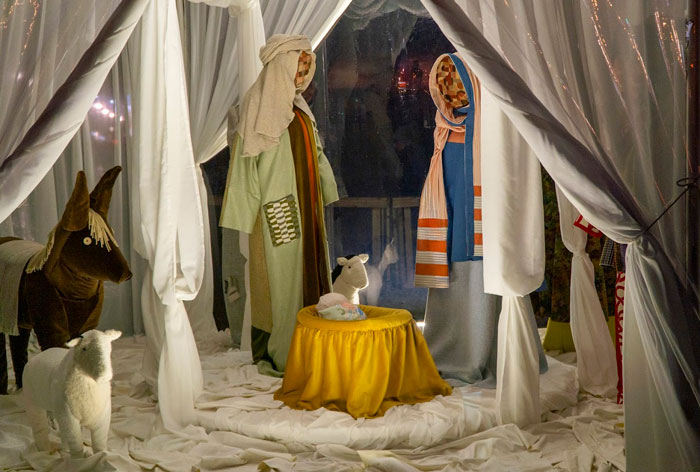
This year, Brussels presents a “nativity scene” that is no longer a traditional display. It features anonymous silhouettes, faceless and draped in dull fabrics, resembling mannequins in an exhibition. Belgian interior designer Victoria Maria Geyer, in collaboration with By Souveraine Studios, created this new design to allow everyone to see themselves reflected in it, fostering a spirit of inclusion.
This installation has caused deep unease among the faithful, unease that is unrelated to aesthetic whimsy. For those who observe closely, this nativity scene reflects a worldview. It carries an anti-Christian message that is a form of subtle blasphemy, a desecration of the mystery of Christmas.
The Absence of a Face Is a Denial of the Person
The first thing that stands out is the absence of faces. And this is not a minor detail.
The face is the window to the soul, the mark of the person, the expression of presence. Throughout the Christian tradition—whether in icons, altarpieces, medieval sculptures, or Italian frescoes—the faces of Jesus, Mary, and Joseph are treated with special tenderness, for it is through their features that we contemplate the love of God.
Removing the face from a nativity scene rejects something fundamental. It denies the person and his humanity. In this case, it rejects the Incarnation itself. Christianity is not an abstract religion. It is the religion of a God made man, who was a child that truly smiled, cried and breathed. This God revealed His divinity through His gaze.
In the silhouettes shown in Brussels, the human figure vanishes behind a patchwork of anonymous squares that resemble a pixelated mosaic, deliberately blurring the faces. It is no longer the Child-God; it is a “non-being.” It is no longer Mary: it is a “neutral element.” It is no longer Joseph: it is a mannequin.
Such a portrayal is fundamentally opposed to the Faith. We can say that it borders on the occult since a faceless human figure always suggests, in the traditional imagination, the absence of a soul. Indeed, the erased face universally symbolizes depersonalization, even dehumanization.
The Negation of any Hierarchy
Another striking element of the scene is its rejection of all hierarchy. For centuries, the Christian nativity scene has reflected a natural and supernatural order: the Child Jesus is at the center; Mary and Joseph surround him with their own dignity; then come the shepherds, the Magi and the angels. Each has its role, function and distinctive meaning. It is a microcosm reflecting how the entire Creation is structured around the Incarnate Word.
None of this order is found in the Brussels nativity scene. Mary and Joseph are interchangeable figures. The Child Jesus appears to dissolve into a bed where nothing sets him apart. The sheep placed behind them seems to be just as important as the Savior’s parents. Everything is flat, equal and anonymous.
This desire to disrupt the natural order echoes modern ideologies that imagine a society without hierarchy, roles, fatherhood, motherhood or distinctions between sexes, missions, or functions. Wokism does not aim to elevate but level.
This nativity scene shows a world where no figure is recognizable, where excellence seems impossible, and nothing stands out anymore. Christ Himself is lost in sameness.
The Negation of Beauty
Finally, any Catholic with even a modicum of aesthetic sensibility immediately perceives the negation of beauty. The colors are pale, dull, and deliberately clash. The fabrics seem to have been chosen for their total lack of nobility. The stage upon which the scene rests is stripped down, not with spiritually meaningful Franciscan poverty but a poverty of ugliness. There is no sobriety but only emptiness. There is no humility but only negation.
This deliberate ugliness aligns perfectly with the current ideological mindset that seeks to uproot Christian traditions and destroy symbols. Wokism declares Christian beauty to be subversive since a statue of the Virgin Mary, a Gothic altarpiece or a traditional nativity scene ignites a light in souls that the spirit of the world would prefer to extinguish. Thus, beauty is replaced by the ugly, the sacred by the abstract, and the Incarnation by geometry.
This nativity scene was meant to symbolize “inclusion.” Paradoxically, it excludes the most important things: God, humanity, joy and even childhood.
A “Halal” Nativity Scene?
Islam rejects the Christian adoration of the Divine Jesus Christ as a form of idolatry. It believes that Allah can do anything except take on human flesh. There is a vast gap between him and creation. He is forever unapproachable without a name or face. When Muhammad captured Mecca, his first act was to destroy the idols worshipped in the Kaaba. Emptied of all images, this building is now Islam’s holiest site.
Since its origins, Islam has been deeply iconoclastic. Thus, it forbids the depiction of human features, especially those of prophets—including Isa (its name for Jesus), whom it regards as one of its own. This is done because of the fear that any figurative image could lead to idolatry.
Istanbul’s Hagia Sophia was once one of Christianity’s most sacred sites before the Muslims captured it. In 1935, Turkey’s secular government turned the church into a museum where the surviving last mosaics of the Virgin and Child were displayed. When the current President, Tayyip Erdogan, returned the building to an Islamic house of worship, he requested that the mosaics be covered with heavy drapes to prevent any “idolatry.” In Algeria, Islamic Salafists even promote the sale of faceless dolls to children.
The Brussels nativity scene is fundamentally anti-Christian. Conversely, it is perfectly Islam-compatible. How can we not see these faceless effigies displayed on the Grand Place as an act of implicit submission to the Islamist networks that are very active in the Belgian capital? Around a third of Brussels’ inhabitants are now Muslim, and Islam could become the majority religion in the city within less than a decade. The most radical movements are firmly established there, particularly in Molenbeek, a stone’s throw from the Grand Place.
The Tragic Effect on Children
Perhaps the most tragic aspect of the scene is its impact on children. A love for Christ can no longer be felt in its faceless characters. How can children recognize Jesus if Jesus no longer has eyes? How can they feel maternal tenderness if the Virgin Mary has no face? How can they feel attached to the Holy Family when it appears as a collection of silent mannequins?
Such a Christmas no longer awakens innocence but disturbs it. It no longer reflects the light of Bethlehem but abstract gloom. The sweetness of the Nativity is replaced by a coldness that freezes the soul.
Thus, a child who looks upon this scene no longer receives the message of love that the Holy Family is meant to convey. Instead, it conveys a message of indifference, neutrality and the loss of humanity.
No to This Disfigurement of the Mystery of the Incarnation
Faced with this disfigurement, we must say no with courage and firmness. We must reject this distortion and dissolution of the mystery of the Incarnation. We must say no to this nativity scene that has been turned into an ideological manifesto. Under the pretext of practicing inclusion, it excludes childhood, joy, humanity, and, of course, God.
Catholics are not demanding extravagant or elaborate displays. They simply want the Nativity to remain true to its meaning: the humble yet profound reminder that God became man to save mankind. A faceless nativity scene dismisses the true spirit of Christmas by denying our humanity and God.
We must stand up for beauty, faith and Christmas since the feast belongs to our children, our families, our traditions and most importantly to the One who gave us His Face: the Child Jesus.
First Published: Avenir de la Culture