
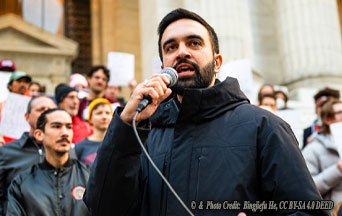
Those who optimistically elected Zohran Mamdani as Mayor of New York City should take note. Despite his smiling and easygoing persona, the thirty-four-year-old democratic socialist is the head of a radical movement that calls for changes that are much more socialist than democratic.
Mr. Mamdani’s victory has emboldened his radical supporters to propose solutions that have long been explored in socialist experiments throughout history. They want the power to be delivered to “the people” and are not known for their patience.
Empowerment or Enslavement
Among the radicals are the publishers of the ultra-leftist magazine, Jacobin. An article published before his inauguration offered advice. The very first line makes explicit the hopes and reservations of the left: “If Zohran Mamdani is serious about delivering on his promises, he needs more than policies—he needs institutions that empower working people.”
The radical leftists at Jacobin see the way to power in “popular assemblies.” In their minds, these would be “durable networks of participation,” each of which would hold some as-yet-undetermined amount of “sustained political power,” thus creating a means through which the working class could play a role in running their neighborhoods and the city.
However, such local organizations have also been used by the left to implement socialism on a much more intense and local scale than that of a political party.
A Network of “Assemblies”
Jacobin envisions a kind of network of these assemblies. Neighborhood assemblies would concern themselves with “concrete issues like housing, transit, and community safety.” Borough assemblies would “debate and rank broader priorities, especially around budgets and major projects.”
These assemblies would “offer ordinary people real and meaningful opportunities to affect the decisions that shape their lives,” “foster meaningful deliberation,” and encourage “non-elites” to “learn to govern themselves.”
However, the Jacobins are vague about the details of how these assemblies would function or interact with each other. There is only a blithe assurance that they would work if they were designed to maximize the influence of “the people.”
Enforcing Communist Ideology
Predictably, the authors do not mention the abundant evidence that such associations rapidly become instruments of repression. Communists and socialists everywhere have tried this idea before. They were described in much the same general terms that Jacobin employs. Three historical examples provide insight into what these Marxist assemblies might resemble.
The first would be the building block of the new society that Vladimir Lenin promised to build in Russia, with a popular assembly he called the soviet. It existed at all levels of society and industry. So crucial was this institution that Lenin cast it into the name of his diabolical creation, the Union of Soviet Socialist Republics.
Lenin himself describes the primary function of the soviet as “offering to the oppressed toiling masses the opportunity to participate actively in the free construction of a new society.” Their role was essential: “the positive and constructive work of establishing an extremely complex and delicate net of newly organized relationships covering the systematic production and distribution of products which are necessary for the existence of tens of millions of people.”
The second structure was that employed in Cuba after 1959, known as el comité (the committee). That term was the widespread usage for the “Committee for the Defense of the Revolution (Comités de Defensa de la Revolución or CDR).” It was first established on September 28, 1960. The CDR established a unit on every block in Cuba’s urban areas. The party described their functions as a basic unit that would deter crime. However, the definition of crime in a Communist state varies sharply from that in a free country.
Soon, the comité member began keeping watch for any “counter-revolutionary” activity among the residents of that block. Even the purchase of new clothes could spark el comité’s notice. Soon, it became the active agent in the operation of Castro’s police state. These infamous committees still operate today in that island prison.
In 1981, the French elected Francois Mitterrand, a socialist, as president of the republic. His party proposed a new, more radical form of socialism called self-managing socialism.
Prof. Plinio Corrêa de Oliveira denounced this new socialism in a special study published in major newspapers worldwide. Using socialist documents, he showed how networks of these self-managing assemblies would dictate how companies, schools and even families would be run. Every detail of human life (even home decoration) would be discussed and governed by these micro-socialist bodies.
This form of socialism was proposed as an international model, which fortunately failed to take hold.
Nothing New Under the Socialist Sun
Thus, Mr. Mamdani’s handlers and their allies propose nothing new in their “popular assemblies” They originate directly from the Marxist-Leninist playbook. Hopefully, the people of New York will see through this rhetorical fiction.
However, the election of Mr. Mamdani and the rapturous acclaim from the liberal media do not augur well for the city. New Yorkers will soon find out that a socialist is always a socialist, regardless of the adjectives that are put before the label.
© & Photo Credit: Bingjiefu He, CC BY-SA 4.0
