
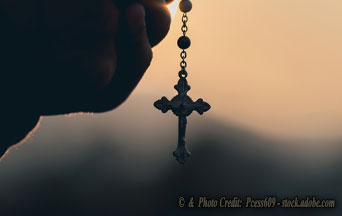
Faith, along with hope and charity, form the three theological virtues. Each has God as its object.
In his Theology of Christian Perfection, the renowned Spanish theologian Fr. Royo Marin explains that “the theological virtues are the most important virtues in the life of a Christian, because they are the basis and foundation of all the others. Their function is to unite us intimately with God as infinite truth, as supreme beautitude, and as the greatest good. They are the only virtues which are immediately related to God; all others refer directly to things distinct from God. Here lies the supreme excellence of the theological virtues.”1
Father Marin explains that faith, the best known of the three theological virtues, is “infused by God in the intellect, by which we firmly assent to divinely revealed truths on the authority of God who reveals them.”2
Why America Must Reject Isolationism and Its Dangers
This virtue can be approached from many angles. Based on the teachings of influential theologians, documents from the Magisterium, and, above all, the Ecumenical councils, this article analyzes it from a lesser-known theological perspective.
Natural Faith and Supernatural Faith
Holy Mother Church has always maintained that there are two orders of knowledge, distinguished from each other not only in their principle but also in their object. One we know by natural reason, and the other by divine faith.
Natural faith is daily trust grounded in reason and the senses. For example, “I have faith that this medicine will work.” It aims to attain truth through natural reason.
Supernatural or divine faith, on the contrary, has as its object the mysteries hidden in God, which can be known only through divine revelation. Therefore, it does not contradict logic and physical evidence, but transcends them by being grounded in the Word of God, which requires man to adhere fully to the truth as presented.
While natural faith is common to all, supernatural faith is received and developed through our union with God and the action of the Holy Spirit. Sometimes, faith requires acts that defy natural laws, as in the requests made of Moses and Abraham.
As the Catholic Church and her representatives on Earth are the depositories of the truth as revealed by God, the Council of Trent affirmed that we must fully adhere without hesitation or the slightest doubt to what she teaches with supreme authority as having been revealed by God.
Faith “Is the Certainty of What We Hope for and the Proof of Things We Cannot See”
In his epistle to the Hebrews (11:1), Saint Paul succinctly defines faith as “the substance of things to be hoped for, the evidence of things that appear not.” Thus, one must believe in what is not seen but has been revealed by God.
Faith is the foundation of all virtues, for “all of them, including charity, presuppose the existence of faith and rest on it like a building on its foundations.” Saint Paul explains, “without faith, it is impossible to please God. For he that cometh to God, must believe that he is, and is a rewarder to them that seek him” (Heb 11:6). This is because “by grace you are saved through faith, and that not of yourselves, for it is the gift of God; not of works, that no man may glory” (Eph. 2:8-9).
Regarding the need to have faith, the Divine Savior said to his disciples, who were amazed that the fig tree he had cursed immediately withered, “Amen, I say to you, if you shall have faith, and stagger not, not only this of the fig tree shall you do, but also if you shall say to this mountain, Take up and cast thyself into the sea, it shall be done. And in all things whatsoever you shall ask in prayer, believing, you shall receive” (Mt. 21:21-22).
How to Develop the Virtue of Faith
Fr. Royo Marin further explains that “when informed by charity, faith produces, among other things, two great effects in the soul: the filial fear of God, which helps the soul keep itself from sin, and the purification of the heart, which raises it to the heights and cleanses it of its affection for earthly things.”3
Furthermore, both objectively and subjectively, faith can grow and develop in souls until it reaches an extraordinary height. This growth can be achieved through daily prayer, attentive reading of the Gospel, and fervent participation in the sacraments of the Eucharist and Confession, for faith is nourished by knowledge of God and obedience to His commandments, and above all by the help of divine grace.
Faith and hope will disappear in Heaven, and only charity will remain, because the former will be replaced by the beatific vision of God and the possession of what was desired on Earth. However, it is impossible to hope or love without faith and hope on Earth.
Sins Against the Virtue of Faith:
Father Royo Marin, in his excellent treatise, explains the various sins against the virtue of faith.
“According to St. Thomas Aquinas, sins opposed to the virtue of faith are: infidelity or paganism, which, when voluntary, is the greatest of all sins except for the direct hatred of God; heresy, which denies some revealed doctrine in particular or voluntarily doubts it; apostasy, which is the complete abandonment of the Christian faith received at Baptism; blasphemy, especially that against the Holy Ghost; and blindness of heart and dullness of the senses, which are opposed to the gift of understanding and proceed especially from the sins of the flesh.”4
The Role of Ecumenical Councils – Nicaea
Whenever it is necessary to discuss, define, and legislate on matters of faith, doctrine, morals, and their practical application, the Catholic Church convenes formal assemblies of bishops and other ecclesiastical leaders in a council, which may be local or regional. However, an Ecumenical council is convened when it is necessary to hear the views of all the bishops of the world in communion with the pope. Among the most famous Ecumenical councils are those of Nicaea, Trent, and Vatican I.
The Council of Nicaea, convened by Emperor Constantine in 325, was the first in the history of the Church. It primarily addressed the Divine nature of Jesus and his relationship to God the Father, refuting the heretical teachings of Arius. This dispute led to the drafting of the first part of the Nicene Creed. The council also set the date of Easter and promulgated twenty new Church laws, known as “canons,” which established immutable rules of discipline. Unfortunately, it failed to address other matters exclusively related to faith.
The Council of Trent
A second council that notably marked the life of the Church was the Council of Trent.
The Council of Trent (1545-1563) was a fundamental ecumenical council of the Catholic Church convened to respond to the Protestant Revolution. It reaffirmed traditional Catholic dogmas, including the seven sacraments, papal authority, salvation through works and the worship of saints. It also promoted internal reforms, especially the creation of seminaries and the prohibition of the sale of indulgences. All its actions shared the aim of containing the Protestant advance. It was a milestone of the Counter-Reformation, which reorganized the Church and defined Catholic doctrine for centuries to come.
The council’s decrees were so important that they became the primary sources of ecclesiastical law for the next four centuries. These were only superseded by the promulgation of the Code of Canon Law in 1917. The Catholic Encyclopedia states that this council “issued the largest number of dogmatic and reformatory decrees, and produced the most beneficial results.”5 regarding the Faith and Discipline of the Church.
The First Vatican Council
In turn, the First Vatican Council (1869-1870) was an Ecumenical council convened by Pope Pius IX to reaffirm Catholic doctrine against the errors of modernism, rationalism, liberalism and socialism. It also defined key dogmas, including papal infallibility, which holds that the pope is infallible when speaking ex cathedra on matters of faith and morals. It thus strengthened papal authority and the unity of the Church during a period of significant political and cultural change in Europe.
The Council of Trent affirmed that faith is the beginning, foundation and root of justification, and that it is impossible to please God or be among His children without faith.
The First Vatican Council expanded this definition by adding that, since man is dependent on God, he must completely subject his reason to the Almighty, the uncreated truth. Therefore, through faith, he must render complete obedience of his mind and will to the truths God revealed to His Church. This state is not only accomplished through the natural light of reason but through the authority of the One Who reveals it and cannot deceive Himself or mankind. For faith, according to the Apostle (Heb 11:1), is “the substance of things hoped for, the basis of things that appear not.”
The Role of Miracles and Prophecies
However, so that the observance of one’s faith might be in accordance with reason, God willed that the external signs of His Revelation should join the internal assistance of the Holy Spirit through divine interventions such as miracles and prophecies. These clearly demonstrate God’s omnipotence and infinite knowledge, and are signs of Divine Revelation suitable for everyone’s understanding. For this reason, Christ the Lord, as well as Moses and the prophets, performed many apparent miracles and prophecies. Scripture explains the role of the Apostles. “But they going forth preached everywhere: the Lord working withal, and confirming the word with signs that followed” (Mk. 16:20).
The council mandated, “Further, by divine and Catholic faith, all those things must be believed which are contained in the written word of God and in tradition, and those which are proposed by the Church, either in a solemn pronouncement or in her ordinary and universal teaching power, to be believed as divinely revealed.”6
All this applies to Catholics, who have received the priceless gift of faith. What about non-Catholics?
In this regard, the council states that the Holy Church, like “a standard raised unto the nations” (Is. 11:12), continually invites those who do not believe to come to her … for the merciful Lord encourages those who err and helps them with his grace so they may come to know the truth; he confirms with the same grace those whom he has drawn from darkness into His marvelous light so that they may persevere in that light: He never abandons anyone unless they abandon Him.
Therefore, as the council stipulates, “not at all equal is the condition of those who, through the heavenly gift of faith, have adhered to the Catholic truth, and of those who, led by human opinions, follow a false religion.”
Photo Credit: © Pcess609 – stock.adobe.com
Footnotes
- Antonio Royo Marin, O.P. and Jordan Aumann, O.P., The Theology of Christian Perfection (New York: The Foundation for a Christian Civilization, 1987), p. 309
- Ibid.
- Ibid., p. 310
- Ibid., p.311, emphasis in the original.
- “Council of Trent,” The Catholic Encyclopedia, Council of Trent – Encyclopedia Volume – Catholic Encyclopedia – Catholic Online, Accessed January 6, 2026.
- All quotations from the First Vatican Council are from Dogmatic Constitution “Dei Filius” | Inters.org.