
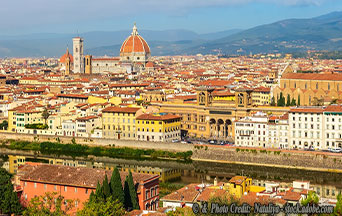
In 1802, although overburdened with work, Father Luigi Virginio decided the time was right to expand Italy’s Amicizie. Florence appeared to be a promising venue for expansion. As seen in the previous installment, while in Vienna, Father Virginio had cultivated many relationships with Italians frequenting Princess Rospigliosi’s salon. Some were influential Florentines. Using those contacts, Father Virginio could create an environment where Amicizia could thrive, so he decided to go there. Unable to stay long, he wrote Father (now Venerable) Pio Brunone Lanteri, proposing to meet him in Florence.
Unfortunately, Father Lanteri could not leave Turin. It seems the two friends were unable to see each other after many years of separation.
In Florence, Father Virginio sought out Leopold Ricasoli Zanchini, Prior of the Military Order of the Knights of St. Stephen, whom he likely had met in Vienna. Prior Ricasoli was enthused by Father Virginio’s style of apostolate and captivated by his zeal and personality. Immediately, Prior Ricasoli took Father Virginio on as spiritual director and placed the Prior’s palace at his disposal. Amicizia held its initial meetings in Florence, in the Zanchini Palace.1 Later, the association installed the Christian Friends’ library and other activities there.
Why America Must Reject Isolationism and Its Dangers
Florence was a promising field for the counter-revolutionary apostolate. A city famous for its artistic taste and writers, its social circles cultivated various forms of beauty. A few years earlier, its people, nobility and clergy forced Grand Duke Leopold’s court to retreat to Pisa because he had tried to impose a revolutionary policy on Tuscany. Father Virginio founded a literary academy with his usual tact and discernment. This institution, the Conversazione Cristiano Cattolica [Christian-Catholic Conversation], acted to make the most of those good tendencies. The academy met periodically to hear Catholic guest lecturers on varied subjects, always delivered in the light of Catholic doctrine.
Unable to stay long, Father Virginio returned to Vienna soon after establishing Amicizia. The historical record does not tell whether he passed through Turin. Among Venerable Lanteri’s papers, researchers later found his notes on the state of the Italian Amicizie. These valuable documents expounded on the possibilities of founding sodalities in other cities of the peninsula and contained the names of people who might assist in spreading the apostolate. Father Virginio also proposed that Father Lanteri visit those cities to meet the new Amicizie members and evaluate the organization’s current state. From then on, Father Lanteri directed the movement in Italy.
Florence’s Amicizia progressed rapidly. Marquis Cesare Taparelli d’Azeglio began an intense participation under the inspiration of the late Father Nicholas Diessbach. The Marquis became one of the Italian Amicizie’s main pillars. While working with Father Lanteri in Turin, Marquis d’Azeglio’s military and political duties prevented him from dedicating himself entirely to the apostolate. After Piedmont was incorporated into the French Republic in 1799, the Marquis did not want to live under a foreign ruler and withdrew to Florence.
Eternal and Natural Law: The Foundation of Morals and Law
In his book, I miei ricordi2The Marquis’s son, Massimo d’Azeglio, describes the Florentine environments his family frequented. He highlights his father’s friendship with Vittorio Alfieri, an old man now approaching the Church after leading an adventurous life without religion. Italian literati were attracted by Alfieri’s fame and gathered in his salons. In his company, the Marquis Cesare d’Azeglio saw first-hand the devastating consequences of revolutionary errors and the need for an apostolate to fight them effectively.
Prior Ricasoli and the Marquis d’Azeglio became the leaders of Florence’s Amicizia and convinced its members to launch a magazine. Since few writers were available, they decided to publish translations of appropriate articles found in foreign Catholic periodicals, with only one or two original pieces in each issue. Titled L’Ape [The Bee], the first issue was published on August 30, 1803. Its subtitle, Scelta d’opusculi litterari e morali estratti per lo piú da fogli periodici oltramontani [Selection of Literary and Moral Booklets Drawn Mostly From Ultramontane Periodicals], described the contents. L’Ape regularly featured articles by the Marquis d’Azeglio under the pseudonym Ottavio Ponzoni.
That same year, Father Lanteri was able to make the trip that Father Virginio had suggested. He first visited Milan, where Amicizia was almost extinct. Its main leader, Count Perturati, had been very loyal to the House of Austria. Revolutionary persecution against him seriously affected and hindered his apostolate. He was eventually arrested and deported. With his usual tact and skill, Father Lanteri restored the dying association to its position as it was before the French Revolution’s turmoils.
 Learn All About the Prophecies of Our Lady of Good Success About Our Times
The success of Florence’s Amicizia indicates the L’Ape’s timeliness. Father Lanteri took advantage of other trips to obtain subscribers and writers for the magazine. One of them, Father Juan Andrés, a Spanish Jesuit, was well-known in Parma’s literary circles. He had written a seven-volume, highly appreciated literary encyclopedia titled Dell’origine, progressi e stato attuale d’ogni letteratura [On the Origin, Progresses and the Present State of Literature], which had been well-received. At first, Father Lanteri unsuccessfully tried to convince him to help L’Ape. Father Andrés said he saw nothing interesting in the magazine’s first two issues. He was unimpressed that it was only a collection of translations of articles that appeared in other newspapers. He argued that this type of publication would find no readers. He also refused to subscribe.
Not discouraged, Father Lanteri went to Count Cesare Ventura’s home and met with the same objections. But the count was more open than Father Andrés. He regretted receiving only the first issue and was curious to know who Ottavio Ponzoni was. He read his articles and enjoyed them very much. By the end of the conversation, he had changed his mind and promised to try to convince Father Andrés to help the magazine.
Perhaps due to Father Lanteri’s contacts, L’Ape gradually replaced translations with original articles by various Italian writers, some of them well-known (including, later, Father Juan Andrés himself).
Florence’s Amicizia also published an annual almanac, Buon Capo d’Anno. It was more widely read than the magazine because its content was less elevated and reached a larger audience.
10 Razones Por las Cuales el “Matrimonio” Homosexual es Dañino y tiene que Ser Desaprobado
Unfortunately, in 1806, political contingencies forced the Marquis d’Azeglio to return to Turin, deprived L’Ape of its main animator, and that might have been the reason for the magazine’s abrupt disappearance. However, the Florence Amicizia did continue publishing the almanac.
Fortunately, L’Ape’s disappearance did not hinder the growth of the Florentine sodality. Always enthusiastic, Prior Ricasoli kept it growing despite adversity. He prepared its members for the glorious episodes they would be involved in during Pope Pius VII’s upcoming captivity in Savona.
Photo Credit: © Nataliya – stock.adobe.com